
Qebax is the name of the bull sacrifice that the Ezidis offer once a year during the autumn festival Cejna Cimayê in Lalîş. It is the only annual bull sacrifice of the Ezidis: at other festivals, for instance at the New Year, lambs, sheep, rams or poultry are sacrificed, because a bull is expensive. The article describes only the course of the custom. It is based on the observations of Artur Rodziewicz (2024) in Lalîş in the years 2018, 2020, 2023 and 2024.
The festival and its date
The autumn festival has several names: Îda Cemayê, Cejna Cemayê, Cejna Cimaya Şîxadî, Cejna Şîxadî or Cemaya Lalişê. On the alternation between îd and cejn see History of terms.
- The festival begins on the evening of September 23 and ends at noon on September 30 according to the eastern calendar – this corresponds to October 6 to 13. The days are counted from sunset to sunset (see Ezidi calendar).
- The Qebax takes place on the fifth day (October 11), the day before the main celebrations with the Berê Şibakê (a brass grille that is brought to Lalîş in procession). Some Ezidis name the fourth or the last day.
- The festival is joyful; Govend is danced every day.
Further festival customs of these days are described in the article Festivals and fast days.
Course today
According to Rodziewicz, the celebration lasts about three hours.
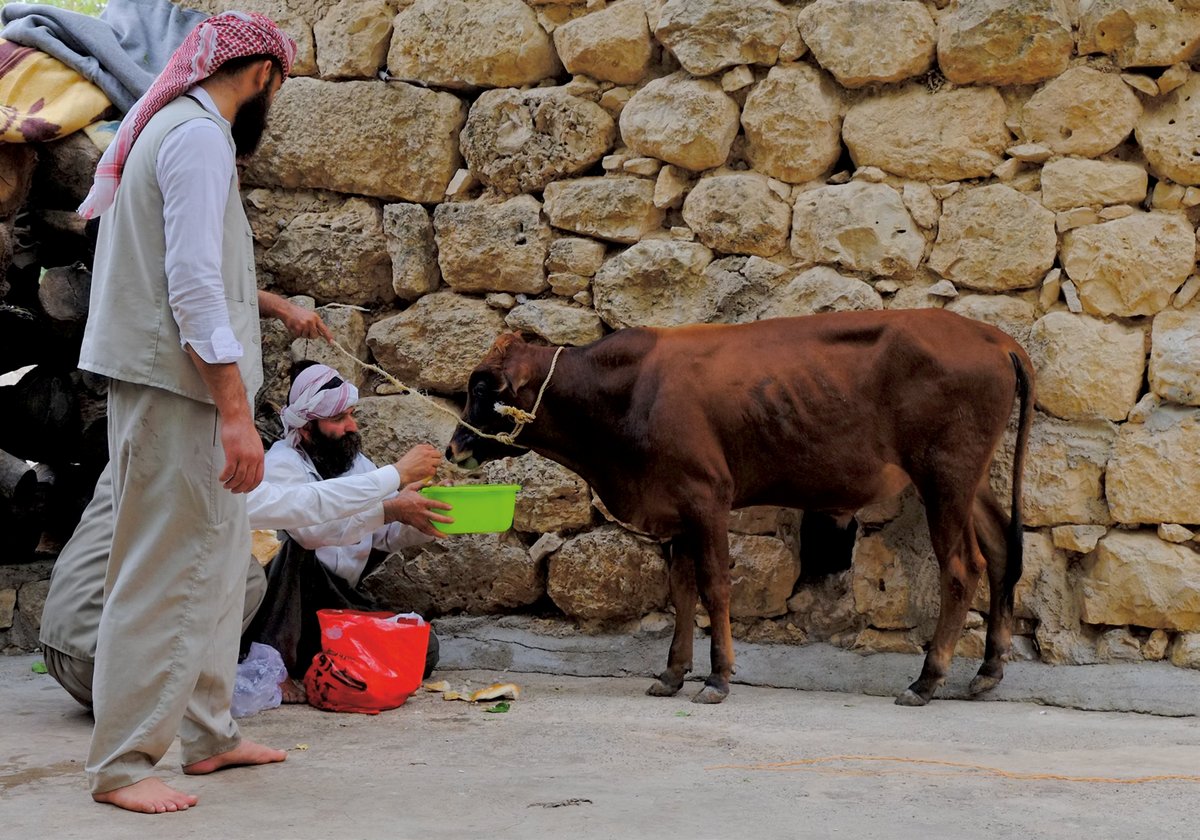
- Arrival of the three tribes (around 9 a.m.): Representatives of the three Mirîd tribes Tirk, Mamûsî and Qayîdî arrive in festive clothing and announce themselves with gunshots. They greet the Baba Şêx in the temple courtyard and then go into the Mîr's reception hall.
- Walk to Gaykuj (around 11 a.m.): With the Baba Şêx, the Mîr and the Baba Çawîş they kiss the threshold and door frame and go into the small courtyard Gaykuj (“where bulls are killed”). There the springs Kaniya Spî and Zemzem unite; there firewood and the animals for slaughter lie ready.
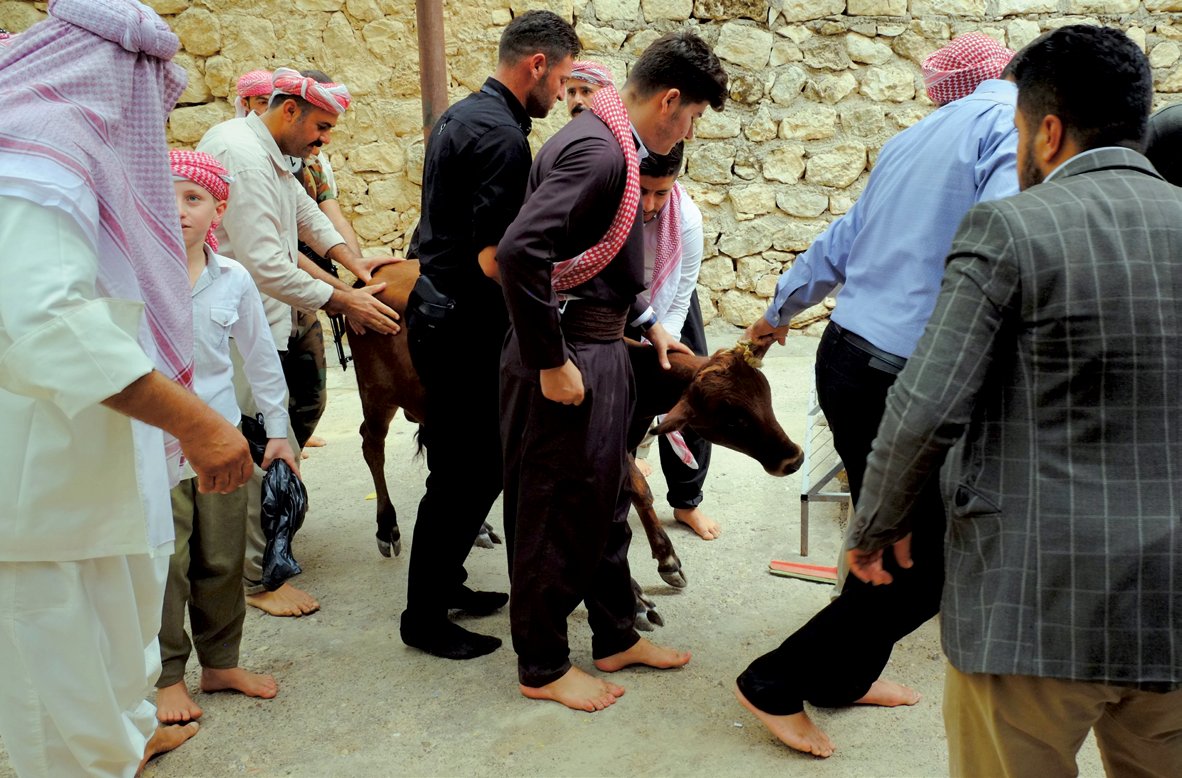
- Procession (around 11:30 a.m.): In front go the Dayka Kebanî (superior of the Feqraya) with the censer, a Qewal with the flute and the Baba Çawîş. Mirîds, young members of the Mîr family and helpers (xilmetkar) lead the bull – its muzzle tied, held by the tail – along the lane Sûka Merîfetê to the sanctuary of Şêx Şems. Pilgrims try to touch it and pull out its hairs; this is supposed to bring luck for the new year. Scuffles and fistfights break out in the process.
- Handover: In the courtyard of the sanctuary of Şêx Şems the bull is handed over to Şêx Wezîr, the head of the Şemsanî Şêx and guardian (mijewir) of the sanctuary. He blesses it with water from the Kaniya Spî and rewards the representatives of the three tribes with white cloth. They tear it into strips and tie them around their heads and shoulders.
- Procession up Mount Erefat: The tribal representatives climb Mount Erefat, pray at the signs (nîşan), break off twigs and put them in their turbans or headbands, fire ornamental guns and dance Govend.
- Sacrifice (at noon): The bull is slaughtered ritually at a post by the wall. Today a butcher from Lalîş, a Mirîd of the Qiranî tribe, slaughters it after Şêx Wezîr has given permission; in doing so he says “Bi destûrî Xwedê” (“With God's permission”). Afterwards the faithful are allowed into the courtyard, take hairs, mark their foreheads and cheeks with the blood and soak handkerchiefs in it.
- Meal: The meat is cooked and served as Simat with wheat after the Govend. It is paid for by the Metbexçî of Lalîş. The meal lasts until about 3 p.m.
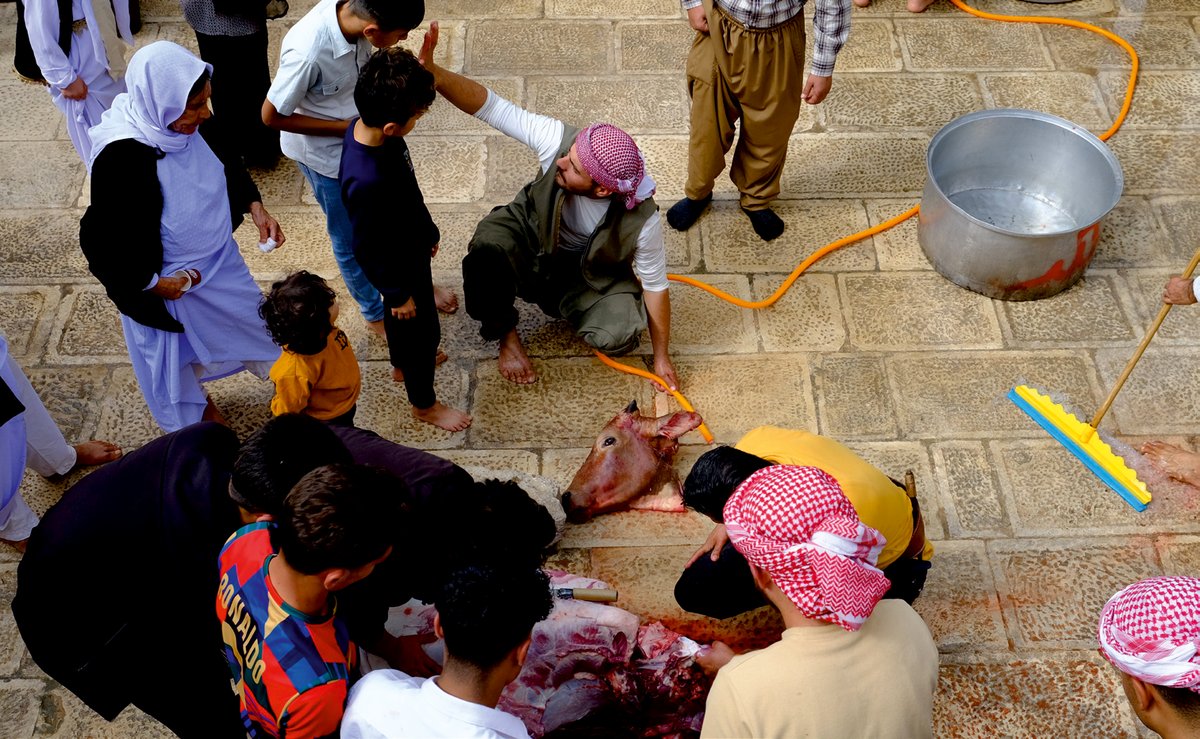
The day after follows the Taştê Mîr (“breakfast of the Mîr”): meat with wheat, roast chicken, okra and tomato vegetables, bread, rice and bulgur on long tables in the Mîr's hall, eaten standing (see Ezidi cuisine).
What has changed
- The bull: Formerly a one-year-old bull was kept for a year in Gaykuj without mating. Today it is bought two to three weeks before the festival; it is usually younger, at most two years old.
- The slaughterer: Formerly the Şemsanî Şêx slaughtered it themselves, today a butcher of the Qiranî tribe.
- Chase and sticks: Formerly the bull was chased and people ran with it (qebaxgêran), and fights with sticks also took place. The Mîr has forbidden this.
- The white cloth: Formerly the three tribal representatives wore it over their heads.
Older descriptions
- Layard (1849/1853) reports white oxen consecrated to Şêx Şems that were slaughtered only at great festivals; the meat was given to the poor. The Qayîdî tribe climbed the rocks with rifles, fired with oak twigs in the barrels and danced before the Mîr Hisên Beg. A bull donated by the Mîr was seized by the Qayîdî and brought to Şêx Mîrza. The women let out continuous trills (tahlîl).
- Kartsev (1891) writes that on the last day three or four rams were cooked and distributed for money – according to Rodziewicz probably the breakfast of the Mîr.
The color of the bull – a discrepancy
Several sources say that the bull is white. This is also stated, following Guest and Omarkhali, in the article Pilgrimage to Lalîş, and Layard speaks of white oxen. Rodziewicz does not consider this accurate for the present day:
| Year | Color of the bull (according to Rodziewicz) |
|---|---|
| around 1960 (Edmonds) | dark |
| 2013 | black |
| 2018, 2020, 2023 | once black, twice brown |
| 2024 | brown and white |
Whether white bulls were formerly sacrificed regularly cannot be decided from the sources.
Cancellations
- In 2019 the Qebax did not take place because of the death of Mîr Tahsîn Beg.
- In 2021 the festival was canceled because of the dispute over the succession of the Mîr and the Baba Şêx (see Religious leadership: succession 2019–2020).
- For 2020 the source contradicts itself: in one place it says that the festival was canceled because of Covid-19, in another Rodziewicz describes the Qebax of 2020 from his own observation.
The word “Qebax”
There are several interpretations of the word (Qebax, Qabax, Gabax, Qapax): as an imitation of the sound of the gun salvos, as a place name or from Turkish. Many Ezidis break it down into ga (“bull”) and bax (“big”). Rodziewicz prefers ga + boẍ (“young, uncastrated bull”). None of these interpretations is certain.
Distinction from the pilgrimage festival
Besides the Cejna Cimayê, the Ezidis celebrate a pilgrimage and sacrificial festival (Cejna Hecîyan, Cejna Qurbanê) with the Day of Erefat, on which animals are sacrificed and pilgrims climb Mount Erefat in Lalîş. According to Rodziewicz, no bull is sacrificed on this occasion.
Sources
- International Journal of Yezidi Studies, Vol. 1. Tbilisi 2024, p. p. 195–205, 209–210
Found a mistake?
Is something wrong – a fact, a spelling, a source, an image? Let us know: we check every report and correct the article.
Other spellings: Qebach · Qebakh · Qabach · Qabakh · Gabach · Gabakh · Qapach · Qapakh · Cejna Cimaye · Dschejna Dschimaye · Jejna Jimaye · Ida Cemaye · Ida Dschemaye · Ida Jemaye · Taste Mir · Taschte Mir · Lalish · Lalisch · Lalesh · Şêx Adî