
Today, above all three flags are to be seen among Ezidis. Common to all are the colors red, white and yellow and the sun with rays in the middle or in the corner. That one of these flags was formally adopted by a body speaking for all Ezidis is not documented; as far as the sources show, they spread through use – in Russia and the Caucasus, in Şengal and in Armenia.
This article distinguishes clearly between what is documented and what remains open. Who designed the flags and when could not be reliably established for any of the three. What can be documented are early attestations, the use, and the meaning of the colors and emblems in Ezidi tradition.
The three flags at a glance
| Flag | Appearance | Sun in the drawing at hand | earliest attestation | Use |
|---|---|---|---|---|
| Red-white vertical | red on the left, white on the right; large yellow-orange sun exactly on the dividing line | 24 rays, alternately long and short (12 + 12) | 2009 | oldest of the three; Ezidis of the former Soviet Union and their diaspora; stands for Êzîdxan |
| White-red-white | three horizontal stripes, the red one in the middle wider; yellow sun in the middle | 24 rays of equal length | 2015 | badge of the Ezidi unit HPŞ in Şengal |
| Red-white with peacock | red at the top, white at the bottom; yellow sun with stylized peacock at the top left | 23 rays | 2025 (drawing) | National Union of Ezidis (E’zîz T’amoyan), Armenia |
The number of rays was counted on the images available to this site. Other depictions of the same flags in part show more rays or rays of a different shape. A binding number of rays is not documented for any of the three flags.
The flag divided vertically into red and white
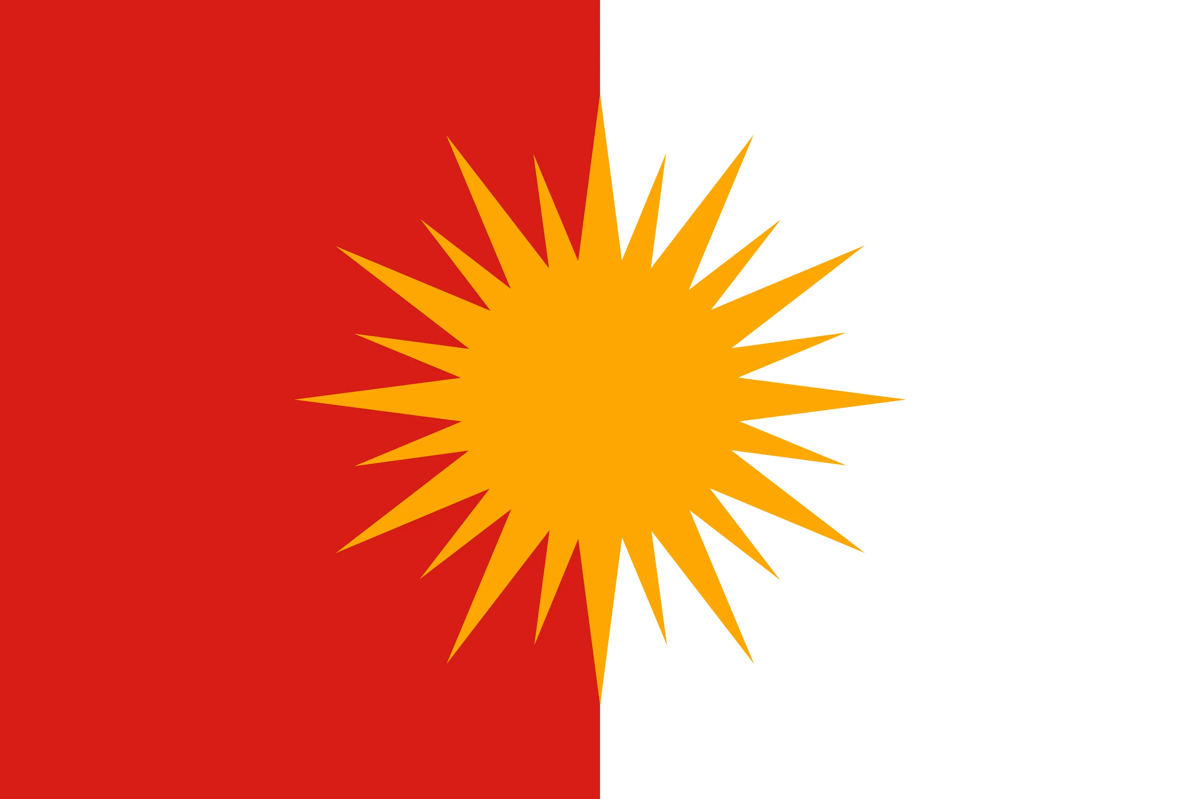
Appearance: The cloth is divided vertically into a red (hoist) half and a white half. Exactly on the dividing line sits a large yellow-orange sun; its disk lies half on red, half on white. In the drawing at hand it has 24 rays: twelve long ones pointing to the main and intermediate directions, and twelve shorter ones between them.
Attestation: The collection Flags of the World (FOTW), an internet database of vexillologists, records on April 10, 2009 (contribution by Chrystian Kretowicz) a yellow sun in the middle of a flag divided vertically into red and white as the flag of the Ezidis, “at least in Russia and the Caucasus”. On Wikimedia Commons, a drawing of this flag was uploaded on February 24, 2010; the source given is a PDF file from a website devoted specifically to the flag. This website is no longer accessible, and its content – possibly with information on the design – could not be checked.
Meaning and use in the community: It is the oldest of the three flags. It is carried above all by the Ezidis from the former Soviet Union (Armenia, Georgia, Russia) and their communities in the diaspora. It stands for Êzîdxan, the land of the Ezidis.
Open: Who designed the flag and in which year it was first shown is not documented in the sources checked.
The white-red-white flag
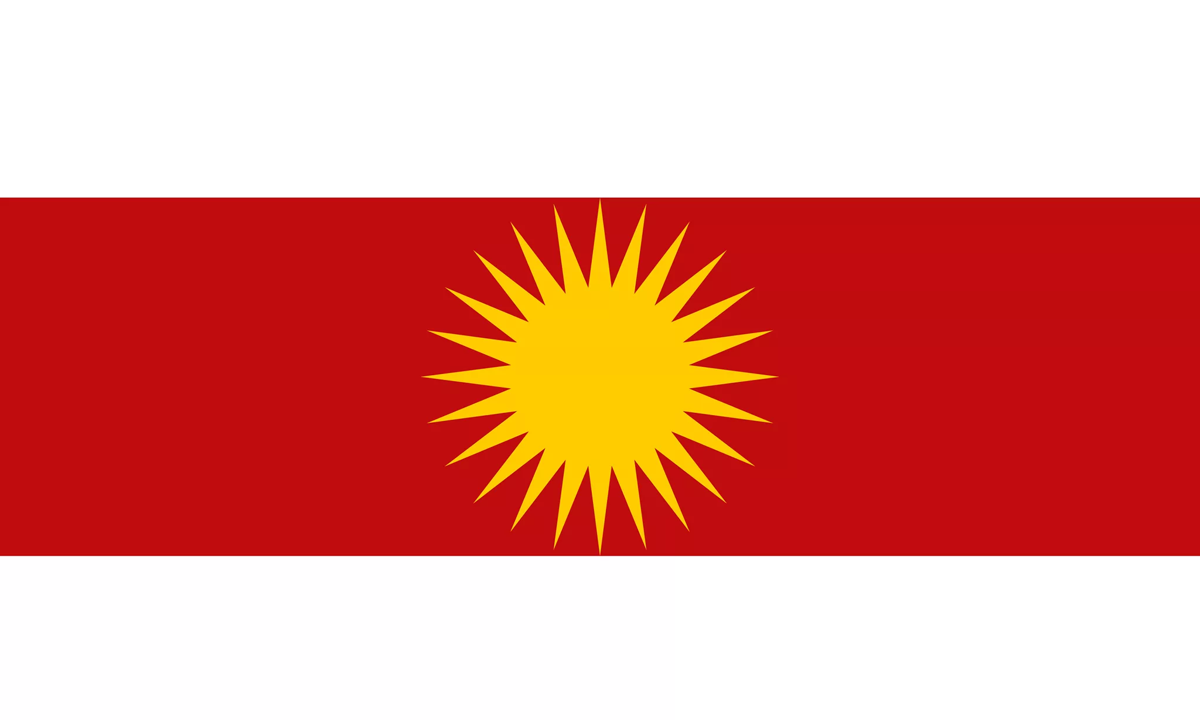
Appearance: Three horizontal stripes – white, red, white –, the red middle stripe wider than the white ones. In the middle of the red stripe stands a yellow sun; in the drawing at hand it has 24 pointed rays of equal length.
Attestation and history:
- After the genocide by the “Islamic State” (IS) in August 2014 (see The genocide of 2014), Heyder Şeşo founded an Ezidi unit in the summer of 2014, the Hêza Parastina Şengalê (HPŞ, “Protection Force of Şengal”); in November 2015 it was renamed Hêza Parastina Êzîdxanê (HPÊ, “Protection Force of Êzîdxan”).
- FOTW shows a photo from March 2015: a fighter of the HPŞ wears the white-red-white flag with sun as a badge on his sleeve. The Ezidi news site ÊzîdîPress called it the unit’s “resistance flag” on that occasion. FOTW also lists the same flag as the flag of the HPÊ.
- On April 5, 2015, security forces of the Kurdistan Regional Government (KRG) arrested Heyder Şeşo on the family estate in Xanke (Duhok province). According to ÊzîdîPress (April 12, 2015), the government led by Mesûd Barzanî’s KDP set conditions for his release, among them the dissolution of the HPŞ, the placing of the Ezidi fighters under KDP-affiliated Peshmerga – and the renunciation of the Ezidi resistance flag.
- In 2017 the HPÊ was nevertheless incorporated into the Peshmerga.
Open: Whether the flag was first designed in 2014/2015 for the unit or is older, and who designed it, is not documented in the sources checked. Majid Hassan Ali (2021) writes that after 2014 Ezidi armed groups in Şengal introduced a flag in red and white with a yellow sun and an anthem “Êzîdxan”; the flag is shown at demonstrations worldwide and by Ezidi institutions (kurds-yezidis-me p. 54; see Self-understanding after 2014). Whether he means exactly this flag he does not say.
The red-white flag with peacock (Armenia)

Appearance: Two horizontal stripes, red at the top, white at the bottom. In the red field at the top left (at the hoist) stands a yellow sun with pointed rays – in the drawing at hand 23 – and a large disk. A stylized peacock is drawn in red in the disk: with a crown on its head, a large “peacock feather” with an eye, and small wedge-shaped marks. The peacock stands for Tawûsî Melek.
Attestation: Wikimedia Commons lists the flag as “Ezidi flag in Armenia” (drawing by a user of November 15, 2025). The English Wikipedia names it in its list of Armenian flags, among parties and associations, as the flag of the National Union of Ezidis (ULE), whose president for a long time was E’zîz T’amoyan (see Ezidi organizations). In the community, too, it is regarded as the flag of E’zîz T’amoyan’s Union. It is modeled on the older red-white flag with the sun and places the peacock in the sun.
Use in Armenia: According to news.am (March 1, 2021), Ayser Îsoyan, head of the initiative “Mala Yezdia”, waved the Ezidi flag at a rally in Yerevan. He said that for the Ezidis in Armenia the Armenian tricolor and the Ezidi flag stand for the same thing; fallen sons are covered with both flags. Which of the flags was meant the report does not say.
Open: Design, year of introduction and an official adoption by the association are not documented in the sources checked. The number of rays in other versions has not been checked.
What the colors and emblems mean
An explanation of the colors by the creators of the flags could not be found. The colors and emblems correspond, however, to what is regarded as sacred in Ezidi tradition. Khanna Omarkhali, a scholar from an Ezidi P’îr family, names white, red and yellow as sacred colors in her book of 2005 (see Colors and dress rules):
- According to Omarkhali, red is the color of Sultan Êzîd. She records the Beyraqa Sultan Êzîd (“banner of Sultan Êzîd”): it is red and is regarded as the banner of the Ezidis. A female informant from Armenia told Omarkhali that Êzîd carried a red banner; therefore he is also called Êzîdê Sor – “the Red Êzîd”.
- White is the color of purity and of clothing; a saying runs, in essence: “We are Ezidis, clothed in white, inhabitants of paradise.”
- According to Omarkhali, yellow stands for light and the sun.
- The sun (Şems) is the emblem of the angel Şêşims; the Ezidis pray facing the sun and swear by it (see The sun).
- The peacock stands for Tawûsî Melek (see Tawûs – the peacock).
Older banners and standards
Flags in today’s sense are new, but field emblems are not:
- In 1672, the Carmelite monk Jean-Marie de Jésus saw an Ezidi leader near Nisibin on the move to the summer pastures. Before him a red standard edged with yellow, with a crescent and seven round disks, was carried (according to Guest).
- The word Sencaq for the peacock standards originally means “flag, banner” and then “district” (Turkish sancak). In 1849 Şêx Nasir called the Sencaq an emblem or banner of the Mîr’s house when speaking to the traveler Layard (see Sencaq and Tawûs gêran).
- In mourning for a brave man, a mourning banner was formerly carried (see Kotel).
Other flags
Besides the three flags there are others that were used only in individual areas or by individual groups:
- Green-red-yellow in three horizontal stripes: reported in 2001 by the vexillologist Jaume Ollé as the flag of the Ezidis in Iraq (according to FOTW).
- A flag that is red with seven golden stars at the top (the middle one larger) and green with a golden sun with 24 rays at the bottom: shown in 2017 at the proclamation of a self-administration in Şengal and, according to FOTW, also used by the police in Şengal.
Open questions
- Designer and year are not documented in writing for any of the three flags. The oldest reliable attestations on the internet are 2009 (red-white vertical), 2015 (white-red-white) and 2025 (drawing red-white with peacock).
- Red-white in the school textbooks of Armenia: A printed attestation of red-white as the colors of the Ezidis is the Ezidi grade 4 school textbook (T’amoyan et al., 2013). A folk song printed there calls the Ezidis bearers of the “red-and-white flag” (beyraqa sor û sipî), and the book asks the children about the color of the Ezidi flag. The grade 11 textbook (2014) explains the colors with a tradition: the flag of the Ezidis was white until the battle of Karbala and afterwards became red-and-white as a sign of the blood shed. This is an interpretation of the textbook without evidence and is connected with its undocumented derivation of the name of the people (see The name Êzîd and Yazîd).
- A fixed number of sun rays is not documented; the images at hand show 24, 24 and 23.
Sources
- E’zîzê E’mer, H’esenê Şêx-Me’mûdê: E’debyet û zimanê êzdîkî, grade 4. Yerevan: Spîka 2013, p. p-018
- E’zîzê E’mer, Omerê Şero (Omar Mamoyan), Xidirê Sûrên (Chidir Hadschojan): E’debyet û zimanê êzdîkî, grade 11. Yerevan: Spîka 2014, p. p-007
- Flags of the World (FOTW): Yezidi (Iraq) – contributions by Ch. Kretowicz (10.4.2009), J. Ollé (2001/2018), V. Lomantsov (5.3.2015), E. Ipavec (2.3.2018), O. Touzeau (17.10.2018); page last modified 31.7.2020, accessed 24.11.2026
- Wikimedia Commons: File:Yezidi Flag.svg (uploaded 24.2.2010, template: yezidiflag.webs.com/Yezidi_Flag.pdf) and category “Yezidi flags”, accessed 24.11.2026
- Wikimedia Commons: File:Yezidi flag in Armenia.svg (a user’s own drawing, 15.11.2025); Wikipedia (English): List of Armenian flags, section Parties (“Yezidi National Union ULE”), accessed 24.11.2026
- ÊzîdîPress (English): HPS commander Shesho still in custody: Kurdish government makes demands for release, 12.4.2015, accessed 24.11.2026
- Wikipedia (English): Êzîdxan Protection Force, accessed 24.11.2026
- news.am: Member of Yezidi community in Armenia to MP: Don't speak on behalf of Yezidis, 1.3.2021, accessed 24.11.2026
- Khanna Omarkhali (Ханна Омархали): Йезидизм. Из глубины тысячелетий (From the depths of the millennia). Saint Petersburg 2005, p. p. 43–44, 65, 123
- Khanna Omarkhali: The religious textual tradition of the Ezidis – from the oral to the written. Saint Petersburg 2023 (Russian translation of the English original, Wiesbaden 2017), p. p. 137, 142
- Güneş Murat Tezcür (ed.): Kurds and Yezidis in the Middle East. Shifting Identities, Borders, and the Experience of Minority Communities. London: I.B. Tauris 2021, p. Ali p. 54
- John S. Guest: The Yezidis. A Study in Survival. London/New York 1987, p. p. 67
- Austen Henry Layard: Discoveries among the Ruins of Nineveh and Babylon (abridged edition). New York 1853, p. p. 47
Found a mistake?
Is something wrong – a fact, a spelling, a source, an image? Let us know: we check every report and correct the article.
Other spellings: Ezidisdschhe Flagge · Ezidisjhe Flagge · Ezidisch Flagge · Ezidisdschh Flagge · Ezidisjh Flagge · Ala Ezdiyan · Flagg mit Sonne · Flagg mit Pfau · Sinjar · Sindschar · Shingal · Shengal · Singal · Ezidkhan · Ezidchan · Dohuk · Dahuk · Dihok · Tawuse Melek · Melek Taus