
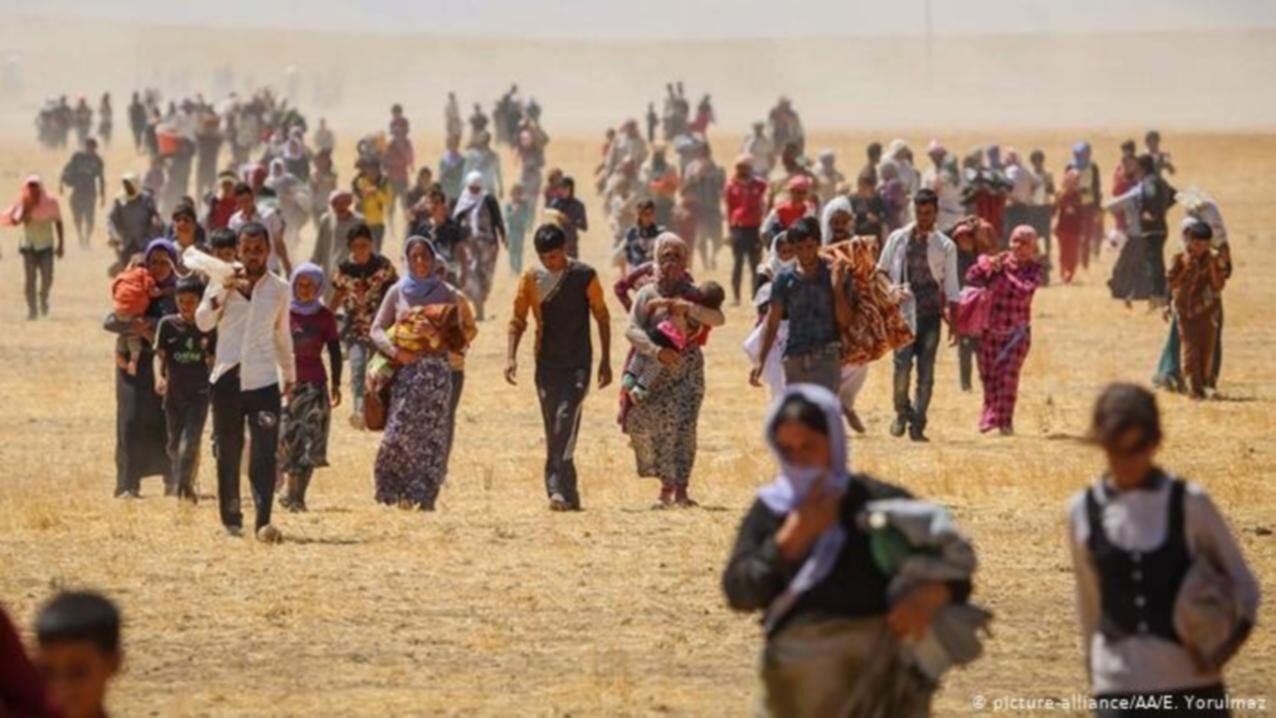
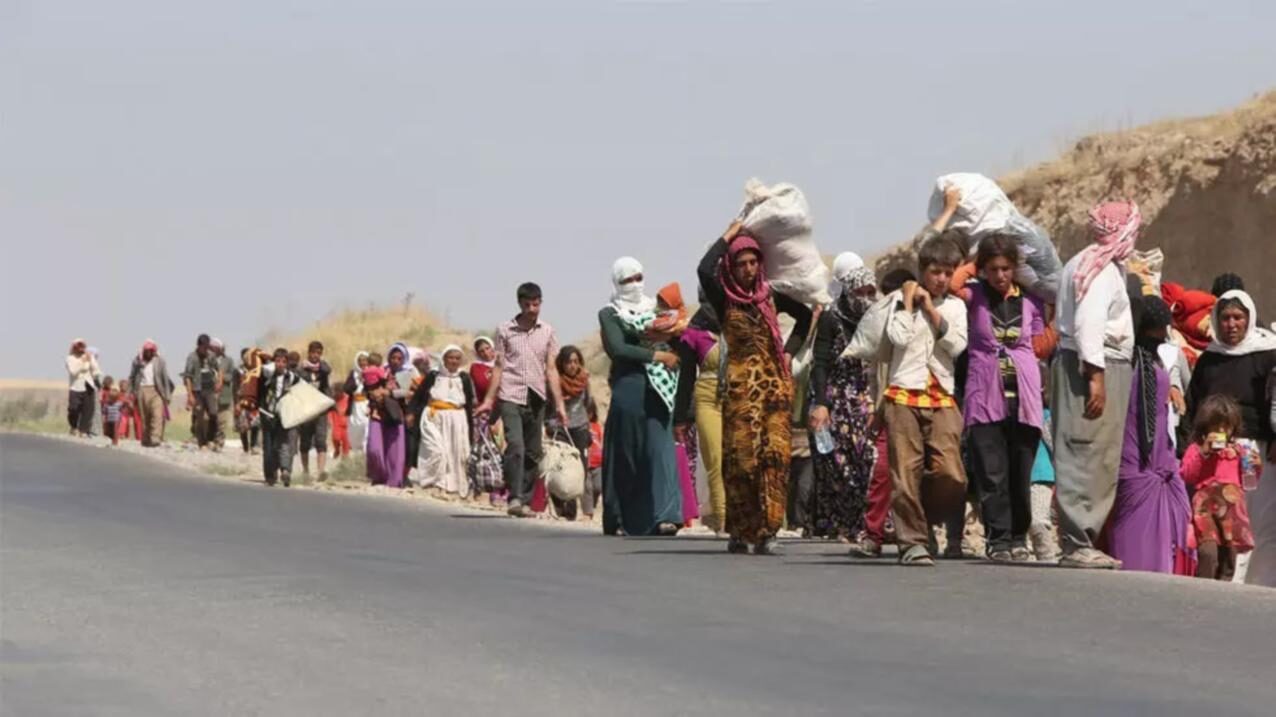
On August 3, 2014 the terrorist organization “Islamic State” (IS) attacked the area of Şengal, and on August 7 further Ezidi places in the Şêxan district. The Ezidis were faced with the choice “conversion or death”. Men were shot en masse, women and children carried off and enslaved, sanctuaries blown up. The Ezidis count these events as the 74th Ferman. The article follows above all Qader Saleem Shammo (2026), who evaluates UN reports, IS documents, confessions of perpetrators before Iraqi courts and over 30 of his own interviews with survivors. Witness statements are marked as such; names of survivors are not given.
On the bombings of 2007, the refugee figures of 2015 and the reactions in Armenia see Şengal 2007 and 2014.
Course of events and intent
- According to the UN Human Rights Council (report of June 15, 2016), IS intended to destroy the Ezidis of Şengal in whole or in part: by killing, sexual enslavement, torture, expulsion, separation of men and women, forced conversion and the taking away of the children.
- IS separated the captives according to a fixed scheme: men and older boys; older women; married women with children; childless women and girls. This was confessed on Iraqi television by the “sharia official for the conquest of Şengal”, Abu Humam ash-Shar’i (Muhammad Rashid Sahab Muslih); he was sentenced to death in Baghdad on March 2, 2020.
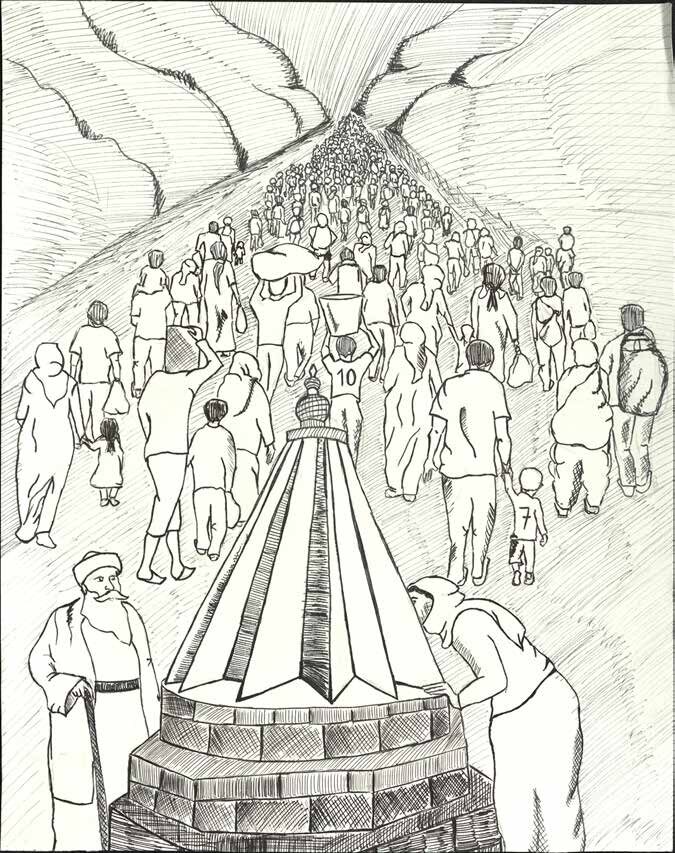
- Hundreds of thousands fled into the Şengal mountains and further north. In December 2014 Peshmerga units with US air support broke the siege of the mountains; on November 13, 2015 the town of Şengal was liberated.
The massacre of Koço
- August 3, 2014: IS occupies Koço on the southern slope of the mountains and disarms the inhabitants.
- August 5: Ultimatum – conversion or death. The inhabitants decide to remain with their religion; the deadline is extended.
- August 15: All inhabitants are assembled in the school. The village headman (Muxtar) refuses to convert; the men join him. Men and women are separated. The men are taken in groups to four places around the village and shot; some survive beneath the dead. Over 500 men and boys are killed on this day.
- The women and children are taken to the building of the Technical Institute in Solax; young women and girls are brought from there to the “Galaxy” wedding hall in Mosul, later on to Raqqa.
- August 16: Over 80 older women from Koço are murdered behind the Technical Institute (according to OHCHR/UNAMI 2016).
Further massacres in 2014 (selection)
| Place | Events (according to Shammo) |
|---|---|
| Solax | Occupied on August 4; about 50 people refuse to convert, 30 older people are shot, the rest locked up, and they die after 16 days (OHCHR/UNAMI 2016). According to a witness, among the perpetrators there were also Muslim Kurds (“Kurmanc”) from Şengal who belonged to IS. |
| Til Ezer | According to the confession of the IS member “Abu Suraqa”, men, older women and children were killed and young women distributed among IS members. |
| Siba Şêx Xidir | Massacre of men who refused to convert; according to a female witness many young men of the Qîranî tribe were burned in rooms. |
| Skêniyê and Hayalî | Massacre; according to survivors, inhabitants of neighboring Arab villages were among the perpetrators (according to Shand 2018). |
| Hardan | One of the worst massacres; many men shot, ten beheaded. |
| Qinê | In mid-August about 67 men killed (UNAMI, December 15, 2014). |
| North side of the mountains | Captives brought to checkpoints and to Xanesor and Sinûnê; those who refused shot or beheaded. |
Forced conversion
- Men and boys who converted in appearance had to perform forced labor in Tel Afar, Mosul and Ba’aj.
- At the end of August 2014 IS brought “converted” families to the abandoned villages of Qasr Mihrab and Qizil-Qayo near Tel Afar. In April 2015 it declared the conversions not genuine; women and children were taken away, the men and older boys presumably executed. An IS document of September 27, 2014 assigned the checking of the conversions to the IS judicial office.
- In al-Hasaka, Raqqa and Shaddadi Ezidi families were gathered in schools and forced to make the Islamic profession of faith; children of about 8–15 years were separated from their mothers for this purpose.
Slave markets and enslavement
In detail in the article Abduction and enslavement of Ezidis. In brief:
- Collection camps and markets (according to survivors and UN reports): girls’ school in Tel Afar, Badûş prison near Mosul, the Galaxy hall and other buildings in Mosul; in Syria an agricultural site (“the farm”) and halls in Raqqa, an underground hall in Tadmur (Palmyra) with auctions, houses in Deir ez-Zor, Qastala and Homs. In addition there was trade via messenger groups and Facebook.
- Administration: An IS department for “spoils of war” and a central committee directed the trade. About 80 percent of the women and girls were sold to fighters, 20 percent remained “common property” of IS (UN 2016).
- Perpetrators, according to UN reports and witness statements, came from Iraq, Syria and many other countries of Asia, Africa, Europe and from Australia; according to UN information of December 2019, from 46 countries.
IS documents
| Date | Document | Content |
|---|---|---|
| August 9, 2014 | Fatwa no. 011 of the IS “Office for Research and Fatwas” | Ezidis are “original unbelievers” |
| September 27, 2014 | letter on Qasr Mihrab | checking of the conversion of Ezidi captives by the IS judicial office |
| October 2014 | “Dabiq” no. 4; brochure “Question and answer on captivity and slaves” | religious justification of enslavement |
| around October 2014 | price list (according to OHCHR/UNAMI 2016) | prices according to the age of the captives |
| April 15, 2015 | receipt of the IS “Zakat Office” in Mosul | confiscation of over 83 million Iraqi dinars of an Ezidi |
| around June 15, 2015 | circular no. 1 of the “Homs Province” | registration and auction of captives |
| July 2015 | announcement of the “al-Baraka Province” (Hasaka) | captured women as prizes in a Koran competition |
| July 11, 2015 | letter of the IS judicial office of the “Nineveh Province” | sale only through the sharia court and only to members; maximum prices |
| August 16, 2016 | “deed of ownership” of the Nineveh sharia court | purchase of a young Ezidi woman |
The fatwas of IS are compiled in the article Fatwas against the Ezidis.
Robbery and destruction
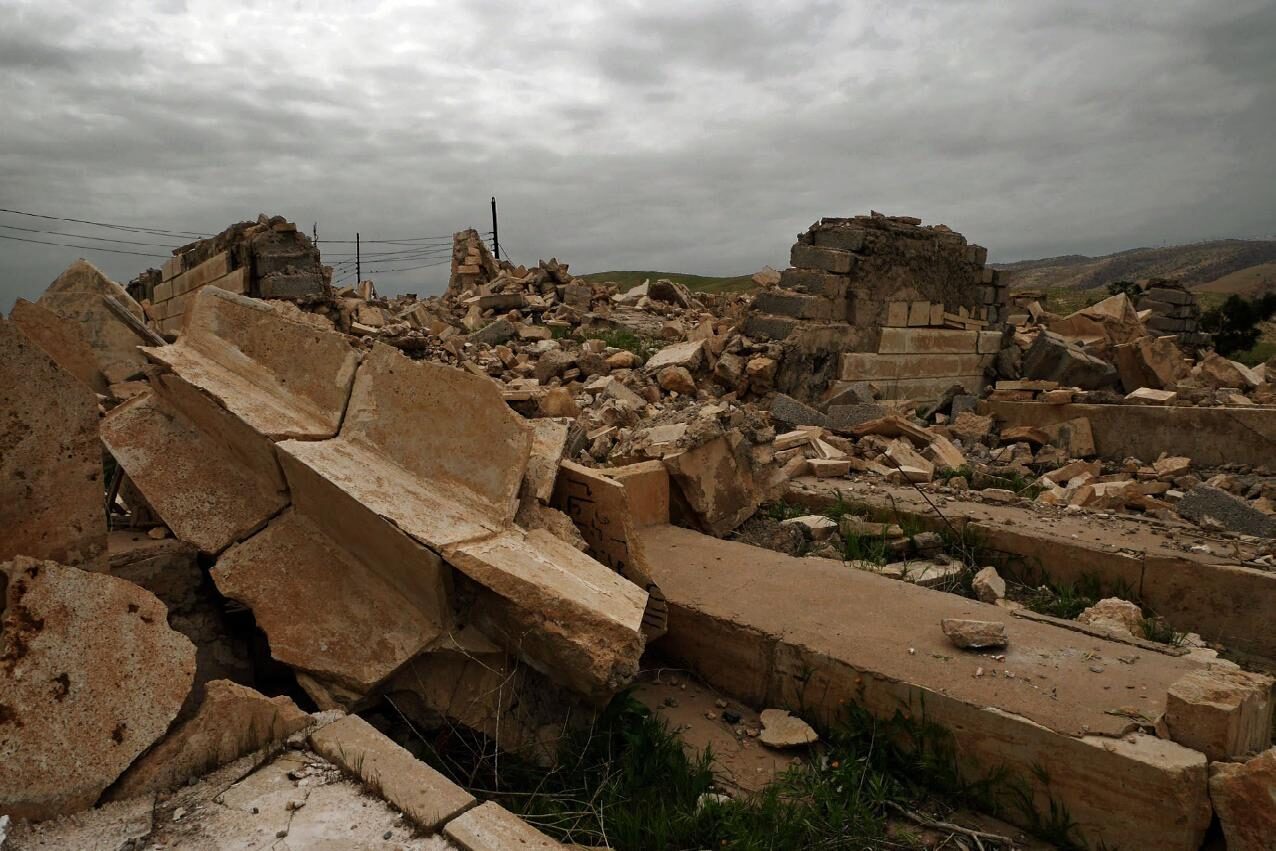
- Houses of the Ezidis in Şengal were marked and plundered; money, gold, cars, identity papers and thousands of sheep were stolen. In October 2014, according to UNAMI, IS destroyed houses and parts of the cemetery of Skêniyê, in December 2014 houses in Koço.
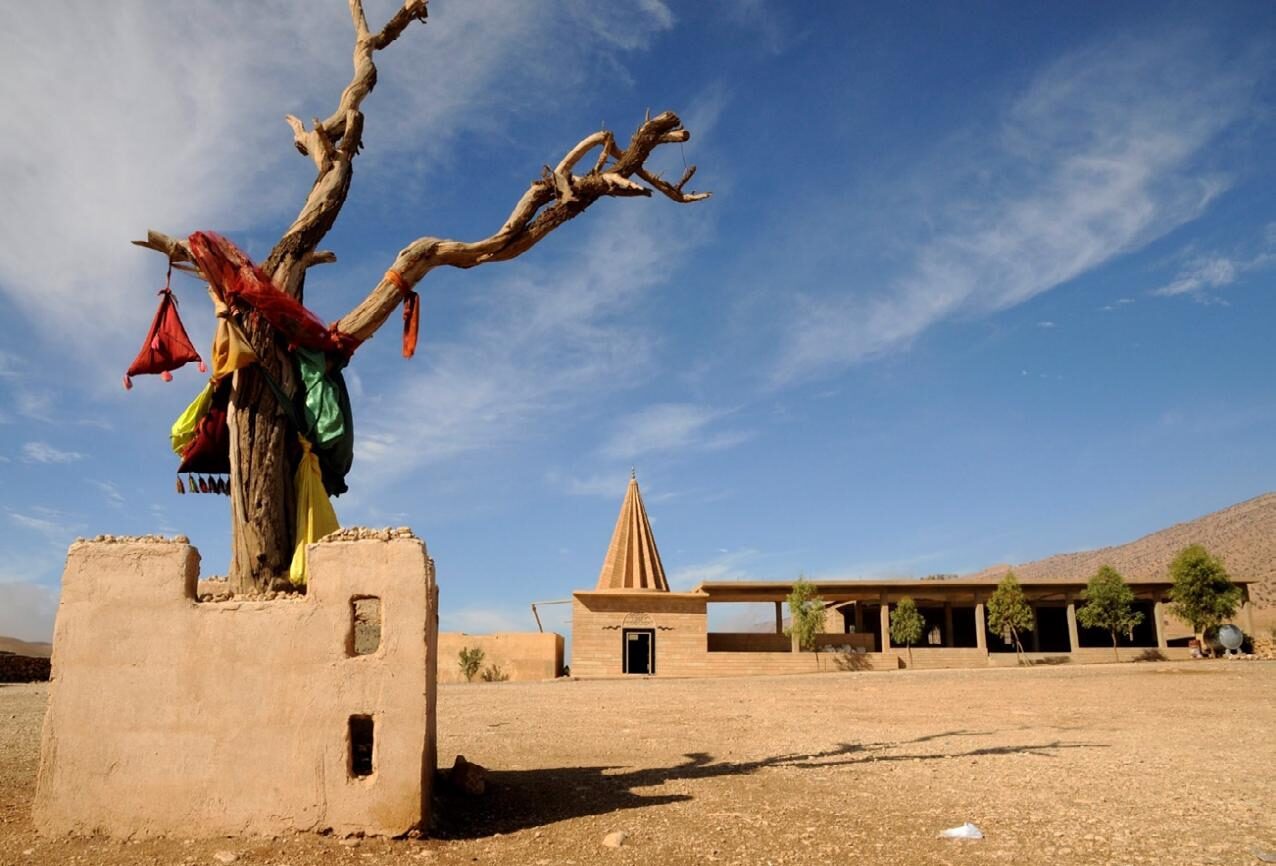
- According to the office in Duhok (September 13, 2020), IS destroyed 68 Ezidi shrines and religious sites, among others on the southern slope of the Şengal mountains (including Şêx Hesen, Şêx Mend Paşa, Îsmaîl Beg – “Kiçik Lalîş” –, Melek Fexredîn), on the north side, in Babîrê, as well as about 20 domes in Bahzanê and others in Başîqa.
- Reconstruction: The shrine of Şixsê Batê in Babîrê was rebuilt with donations from the community (over 150 million dinars) and voluntary labor and reopened on February 15, 2017. In Başîqa and Bahzanê Ezidis collected about 220 million dinars for 23 sites.


Abducted children
- Boys were given military training and indoctrinated in camps, schools and mosques (among others the al-Farouq camp in Raqqa, Tel Afar) and used as guards, porters and fighters. Children were also sold.
- The children were forbidden their mother tongue; at their liberation many spoke only Arabic, Turkish or Russian.
- Some liberated children refused to return to their families.
Mass graves
| Date | Find (according to Shammo) |
|---|---|
| September 9, 2014 | first mass grave near Bardi (road to the Mosul Dam): 14 Ezidis |
| February 25, 2017 | al-Khasfa sinkhole on the Baghdad–Mosul road, about 4,000 dead, among them Ezidis |
| November 28, 2017 | mass grave in Ba’aj with 340 Ezidis |
| December 3, 2017 | two graves in Qabûsî and in the Cezîre residential complex near Şengal, together 140 dead |
| November 6, 2018 | UNAMI/OHCHR: 202 mass graves in four provinces, of which 95 in Nineveh; estimated 4,000–10,500 victims in Nineveh |
| March 15, 2019 | opening of the first mass graves in Koço by UN forensic experts after Ezidi prayers; by June 2019, 16 grave sites, 141 dead |
| October 2019 | 80 mass graves (official statistics according to Majid Hassan Ali, kurds-yezidis-me p. 44–45) |
| December 2019 | Nadia Murad names 81 mass graves in the Şengal region at the UN Young Activists Summit in Geneva (according to Krimmer p. 14) |
| February 19, 2020 | sinkhole near Tel Afar with at least 1,000 dead, among them at least 30 Ezidis |
| July 12, 2020 | 82 Ezidi mass graves and dozens of individual graves (Kurdistan Regional Government, confirmed by the UN) |
| September 13, 2020 | office in Duhok: 83 mass graves in Şengal and surroundings |
| from October 24, 2020 | exhumation in Solax under the supervision of the head of UNITAD, Karim Khan: remains of about 75 women over 40 years of age |
| February 6, 2021 | burial of 104 identified men in a separate cemetery in Koço |
Figures
| Item | Figure | Origin |
|---|---|---|
| Abducted | 6,417, of whom 2,869 women and girls | Office for the Liberated Abductees, Duhok, Sept. 13, 2020 |
| Freed | 3,537 (1,201 women, 339 men, 954 boys, 1,043 girls) | ibid. |
| Missing | 2,880, of whom 1,304 women and girls | ibid. |
| Killed | 1,293 | ibid. |
| Victims in mass graves in Nineveh | 4,000–10,500 (estimate) | UNAMI/OHCHR, Nov. 6, 2018 |
| Captive women and children | 4,000–5,000 | figure in Shammo (as of 2015) |
| Fled from Şengal | over 300,000 | Shammo; Bundestag resolution 2023 |
| Orphans | over 2,700 | unofficial statistics (2020) |
The figure of 1,293 killed given by the office in Duhok and the UN estimate of up to 10,500 victims in the graves of Nineveh lie far apart; the UN figure also includes non-Ezidi victims. Further, divergent figures are given in the article Şengal 2007 and 2014.
Figures as of 2019 (Ali)
In the edited volume by G. M. Tezcür (2021), the Ezidi historian Majid Hassan Ali reproduces the official statistics as of August 2019 (according to the General Directorate for Ezidi Affairs 2016 and the office for the abducted; kurds-yezidis-me p. 44–45):
| Item | Figure |
|---|---|
| Ezidis in Iraq before 2014 | 550,000 |
| Displaced | 350,000 |
| Emigrated abroad | over 100,000 |
| Killed in the first days | 1,293 |
| Orphans | 2,745 |
| Abducted | 6,417 (3,548 female, 2,869 male) |
| Returned | 3,509 (1,192 women, 337 men, 1,033 girls, 947 boys) |
| Missing | 2,908 (1,323 female, 1,585 male) |
| Mass graves | 80 (October 2019) |
| Destroyed sanctuaries | 68 |
The figures for the freed and missing differ slightly from those of the office in Duhok of September 2020 (above), because further abductees have returned since then. In the breakdown by sex the statements do not agree: Ali counts 3,548 female abductees, the table above according to Shammo 2,869 women and girls – the same figures thus appear reversed. Which assignment is correct cannot be determined from the sources.
An extrapolation from a household survey (Cetorelli et al. 2017, according to Tezcür et al. p. 85) arrives at at least 1,500 executed, almost 1,500 people who died of thirst or starvation on the mountain, and about 6,400 abducted.
Return of the survivors
- On February 6, 2015 the Spiritual Council of the Ezidis declared that the liberated remain Ezidis; their faith cannot be changed against their will.
- On April 24, 2019 the Council called for the acceptance of all survivors. On April 27, 2019 it clarified that this applies to children of Ezidi parents, not to children born of rape by IS members.
- Under Iraqi law, children of unknown fathers are registered as Muslims; minors follow the religion of a parent who has converted to Islam.
Help
- Germany: From 2016 Baden-Württemberg took in over 1,000 women and children for trauma treatment in a special program; trauma therapists were trained at the University of Duhok. According to the memoirs of Farida Khalaf and Nadia Murad, the first liberated women came to Germany already in 2015 (Khalaf in the summer, Murad at the end of September 2015); which program was responsible for this the books do not say.
- France and Australia took in survivors in their own programs (Australia: 2,738 humanitarian visas 2015–2019).
- From December 2014 six Kaniya Spî schools in refugee camps taught religion, mother tongue and history; in 2019 they were closed because they were not officially approved.
Recognition as genocide
| Date | Body |
|---|---|
| 2014 | Iraqi Council of Ministers |
| March 12, 2015 | European Parliament (resolution) |
| March 14, 2016 | US House of Representatives |
| April 20, 2016 | British House of Commons |
| June 15, 2016 | UN Human Rights Council (report) |
| June 16, 2016 | Canadian House of Commons |
| December 8, 2016 | French National Assembly |
| March 23, 2017 | Scottish Parliament |
| January 16, 2018 | Armenian Parliament |
| February 26, 2018 | Australian Parliament (elsewhere in Shammo: March 2018) |
| August 3, 2019 | Parliament of the Kurdistan Region (Iraq) |
| November 27, 2019 | Portuguese Parliament |
| May 13, 2021 | Head of UNITAD Karim Khan: “clear and convincing evidence” of genocide |
| July 6, 2021 | Dutch House of Representatives |
| July 15, 2021 | Belgian Parliament (Foreign Affairs Committee) |
| January 18, 2023 | German Bundestag (unanimously) |
| December 17, 2024 | Swiss Parliament |
Additions according to testimonies of survivors
The memoirs of Nadia Murad (2017, Russian 2018) and Farida Khalaf (2016), both from Koço, as well as the reports of Patrick Desbois (2018) and Dunya Mikhail (2018), who questioned survivors in the camps near Duhok, supplement the account. They are testimonies, not statistics. In detail: Koço, Rescue and ransoming, Forced recruitment of Ezidi boys, Refugee camps in northern Iraq.
Withdrawal of the Peshmerga
On the withdrawal as a whole see The withdrawal of the Peshmerga in 2014.
- According to Farida Khalaf, the Peshmerga withdrew from Koço in the night before August 3, 2014 without warning the inhabitants. Her father, a soldier of the Iraqi army, said according to her recollection that all 250 Peshmerga in the Şengal area had left their positions overnight. Tagay and Ortaç (above), by contrast, name 11,000 men. The figures rest on entirely different bases – an oral statement from memory and a statement by the authors according to Dangeleit and Knapp – and cannot be reconciled here.
- Nadia Murad writes that the request to leave at least weapons behind was unsuccessful; the Kurdistan Regional Government later called the withdrawal a “tactical withdrawal”. Even before August 2014, Ezidis who wanted to move to the Kurdistan Region had been sent back at checkpoints.
- According to Murad, in Şengal only a few hundred armed Ezidi men resisted until they ran out of ammunition.
Date and course of events
- Desbois gives for the capture of Şengal once August 3 and once August 4, 2014 – a contradiction within his book; the other sources give August 3.
- According to Murad, Khalaf and Desbois’s witnesses, many Sunni Arab neighbors joined IS, blocked roads and helped in the capture.
- Ultimatum in Koço: Shammo names August 5, Murad August 12 with a three-day deadline; Khalaf and Desbois name a three-day deadline without a date.
- Vehicles on August 15: Khalaf names 13, Desbois’s witness about 80 vehicles.
- According to Murad, almost 40 children died in the mountains. The YPG brought bread and, with US air support, opened a route to northern Syria.
Older women in Solax
| Figure | Source |
|---|---|
| over 80 older women | OHCHR/UNAMI 2016 (according to Shammo, above) |
| 80 older women in a mass grave | Amal Clooney, foreword to Murad |
| 84 older people and a group of 15-year-olds | Ezidi companions of Desbois (visit 2016) |
| 67 older women, with grandchildren who did not want to be separated | second-hand witness in Mikhail |
| remains of about 75 women over 40 years of age | exhumation from October 2020 (Shammo, above) |
According to the same witness in Mikhail, about 600 younger women and children from Solax were sold en bloc to a Syrian dealer – a second-hand statement.
Other places
- The administrative building in the center of the town of Şengal, according to witnesses in Desbois, served as a collection and separation point; at the time of his visit in 2016 identity papers of Ezidi inhabitants were still lying there.
- In the dried-up riverbed Wadi Zelleli, Desbois’s companions found the remains of about 50 people who had been shot while fleeing into the mountains, and further small mass graves.
- At the liberation of the town of Şengal on November 13, 2015, according to Mikhail, mass graves with hundreds of dead were discovered on the same day; the town was devastated, sanctuaries and churches destroyed. Desbois found it largely destroyed and full of mines and booby traps in 2016.
Contradictions in the source
- Shammo dates the liberation of an abducted boy from Hardan once to January 2017, once to January 2018.
- For the recognition by the Australian Parliament he gives February and March 2018.
Additions according to Tagay and Ortaç (2016)
In their book of 2016, Şefik Tagay and Serhat Ortaç reproduce the state of knowledge at that time; they rely above all on reports by the UN, Amnesty International and Human Rights Watch. Ortaç is a lawyer and classifies the acts under international criminal law.
The attack on August 3, 2014
- On August 3, 2014 IS advanced on Şengal. According to the authors there was no significant resistance by Iraqi armed forces or the Peshmerga (p. 152–153).
- Many Ezidis from Şengal feel abandoned by the Kurdistan Regional Government (KRG): at the time of the attack it abruptly withdrew the Peshmerga units – according to the authors 11,000 men strong – stationed in Şengal to protect the population. The Peshmerga are said to have refused to give the Ezidis weapons for self-defense (according to Dangeleit and Knapp 2015). The President of the Kurdistan Region, Mesûd Barzanî, was accused of having done too little for protection. The Peshmerga played a decisive part in the later liberation (p. 174–175).
- According to Tagay and Ortaç, many Arab neighbors of the Ezidis in Şengal actively or passively supported IS (according to Durm 2014); plots of land of those who had fled were occupied by IS fighters and supporters from the local Sunni population (p. 153–154, 174).
- About 50,000 Ezidis were trapped in the mountains from August 3 to 10 at temperatures of up to 55 °C. Relief drops by the USA and an escape corridor of the YPG, a militia from northern Syria close to the PKK, saved many; several hundred people, above all small children and the elderly, died (p. 154, 163, 175).
Massacres according to Tagay and Ortaç
| Place | Date | Events (according to Amnesty, HRW, UN; p. 155–156) |
|---|---|---|
| Solagh (Solax) | August 3 | about 10 men executed, about 20 women and girls abducted |
| Qiniyeh | August 3 | about 300 Ezidis, mainly from Tal Qasab, attacked; 85–90 men and boys aged 12 and over shot |
| Jdali | August 3 | 50–60 men shot |
| Hardan | August 4 | 60 men killed |
| Koço (Kocho) | August 15 | at least a hundred, probably several hundred men and boys executed, about 400 missing; according to the UN at least 700 |
The authors name mass graves, among other places, in Hardan, Xanesor, Sinûnê, Zummar, Solax and Qinê (according to Yazda 2016, p. 156).
Discrepancies: For Solax, Shammo (above) gives August 4 and about 30 older people shot, Tagay and Ortaç August 3 and about ten men executed. For Koço, Shammo names over 500 men and boys killed, Tagay and Ortaç “at least a hundred, probably several hundred” and the UN figure of at least 700. Whether “Qiniyeh” is the same village as “Qinê” in the table above cannot be said with certainty from the sources; the figures (85–90 and about 67 dead respectively) and dates differ.
Figures as of 2016
| Item | Figure | Origin (according to Tagay/Ortaç) |
|---|---|---|
| Executed | about 5,000 | UN |
| Abducted girls and young women | about 7,000 | UN |
| Recorded victims | 3,133 names, among them 2,305 abducted (412 children) | Human Rights Watch database |
| Freed or escaped women and girls | about 2,000 (by 2016) | p. 159, 176 |
| Ezidis in camps in the Kurdistan Region | about 300,000 (2016) | p. 176 |
The figures date from the time before the later surveys and differ from the figures of the office in Duhok (2020, above).
Women, children, sanctuaries
- The women were separated into three groups – married with children, married without children, unmarried and girls – and often carried off to more than ten places; some were sold as far as Saudi Arabia, Libya, Afghanistan and Lebanon (p. 157, 164). Shammo (above) names a division into four groups.
- Children aged 8 to 15 were separated from their mothers, forcibly converted and given military training for between 13 days and three weeks (p. 159–160).
- Immediately after the return of the first liberated women, the Baba Şêx called for them to be taken back and supported; in conservative circles a stigma nevertheless remained (p. 164).
- Destroyed were, among others, the temple of the three sisters in Başîqa and the temple of Şêx Mend in Şengal (according to Amnesty 2014, p. 160).
Ezidi units and self-administration
- After 2014 Ezidis formed their own armed units: the Hêza Parastina Şingal (HPŞ, “Protection Force of Şengal”) and the Yekîneyên Berxwedana Şingal (YBŞ, “Resistance Units of Şengal”) (p. 175).
- At the beginning of 2016 an Ezidi self-administration council with 200 representatives was founded in Şengal (p. 175).
- The town of Şengal was recaptured in November 2015 (p. 169); there were many booby traps in the liberated areas. In 2016 the camps lacked drinking water, electricity and medical and psychological help (p. 176).
Legal steps until 2016
- March 13, 2015: UN report with the accusation of genocide (p. 7).
- September 24, 2015: The organizations Yazda International and Free Yezidi Foundation handed over to the Chief Prosecutor of the International Criminal Court, Fatou Bensouda, documents on 20 foreign IS fighters. Iraq has not ratified the Rome Statute (p. 160–173).
- February 4, 2016: Resolution of the European Parliament (p. 7). The table above names, according to Shammo, a resolution of March 12, 2015; whether these are two different resolutions cannot be determined from the sources.
- According to Ortaç, all five elements of Art. II of the Genocide Convention are fulfilled; in Germany the acts can be prosecuted under § 6 of the Code of Crimes against International Law (p. 160–173).
73rd or 74th Ferman
Tagay and Ortaç write that 2014 is counted as the 73rd or 74th Ferman; in the second case the bombings of August 2007 count as the 73rd Ferman (p. 173–174). See The 74 Ferman.
After the flight, according to the authors, Ezidis often received support from Kurds from northern Iraq, Turkey and Syria (p. 174). On many Ezidis turning away from the regional government after 2014 see Self-understanding after 2014.
Additions according to Tezcür (ed.) 2021
The edited volume published by Güneş Murat Tezcür (London 2021) contains contributions by Majid Hassan Ali, Tezcür/Kaya/Sevdeen and Tutku Ayhan, based on field research in Duhok and Şêxan in 2017–2019.
Perpetrators and accomplices
- The main perpetrator was IS. According to survivors, Muslim neighbors also took part – among them former friends, “blood brothers” and Kirîv of Ezidi children, that is, men with whose families a firm bond existed through circumcision (Tezcür et al. p. 85–86; Ayhan p. 178).
- In Koço, according to these statements, the IS fighters came from neighboring Arab villages; the village remained surrounded until August 15. Hardan was attacked by neighboring Sunni Turkmens (Tezcür et al. p. 85–86, 93 n. 45–46).
- Ayhan names the Tayy, Xawatina and Mitêwta as Arab tribes involved (p. 177).
Withdrawal and rescue
- The KDP Peshmerga withdrew without warning in the hours before the attack (Ayhan p. 177; Ali p. 44–45).
- According to Ali, the escape corridor to Syria was opened by the YPG and the HPG (armed wing of the PKK) (p. 44). About 10,000 Ezidis afterwards lived in camps in northeastern Syria (p. 44).
Camps and the situation afterwards
- In February 2017 about 36,000 families lived in camps in the Duhok Governorate, about 77 percent of them Ezidis; the camps Xanke, Şarya and Rwanga are named (Tezcür et al. p. 93 n. 47; see Refugee camps in northern Iraq).
- In October 2017 the forces of the Kurdistan Regional Government withdrew from Şengal; since then the Iraqi army, the Hashd al-Shaabi and forces close to the PKK have controlled the area (p. 87). On further developments see Ezidis in Iraq since 2014.
Additions according to Krimmer (2020)
In her Innsbruck master’s thesis (2020), Anna Maria Ute Krimmer summarizes the state of knowledge around 2019; she relies on UN reports and specialist literature. The page references refer to her thesis; the original source is given in parentheses.
- Attack: On August 3, 2014 IS attacked simultaneously from Mosul, Tel Afar, ash-Shaddadi and Tal Hamis (p. 11, according to UN Human Rights Council 2016). The Iraqi government had entrusted the security of Şengal to the Peshmerga; they withdrew without warning the population (p. 11).
- Mountains and corridor: Over 50,000 Ezidis were stranded on the mountain. After US President Obama’s pledge of August 7, relief drops and air strikes followed from August 8 to 14; via the YPG corridor to Syria 40,000–50,000 people were rescued from August 9 to 14, before IS closed the route again on August 14 (p. 11–12).
- Capture: Within 72 hours IS captured the Ezidis who had stayed behind; the exception was Koço, which was attacked only on August 15. Arab neighbors advised them to hoist white flags; Sunni inhabitants helped IS (p. 12). Christians were allowed to stay on payment of the poll tax (jizya), Ezidis were not (p. 13).
- Koço: 500–700 men executed (p. 13, according to Eziden Weltweit 2018).
- Mass graves: In December 2019 Nadia Murad named 81 mass graves in the Şengal region (p. 14); the office in Duhok counted 83 in September 2020 (above). The figures reflect different points in time.
- Abducted: According to Eziden Weltweit (2018), about 7,000 women and girls were abducted; by July 2019 about 2,400 had escaped or been ransomed (according to the Society for Threatened Peoples). According to Irfan Ortaç (Central Council of Ezidis in Germany), in 2019 2,600 women and children were still missing; many had presumably been carried off to Qatar, Saudi Arabia, Pakistan, Yemen, Libya and Turkey (p. 26). For ransoming, 10,000 to 40,000 US dollars were demanded (p. 25; see Rescue and ransoming).
- Boys: According to Cavelius and Kızılhan, by 2016 IS had given military training to between 1,200 and 2,000 Ezidi boys; about 400 of them died (p. 23; see Forced recruitment of Ezidi boys).
- Classification: Krimmer dates the UN report “They came to destroy” to 2015; the report dates from June 2016 (see table above).
- Count: Following Tagay and Ortaç, Krimmer calls the attack the 73rd Ferman (p. 46); on the count see above and The 74 Ferman.
Sources
- Qader Saleem Shammo: From Fatwā to Genocide. Historic and Contemporary Manifestations of the Islamic Genocide against the Yezidis (Yezidi Studies 5). Berlin 2026, p. 27–34, 76–84, 101–220, 223–226
- Şefik Tagay, Serhat Ortaç: Die Eziden und das Ezidentum. Geschichte und Gegenwart einer vom Untergang bedrohten Religion. Hamburg (Landeszentrale für politische Bildung) 2016, p. 7, 152–176
- Nadia Murad (with Jenna Krajeski): Последняя девушка. История моего плена и моё сражение с «Исламским государством». Moscow (Eksmo) 2018 (Russian translation by Oleg Perfil’ev from the English: The Last Girl. My Story of Captivity, and My Fight Against the Islamic State, 2017; foreword by Amal Clooney), p. foreword; part I ch. 6–10; part II ch. 1–3
- Farida Khalaf, Andrea C. Hoffmann: The Girl Who Escaped ISIS. This Is My Story. New York (Atria Books) 2016 (English translation by Jamie Bulloch; original: Das Mädchen, das den IS besiegte. Farida erzählt ihre Geschichte. Bergisch Gladbach: Bastei Lübbe 2016), p. ch. 2–4
- Patrick Desbois, Costel Nastasie: The Terrorist Factory. ISIS, the Yazidi Genocide, and Exporting Terror. New York (Arcade Publishing) 2018 (translated by Shelley Temchin from the French: La Fabrique des terroristes. Paris: Fayard 2016), p. ch. “Taking Up My Pen”, “Lion Cubs”, “The Mass Graves”, “Sinjar Liberated”
- Dunya Mikhail: The Beekeeper. Rescuing the Stolen Women of Iraq. New York (New Directions) 2018 (translated by Dunya Mikhail and Max Weiss from the Arabic: Fī Sūq as-Sabāyā), p. p. approx. 120, 167–168
- Güneş Murat Tezcür (ed.): Kurds and Yezidis in the Middle East. Shifting Identities, Borders, and the Experience of Minority Communities. London: I.B. Tauris 2021, p. p. 44–45, 85–87, 93 n. 45–47, 177
- Anna Maria Ute Krimmer: Sequenzielle Traumatisierung von Êzîd_innen infolge des Genozids. Eine qualitative Studie. Master’s thesis, University of Innsbruck 2020, p. p. 11–14, 23, 25–26, 46
Found a mistake?
Is something wrong – a fact, a spelling, a source, an image? Let us know: we check every report and correct the article.
Other spellings: Koco · Kotscho · Kodschho · Kojho · Solach · Solakh · HPS · HPSch · HPSh · YBS · YBSch · YBSh · Massengräber in Sengal · Massengräber in Schengal · Massengräber in Shengal · Firman · Fermans · Sinjar · Sindschar · Shingal