
The Ezidis believe in one God, who created the world and handed over its governance to seven angels; at their head stands Tawûsî Melek. Their religion is called Şerfedîn; many also say Êzdîtî. Its center is the sanctuary of Lalîş in northern Iraq. The teaching was passed on orally over centuries, above all in sacred hymns, the Qewl. This article gives a first overview; the individual topics are explained in detail in separate articles.
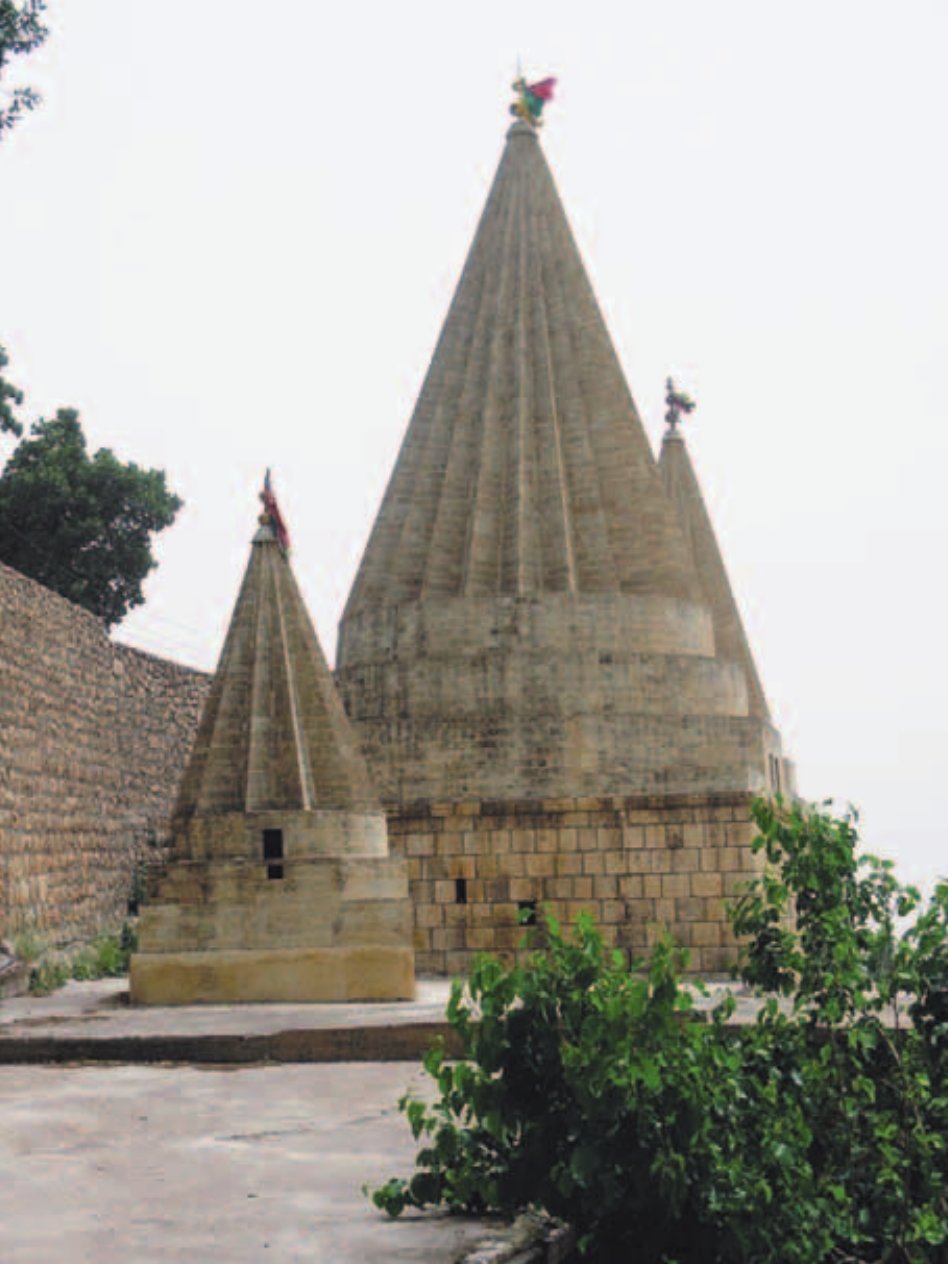
The essentials in brief
| Question | Short answer | |
|---|---|---|
| What is the religion called? | Şerfedîn; also Êzdîtî or Êzdiyatî | The name of the religion |
| Whom do Ezidis believe in? | in one God, Xwedê, who is light and has many names | God and his names |
| How did the world come into being? | according to most sources from the White Pearl (according to Şêx Mak’sîm, Dûr means "universe"); Lalîş was the first solid place | Creation and the Pearl |
| Who are the holy beings? | seven angels, at their head Tawûsî Melek; Şêx Adî; many saints | Holy beings – overview |
| What is the human being? | a body of four elements, an immortal soul, an "ego-soul" (nefs) | Adam and the human being |
| What comes after death? | judgment of the soul, the bridge Pira Selatê, paradise and hell – and the belief in rebirth | Soul, afterlife and rebirth |
| Is there a devil? | no – evil comes from the human being | Good and evil |
| What must an Ezidi observe? | three basic commandments, five spiritual bonds, the pillars of the religion | The basic pillars of the faith |
| How does time end? | Şerfedîn comes as redeemer (Mehdî) | Ages and end times |
| How do Ezidis see other religions? | with respect; no missionary activity | Other religions |
One God and his angels
The Ezidis are monotheists: they believe in a single God, Xwedê (Omarkhali 2023, p. 23). According to tradition, even before this world God created seven angels and handed over to them the governance of the world; their head is Tawûsî Melek, the "Angel-Peacock". After that God withdrew from acting in the world (Omarkhali 2023, pp. 23, 102–103; Omarkhali, article, p. 145). The angels also appear in human form; many Şêx and P’îr families trace themselves back to such holy beings (Kreyenbroek/Rashow 2005, pp. 12–13). See Tawûsî Melek and The seven angels.
God is regarded as light. Therefore Ezidis pray facing the sun (Omarkhali 2023, p. 23; Pirbari 2016, p-014). Fire, water, air and earth are regarded as holy and must not be polluted (Omarkhali 2023, p. 23).
Şêx Adî and Lalîş
A key figure is Şêx Adî (d. 1162). In his time the community was most profoundly transformed; his tomb in Lalîş is the most important place of pilgrimage (Omarkhali 2023, pp. 21, 23). According to the creation tradition, Lalîş is the place where the earth first became solid (pp. 108–110). See Şêx Adî and Lalîş.
A religion of action
The religion is traditionally based on right action, not on a fixed doctrine. There is no formulated theology and no belief system that is the same everywhere; Omarkhali speaks of an "unspoken" theology that can differ from region to region (Omarkhali 2023, pp. 9, 22; Kreyenbroek/Rashow 2005, p. 6). Only since Ezidis have lived among people of other faiths have they had to explain their religion in words (Omarkhali 2023, p. 22).
One people, one religion
One becomes an Ezidi only by birth; the religion does not proselytize (Omarkhali 2023, p. 23; Grigoriev et al. 2008, pp. 12–13). Ezidis believe they are a people chosen by God that will be saved at the end of time (Omarkhali 2023, p. 23). One formula reads: "The people is Ezidi, the religion is Şerfedîn" (Pirbari 2016, p-018). Society is divided into three hereditary groups: Şêx and P’îr are the clergy, the Mirîd the laypeople (Omarkhali 2023, p. 23). See Clergy and castes.
How we know this: the sacred texts
The most important sources of the faith are the Qewl (sacred hymns) and Beyt (songs), as well as prayers (Du’a) and explanatory narratives (çîrok). The Qewl is regarded as the highest genre, as the "knowledge of God" (Omarkhali 2023, pp. 70, 83; Pirbari 2016, p-019). The texts were learned by heart and passed on by experts; only since the 1970s have they been printed (Omarkhali, article, pp. 145, 188). See Sacred tradition.
Many voices
Because the religion is handed down orally, there are several versions on many questions. Omarkhali distinguishes the knowledge of the experts, who perform and interpret the hymns, from the popular knowledge of the majority; a reconstruction from the hymns alone, she says, does not reflect the faith of most Ezidis (Omarkhali 2023, pp. 491–492). In these articles the versions therefore stand side by side, each with its source:
- the research of Khanna Omarkhali (herself an Ezidi woman from a P’îr family) and Philip Kreyenbroek with Xelîl Cindî Reşo;
- the accounts of Ezidi clergy: P’îr Dîma (Dimitri Pirbari), Hesenê Şêx Kelaşê (1995) and Şêx Mak’sîm (2017).
Şêx Mak’sîm himself understands his book as a "first acquaintance" with the religion (Şêx Mak’sîm 2017, PDF pp. 4, 13, 208). On the authors and their perspectives see Perspectives and research.
Sources
- Khanna Omarkhali: The religious textual tradition of the Ezidis – from the oral to the written. Saint Petersburg 2023 (Russian translation of the English original, Wiesbaden 2017), p. 9, 19–25, 70, 83, 102–103, 108–110, 491–492
- Khanna Omarkhali: Yezidi Religious Oral Poetic Literature: Status, Formal Characteristics, and Genre Analysis. With some examples of Yezidi religious texts. In: Scrinium VII–VIII.2 (2011–2012): Ars Christiana, Leiden: Brill, pp. 144–195, p. 145, 188
- Philip G. Kreyenbroek, Khalil Jindy Rashow: God and Sheikh Adi Are Perfect. Sacred Poems and Religious Narratives from the Yezidi Tradition. Wiesbaden: Harrassowitz 2005, p. pp. 6, 12–13
- Dimitri Pirbari (P’îr Dîma), A. Ščedrovickij: Тайна жемчужины (The secret of the pearl). Moscow/Tbilisi 2016, p. p-014, p-018–019
- S. A. Grigoriev, L. V. Ivasko, D. V. Pirbari (P’îr Dîma): Lalişa Nûranî / Святой Лалыш / Holy Lalish. Yekaterinburg: Basko 2008, p. pp. 12–13, 46
- Şêx Mak’sîm (Maksim Ezdi): Grundpfeiler der Religion ScherfeDin, 2017 (on EZDIKI.COM in the Religion section and in the library), p. PDF pp. 4–6, 13, 139–142, 208
Found a mistake?
Is something wrong – a fact, a spelling, a source, an image? Let us know: we check every report and correct the article.
Other spellings: Glaub der Eziden · Serfedin · Scherfedin · Sherfedin · Ezditi · ezidisdschhe Religion · ezidisjhe Religion · ezidisch Religion · ezidisdschh Religion · Tawuse Melek · Melek Taus · Taus-i Melek · Malak Tawus · Lalish · Lalisch · Lalesh · Qawl · Qaul · Kewl · Sheikh