
The Ezidi religion knows several ideas of time side by side: a timeless eternity before creation, recurring ages, great upheavals and an end time in which a redeemer appears. Omarkhali therefore calls the religion "inclusive": circular and linear time, transmigration of souls and final judgment stand peacefully side by side (Omarkhali 2023, pp. 21–22).
Enzel – the time before time
Enzel is the name of the hidden eternity before the creation of the world (Omarkhali 2023, p. 100). It was without time and motion; God was still scarcely separated from the Pearl (Kreyenbroek/Rashow 2005, p. 25). The word also means "primordial, genuine" – old, recognized hymns are therefore called enzelî (Omarkhali 2023, p. 87).
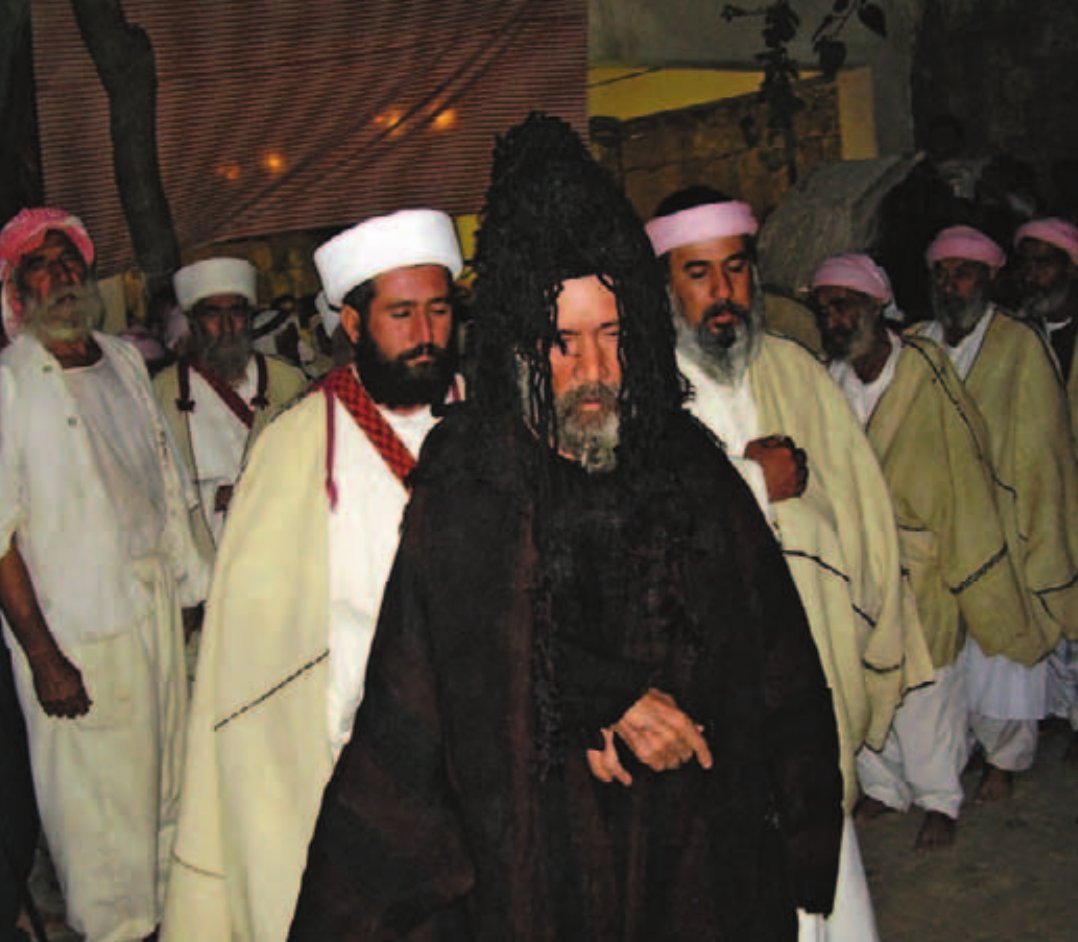
The mythical primordial time is regarded as an epoch of its own outside history. Some actions of that time are repeated in rituals: the solemn procession Sema at the festival in Lalîş recalls the time of creation (Omarkhali 2023, p. 100); according to one Qewal, it represents the worship of God by the angels (p. 139, n. 49). The annual Festival of the Assembly also mirrors the heavenly assembly of God with the seven angels (Kreyenbroek/Rashow 2005, p. 17).
Two great times
Kreyenbroek distinguishes in the tradition two times of "distant history": the time of creation and the time of Şêx Adî. The second is regarded as a new manifestation of the first. In addition there is the end of time (Kreyenbroek/Rashow 2005, pp. 19, 25). Linear time is unimportant in this (p. 22).
Bedîl and dewr – ages
History is divided into sections called bedîl ("change, turn") or dewr ("cycle, period") (Omarkhali 2023, pp. 21–22). In each age, according to the hymns, "the cup" – leadership – passes to another (Kreyenbroek/Rashow 2005, p. 21). As sections of the history of humankind a Qewl names Noah and the Flood, Ibrahim, Jesus, Moses and Muhammad. Siltan Êzî (Êzîd), however, has seen all the ages and is always present (p. 31).
According to the faith, some events of creation repeat themselves in such cycles (Omarkhali 2023, p. 21).
The three floods (tofan)
Three great events called tofan ("storm, flood") divide the history of the religion into four stages. They come when the sins of people get out of hand. But they are regarded as a purification that turns life for the better (Omarkhali 2023, pp. 21–22, 108). This fits with God's promise to the earth at the creation to purify it when sins become too great (p. 108; see Creation and the Pearl).
On the Flood, one tradition relates: the ark had a leak, and a snake curled itself into it and saved the ship (Kreyenbroek/Rashow 2005, p. 30). According to a version reproduced by Guest, the ark was built in Êsiyan near Êsivn, its hull was pierced on a peak in Şengal, and it landed on Mount Cûdî (Guest 1987, p. 48).
The end times
The Ezidis expect an end time (axirzeman), the resurrection (roja qiyametê) and a redeemer, Mehdî Şerfedîn (Grigoriev et al. 2008, pp. 4–5).
The Qewlê Şerfedîn relates: Şerfedîn dwells hidden in a cave or in a "tent with golden sides". At the end he calls a great assembly; Siltan Êzî makes him the Mehdî, the savior. A great battle follows in which the Feqîr drive out evil. Siltan Êzî stands at the bridge Silat between heaven and earth; "the King" – God – comes to earth. After that the sacred hymns are explained to all, and the world returns to its original state (Kreyenbroek/Rashow 2005, pp. 33, 368; Omarkhali 2023, p. 481). Şerfedîn establishes an ideal existence for a certain time (Omarkhali 2023, p. 481).
The Qewlê Tercal (Tercal corresponds to the Islamic Dajjal, the deceiver at the end of time) relates a different order: Jesus returns, rules for 40 years and kills the Tercal; then Şerfedîn rules for 40 years in peace. After that Gog and Magog kill Şerfedîn, the sea dries up, the throne of God comes down, and the judgment begins. Siltan Êzî unites the world in one religion (Kreyenbroek/Rashow 2005, pp. 33–34, 364).
Other hymns about the end are the Qewlê Qiyametê (36 stanzas, also called Qewlê Axiretê) and the short Qewlê Tircalî (Omarkhali 2023, p. 479). The Qewlê Bedîla Xedara ends with the end time (pp. 468–469). Omarkhali considers the Qewlê Çî Sibeyeke Tarî ye about the end of time probably not genuine (p. 470).
The great festival Bêlinda in winter is regarded as the day on which the dead will rise (Kreyenbroek/Rashow 2005, p. 18).
Differing traditions
Who rules first at the end?
| Version | Course of events | Source |
|---|---|---|
| Qewlê Şerfedîn | Şerfedîn comes out of hiding, is made the Mehdî by Siltan Êzî; God comes to earth | Kreyenbroek/Rashow 2005, pp. 33, 368; Omarkhali 2023, p. 481 |
| Qewlê Tercal | first Jesus (40 years), then Şerfedîn (40 years); Gog and Magog kill Şerfedîn; then judgment | Kreyenbroek/Rashow 2005, pp. 33–34, 364 |
| Şêx Cinnêt in Lescot (1936) | Jesus rules for 40 years; Şerfedîn is the Mehdî | Lescot 1938, pp. 65–66 |
| Version in Lescot (according to Kreyenbroek) | after the rule of the Ottomans the throne passes to Jesus in Egypt; Şerfedîn is the Mehdî; al-Hallaj purifies the world | Kreyenbroek/Rashow 2005, p. 35 (n. 48), 364 |
How long do the ages last? - Tagay and Ortaç report that each of the seven angels rules for 1000 (or 10,000) years (Tagay/Ortaç 2016, pp. 54–55). - Şêx Mak’sîm understands Bedil as "era", as beginning and turning point of the ages; he interprets the beginning of the universe as an "original explosion", visible in the first colors red, yellow, black and white (Şêx Mak’sîm 2017, PDF pp. 6–8). His connection with astrological ages is an interpretation of his own.
See also
Sources
- Khanna Omarkhali: The religious textual tradition of the Ezidis – from the oral to the written. Saint Petersburg 2023 (Russian translation of the English original, Wiesbaden 2017), p. 20 (n. 21), 21–22, 87, 100, 108, 139 (n. 49), 468–470, 479, 481
- Philip G. Kreyenbroek, Khalil Jindy Rashow: God and Sheikh Adi Are Perfect. Sacred Poems and Religious Narratives from the Yezidi Tradition. Wiesbaden: Harrassowitz 2005, p. pp. 17–19, 21–22, 25, 30–31, 33–35, 364, 368
- S. A. Grigoriev, L. V. Ivasko, D. V. Pirbari (P’îr Dîma): Lalişa Nûranî / Святой Лалыш / Holy Lalish. Yekaterinburg: Basko 2008, p. pp. 4–5
- Roger Lescot: Enquête sur les Yezidis de Syrie et du Djebel Sindjār (Study of the Ezidis of Syria and of the Şengal mountains). Beirut 1938, p. pp. 65–66
- John S. Guest: The Yezidis. A Study in Survival. London/New York 1987, p. p. 48
- Şefik Tagay, Serhat Ortaç: Die Eziden und das Ezidentum. Geschichte und Gegenwart einer vom Untergang bedrohten Religion. Hamburg (Landeszentrale für politische Bildung) 2016, p. pp. 54–55
- Şêx Mak’sîm (Maksim Ezdi): Grundpfeiler der Religion ScherfeDin, 2017 (on EZDIKI.COM in the Religion section and in the library), p. PDF pp. 6–8
Found a mistake?
Is something wrong – a fact, a spelling, a source, an image? Let us know: we check every report and correct the article.
Other spellings: Achirzeman · Akhirzeman · Roja Qiyamete · Mehdi · Terdschal · Terjal · Tirdschal · Tirjal · Belinda · Lalish · Lalisch · Lalesh · Qawwal · Kawal · Kewal · Faqir · Fakir · Sheikh Adi · Scheich Adi · Shaikh Adi