
Şerfedîn is a name with three meanings: it is the name of the religion of the Ezidis, the name of a saint and the name of the redeemer who returns at the end of time. The word comes from Arabic (Šaraf ad-Dīn) and means "honor" or "glory of the faith" (Omarkhali 2023, pp. 19–20; Pirbari 2016, p-259). On the name of the religion see The name of the religion.
The historical Şerfedîn
According to Kreyenbroek, Şerfedîn was a son of Şêx Hesen (Hasan ibn Adî), governor of Harput, and fell in 1257/58 fighting against the Mongols (Kreyenbroek/Rashow 2005, pp. 4, 221, n. 172). In the Lalîş photo book he is listed in the group of Şêx families that descend from Şêx Hesen (Adanî) (Grigoriev et al. 2008, p. 14). From the Şêx family Şerfedîn comes the Pêşîmamê Babê Şêx, who goes before the spiritual head Babê Şêx (p. 205).
The saint of Şengal
Among the Ezidis of Şengal, Şerfedîn stands as high as Şêx Adî (Kreyenbroek/Rashow 2005, p. 221, n. 172). In the texts Şengal is called the "seat of Şerfedîn" and is a place of pilgrimage (pp. 38, 338). A Beyt advises pilgrims to go only to Lalîş and to Şerfedîn's seat in Şengal (p. 337, n. 32).
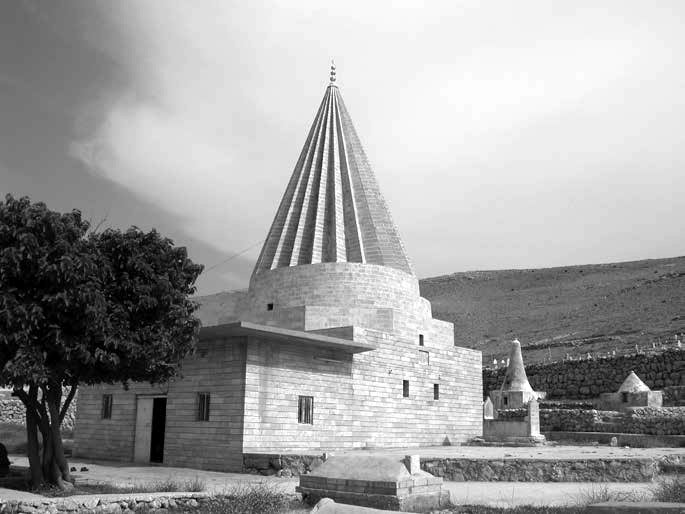
According to Guest, Şerfedîn is regarded in Şengal as the patron saint who brought the religion to the mountain. At his command the men of the eastern slopes wore long hair in braids. A small sanctuary stands on the summit Çilmêran, a larger one in a village lower down (Guest 1987, p. 51). For the New Year festival people celebrated at Şerfedîn's sanctuary on the Çilmêran (p. 54).

In Lalîş two wicks are lit for Şerfedîn (Grigoriev et al. 2008, pp. 202–203). When a member of the Adanî dies, the Semaya Şerfedîn û Şêx Hesen is performed, one of the seven solemn Sema (Omarkhali, article, p. 185; Omarkhali 2023, p. 146, n. 70–72).
The redeemer of the end times
According to tradition, Şerfedîn is a redeemer who is currently not in this world and returns at the end of time (Omarkhali 2023, p. 20, n. 21). The Qewlê Şerfedîn equates him with the Mehdî: he dwells in a cave until the end of time, then comes into the world and establishes an ideal existence for a certain time (p. 481). Siltan Êzî (Êzîd) makes him the Mehdî; Şerfedîn calls a great assembly that pays homage to Siltan Êzî (Kreyenbroek/Rashow 2005, pp. 33, 368). The Lalîş photo book speaks of the "savior Mehdî Şerfedîn" (Grigoriev et al. 2008, pp. 4–5).
In detail: Ages and end times.
Differing traditions
How did Şerfedîn come into being? - According to one tradition, he came into being from a flower in the hand of Şêx Hesen (Kreyenbroek/Rashow 2005, p. 221, n. 172). - According to Perminov, Şerfedîn appeared after the prayers in the form of a flower in order to bring people the religion of Tawûsî Melek (Perminov 2016, p. 92). - According to Şêx Mak’sîm, Şerfedîn is an archangel who does not belong to the seven. Tawûsî Melek made him the founder of the religion for the Ezidis; the religion is named after him (Şêx Mak’sîm 2017, PDF pp. 37, 40).
Whose name is Şerfedîn as well? - According to Pirbari, Şerfedîn is also an epithet of Tawûsî Melek and one of the names of Şêx Adî (Pirbari 2016, p-259).
What happens to him at the end? - According to the Qewlê Şerfedîn, he establishes a time of peace (Omarkhali 2023, p. 481). - According to the Qewlê Tercal, he rules for 40 years in peace after Jesus has killed the seducer; then Gog and Magog kill him (Kreyenbroek/Rashow 2005, p. 364). - According to Lescot's informant Şêx Cinnêt (1936), Jesus rules first for 40 years, and Şerfedîn is the Mehdî (Lescot 1938, pp. 65–66).
What does the name mean? - "Honor/glory of the faith" (Omarkhali 2023, pp. 19–20; Pirbari 2016, p-259). - According to Şêx Mak’sîm, Şerf means "justice" in the old language of prayer (Şêx Mak’sîm 2017, PDF p. 213).
See also
Sources
- Philip G. Kreyenbroek, Khalil Jindy Rashow: God and Sheikh Adi Are Perfect. Sacred Poems and Religious Narratives from the Yezidi Tradition. Wiesbaden: Harrassowitz 2005, p. pp. 4, 33, 38, 221 (n. 172), 296, 337 (n. 32), 338, 364, 368
- Khanna Omarkhali: The religious textual tradition of the Ezidis – from the oral to the written. Saint Petersburg 2023 (Russian translation of the English original, Wiesbaden 2017), p. 19–20 (n. 21), 146 (n. 70–72), 481
- Khanna Omarkhali: Yezidi Religious Oral Poetic Literature: Status, Formal Characteristics, and Genre Analysis. With some examples of Yezidi religious texts. In: Scrinium VII–VIII.2 (2011–2012): Ars Christiana, Leiden: Brill, pp. 144–195, p. 185
- John S. Guest: The Yezidis. A Study in Survival. London/New York 1987, p. pp. 51, 54
- S. A. Grigoriev, L. V. Ivasko, D. V. Pirbari (P’îr Dîma): Lalişa Nûranî / Святой Лалыш / Holy Lalish. Yekaterinburg: Basko 2008, p. pp. 4–5, 10, 14, 202–203, 205
- Dimitri Pirbari (P’îr Dîma), A. Ščedrovickij: Тайна жемчужины (The secret of the pearl). Moscow/Tbilisi 2016, p. p-014, p-259
- Şêx Mak’sîm (Maksim Ezdi): Grundpfeiler der Religion ScherfeDin, 2017 (on EZDIKI.COM in the Religion section and in the library), p. PDF pp. 37, 40, 213
- A. V. Perminov: Езиды – древний народ Адаби (The Ezidis – the ancient people Adabi). Sharya 2016, p. p. 92
- Roger Lescot: Enquête sur les Yezidis de Syrie et du Djebel Sindjār (Study of the Ezidis of Syria and of the Şengal mountains). Beirut 1938, p. pp. 65–66
- Birgül Açıkyıldız: The Yezidis. The History of a Community, Culture and Religion. London 2010, p. p. 184 (ill.)
Found a mistake?
Is something wrong – a fact, a spelling, a source, an image? Let us know: we check every report and correct the article.
Other spellings: Şerfedînê Şêx · Serfedin · Scherfedin · Sherfedin · Melek Serfedin · Melek Scherfedin · Melek Sherfedin · Mehdi Serfedin · Mehdi Scherfedin · Mehdi Sherfedin · Sharaf ad-Din · Serfedine Sex Hesen · Serfedine Sheikh Hesen · Serfedine Scheich Hesen · Scherfedine Sex Hesen · Serfedine Sex · Sheikh · Scheich · Shex · Lalish