
Sicadîn and Nasirdîn are two of the four sons of Êzdîna Mîr and thus brothers of Şêşims and Fexredîn. From all four descend the Şêx families of the Şemsanî (Kreyenbroek/Rashow 2005, p. 9; Omarkhali 2023, p. 24). In the faith they are connected above all with death: they stand at the deathbed, and one of them takes the soul.
At the deathbed
In the declaration of faith (Şehdetiya Dîn), which Ezidis in Armenia and Georgia recite every evening, two "executioners" (celat) stand over a person at death: Sicadîn, the messenger of death, and Nasirdîn, who takes the soul. They call on the dying person to recite the declaration of faith (Omarkhali, article, pp. 179–180; Omarkhali 2023, pp. 92–93). Whoever recites the declaration every evening thus prepares for this hour.
In the Qewl of Şêşims
The Qewlê Şêşims describes the two in more detail (Kreyenbroek/Rashow 2005, pp. 206–207):
- Mîr Sicadîn "opens the world to them". He brings the red sword and takes the "lord of unbelief" out of the world; Kreyenbroek suspects an allusion to the end times here. He received the sword Zulfiqar and the mount Duldul.
- Melik Nasirdîn takes the soul of every living being; the fear of him lies over all. With Cibraîl he leads the hosts of the Prophet. "Nasirdîn is the Şêx of Sicadîn."
There are also Qesîde of their own dedicated to both, short hymns of praise (Omarkhali, article, p. 183). In one narrative Nasirdîn lives in Nasiriye and Sicadîn on the mountain pastures (Kreyenbroek/Rashow 2005, p. 118).
In Lalîş and elsewhere
In the main building of Lalîş, at the entrance to the great hall, lies the basin of Nasirdîn, whom the Lalîş photo book calls the "angel of death" (Grigoriev et al. 2008, p. 68). A hanging lamp burns for Nasirdîn, a wick for Sicadîn (pp. 202–203).

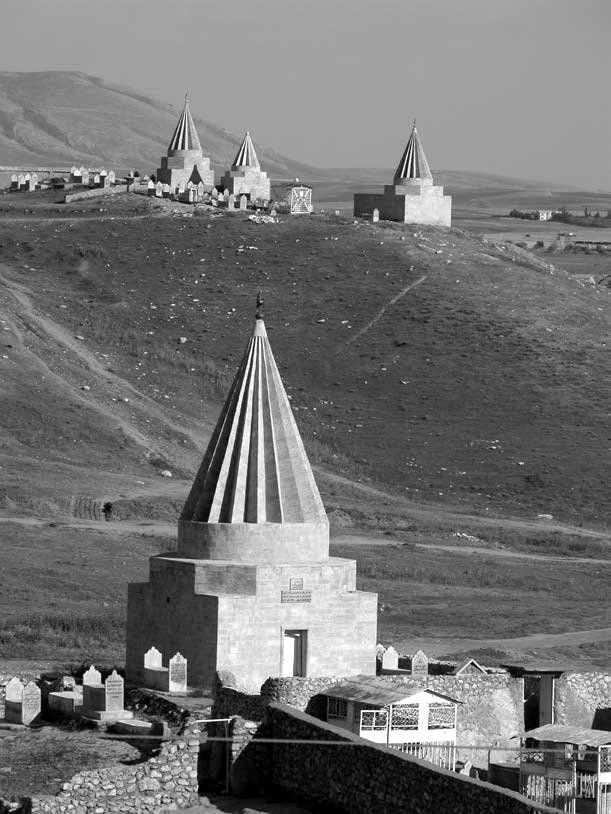
In Behzanê stands a mausoleum of Şêx Sicadîn (Açıkyıldız 2010, p. 164).
Differing traditions
Who is the angel of death? - According to the declaration of faith and the Qewlê Şêşims, Nasirdîn takes the soul; Sicadîn announces death (Omarkhali 2023, pp. 92–93; Kreyenbroek/Rashow 2005, p. 206). - According to Pirbari, the angel of death in the texts is usually Ezraîl, sometimes Nasirdîn (Pirbari 2016, p-246). Sicadîn and Nasirdîn are each the embodiment of one of the seven highest angels (p-253, p-255). - According to the Meshefa Reş in Omarkhali's reading, Sicadîn corresponds to the angel Azrael (Omarkhali 2023, pp. 40–41); according to Tagay and Ortaç, Sicadîn corresponds to Ezraîl and Nasirdîn to the angel Şemnaîl (Tagay/Ortaç 2016, p. 55). - Şêx Mak’sîm: Nasirdîn is the archangel Ezraîl, patron of death, his day is Friday; Sicadîn is the archangel Cibraîl, patron of life, his day is Saturday (Şêx Mak’sîm 2017, PDF pp. 12–14, 46). At a burial, he says, a lamb or an ox is first sacrificed for Azrail (Nasirdîn). Azrail is "innocent": he does not take one soul in place of another (PDF pp. 79–82).
| Source | Sicadîn | Nasirdîn |
|---|---|---|
| Declaration of faith (Omarkhali) | messenger of death | takes the soul |
| Meshefa Reş according to Omarkhali | Azrael | – |
| Meshefa Reş according to Tagay/Ortaç | Ezraîl | Şemnaîl |
| Şêx Mak’sîm | Cibraîl – life | Ezraîl – death |
See also
Sources
- Philip G. Kreyenbroek, Khalil Jindy Rashow: God and Sheikh Adi Are Perfect. Sacred Poems and Religious Narratives from the Yezidi Tradition. Wiesbaden: Harrassowitz 2005, p. pp. 9, 13, 26, 118, 206–207
- Khanna Omarkhali: The religious textual tradition of the Ezidis – from the oral to the written. Saint Petersburg 2023 (Russian translation of the English original, Wiesbaden 2017), p. 24, 40–41, 92–93
- Khanna Omarkhali: Yezidi Religious Oral Poetic Literature: Status, Formal Characteristics, and Genre Analysis. With some examples of Yezidi religious texts. In: Scrinium VII–VIII.2 (2011–2012): Ars Christiana, Leiden: Brill, pp. 144–195, p. 179–180, 183
- Dimitri Pirbari (P’îr Dîma), A. Ščedrovickij: Тайна жемчужины (The secret of the pearl). Moscow/Tbilisi 2016, p. p-246, p-253, p-255
- Şêx Mak’sîm (Maksim Ezdi): Grundpfeiler der Religion ScherfeDin, 2017 (on EZDIKI.COM in the Religion section and in the library), p. PDF pp. 12–14, 46, 79–82
- S. A. Grigoriev, L. V. Ivasko, D. V. Pirbari (P’îr Dîma): Lalişa Nûranî / Святой Лалыш / Holy Lalish. Yekaterinburg: Basko 2008, p. pp. 14, 68, 202–203
- Şefik Tagay, Serhat Ortaç: Die Eziden und das Ezidentum. Geschichte und Gegenwart einer vom Untergang bedrohten Religion. Hamburg (Landeszentrale für politische Bildung) 2016, p. p. 55
- Birgül Açıkyıldız: The Yezidis. The History of a Community, Culture and Religion. London 2010, p. p. 164 (ill.)
Found a mistake?
Is something wrong – a fact, a spelling, a source, an image? Let us know: we check every report and correct the article.
Other spellings: Sicadin · Sidschadin · Sijadin · Mir Sicadin · Mir Sidschadin · Mir Sijadin · Mir Sicadîn · Nasirdin · Melik Nasirdin · Dschelat · Jelat · Emir · Sheikh · Scheich · Shex · Qawl · Qaul · Kewl · Lalish · Lalisch