
Military commander, protector of refugees and hero of the Battle of Bash Abaran
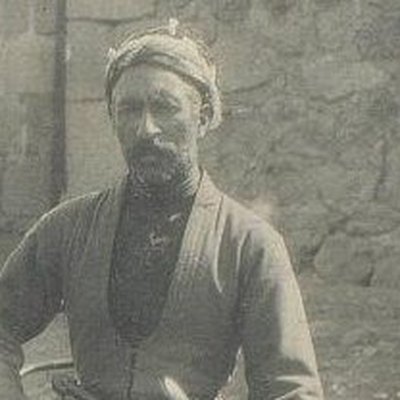
Military commander and leader of the Ezidis from the province of Van. During the genocide of the First World War he protected tens of thousands of refugees, led the Ezidi cavalry regiment in the decisive Battle of Bash Abaran (1918) and is regarded as one of the greatest national heroes of the Ezidis in the South Caucasus.
Origins and early years in the province of Van
Cangîr Ax’a was born in 1874 in the village of Çibuxlî in the Bergri district (north of Lake Van, in what is today eastern Turkey). He came from a respected family of leaders of the Ezidi Mendikî tribe (part of the Zuqurî tribal confederation). His father was the tribal chief Xetîb Axa (Khatib Agha).
At the end of the 19th and the beginning of the 20th century, the Ezidis of the Van region were increasingly exposed to raids, special taxes and persecution by Ottoman troops and by the Hamidiye regiments raised by the Sultan. After his father Xetîb Axa and his brothers had been killed in clashes with Ottoman units, Cangîr Ax’a took over the leadership of the tribe around 1909 and built up his own well-organised cavalry unit for the self-defence of the Ezidi villages.
First World War and protection of the refugees during the genocide (1914–1918)
When the Ottoman Empire entered the First World War (1914) and the systematic genocide of the Christian Armenians, Assyrians and the Ezidis began in 1915, Cangîr Ax’a refused to serve in the Ottoman army. Instead, with his Ezidi cavalry regiment – which at times numbered between 700 and 1,500 armed horsemen – he joined the advancing Russian Caucasus troops and the Armenian volunteer units.
During the flight from the regions of Van, Kars and Bayazid, Cangîr Ax’a and his horsemen provided military cover for the refugee columns:
- His cavalry secured the mountain passes and crossings towards Eastern Armenia against attacking regular and irregular troops.
- Thanks to this military escort, tens of thousands of Ezidis and Armenians reached the Russian Empire of the time alive.
The decisive Battle of Bash Abaran (May 1918)
After the Russian Revolution of 1917, the Russian troops withdrew from the Caucasus front. In spring 1918 the Ottoman army advanced deep into Eastern Armenia, where tens of thousands of Ezidi and Armenian survivors of the genocide were staying. A defeat would have meant the complete annihilation of the refugees in the Ararat valley.
From 23 to 29 May 1918 the decisive battle took place at Bash Abaran (today Aparan), north of Yerevan:
- Under the supreme command of the Armenian general Drastamat Kanayan (known as Dro), the large Ezidi cavalry regiment led by Cangîr Ax’a (together with the units of Ûsivê Beg) formed one of the most important striking forces at the front.
- Through the counter-attacks of the cavalry, the superior Ottoman division was driven back and the advance on Yerevan was stopped.
- The victory of Bash Abaran (parallel to the Battle of Sardarapat) not only secured the founding of the First Republic of Armenia on 28 May 1918, but also saved the surviving Ezidi community in the South Caucasus from a further Ferman.
Soviet era, Stalinist persecution and death (1920–1943)
After the Sovietisation of Armenia at the end of 1920, Cangîr Ax’a remained in Armenia with his family and his tribespeople and lived, among other places, in the village of Çobanker (as well as in Yerevan), where he continued to enjoy great respect as a figure of authority.
During the so-called “Great Terror” under Joseph Stalin, numerous former military commanders and traditional leaders came into the sights of the Soviet secret service NKVD at the end of the 1930s:
- On 18 March 1938 Cangîr Ax’a, then over 60 years old, was arrested by the NKVD. He was charged with fabricated political accusations (“anti-Soviet agitation”, “nationalism” and links to the government of the First Republic of Armenia).
- He was sentenced to a long prison term and deported to a prison camp in the Russian city of Saratov.
- There Cangîr Ax’a died in custody in 1943, at the age of about 69.
Rehabilitation, monuments and literary legacy
After Stalin’s death the case of Cangîr Ax’a was reopened: in 1959 the Supreme Court officially overturned the 1938 verdict and fully rehabilitated him for lack of any offence.
Today Cangîr Ax’a holds a place of honour in Ezidi and Armenian remembrance:
- Monuments: in the Armenian capital Yerevan (in the Nor Nork district) and at the Ezidi sanctuary Quba Mêrê Dîwanê in Aknalich, monuments and a large equestrian statue were erected in his honour. He is also commemorated in the Memorial Park of the Battle of Aparan.
- Music & epics: in traditional Ezidi music (Stranên Mêrxasiyê) numerous historical heroic songs about his courage were created, which were broadcast, among others, by Radio Yerevan throughout the Caucasus and the Middle East.
- Literature: his life and military service are the subject of several historical monographs and documentary novels (including the book about Cangîr Ax’a in our library and the historical novel Hewarî by H’eciyê Cindî).
Books in our library

More on EZDIKI.COM
More notable figures
Sources
- Richard G. Hovannisian: Armenia on the Road to Independence, 1918. University of California Press, 1967
- Garnik Asatrian & Victoria Arakelova: The Ethnic Minorities of Armenia. Jerewan 2002
- Memory of Nations: Zeitzeugenbericht seines Sohnes Surik Kalashyan
- Wikipedia (en): Jangir Agha
Compiled from the sources listed. We welcome additions and corrections via the contact page. Contact
Other spellings: Cangir Axa · Cangir Agha · Cangir Aga · Dschangir Axa · Dschangir Agha · Dschangir Aga · Jangir Axa · Jangir Aga · Cangîr Axa · Cahangir Axa · Cahangir Agha · Cahangir Aga · Dschahangir Axa
Found a mistake?
Is something wrong – a fact, a spelling, a source, an image? Let us know: we check every report and correct the article.