
The Ezidis believe in one God. But God does not act alone: he created seven angels and handed over to them the governance of the world; their head is Tawûsî Melek (Omarkhali 2023, pp. 23, 102). According to the faith, these holy beings also appear in human form – most clearly in Şêx Adî and the saints around him. In addition there are many other saints, patron saints and intercessors (Kreyenbroek/Rashow 2005, pp. 12–13; Pirbari 2016, p-040).
Kreyenbroek compares this group with the archangels, angels and saints in Christianity (Kreyenbroek/Rashow 2005, p. 13). What matters is: all holy beings are subordinate to God. Hesenê Şêx Kelaşê writes that they came into being through God's grace and are his servants (Hesenyan 1995, p. 4).
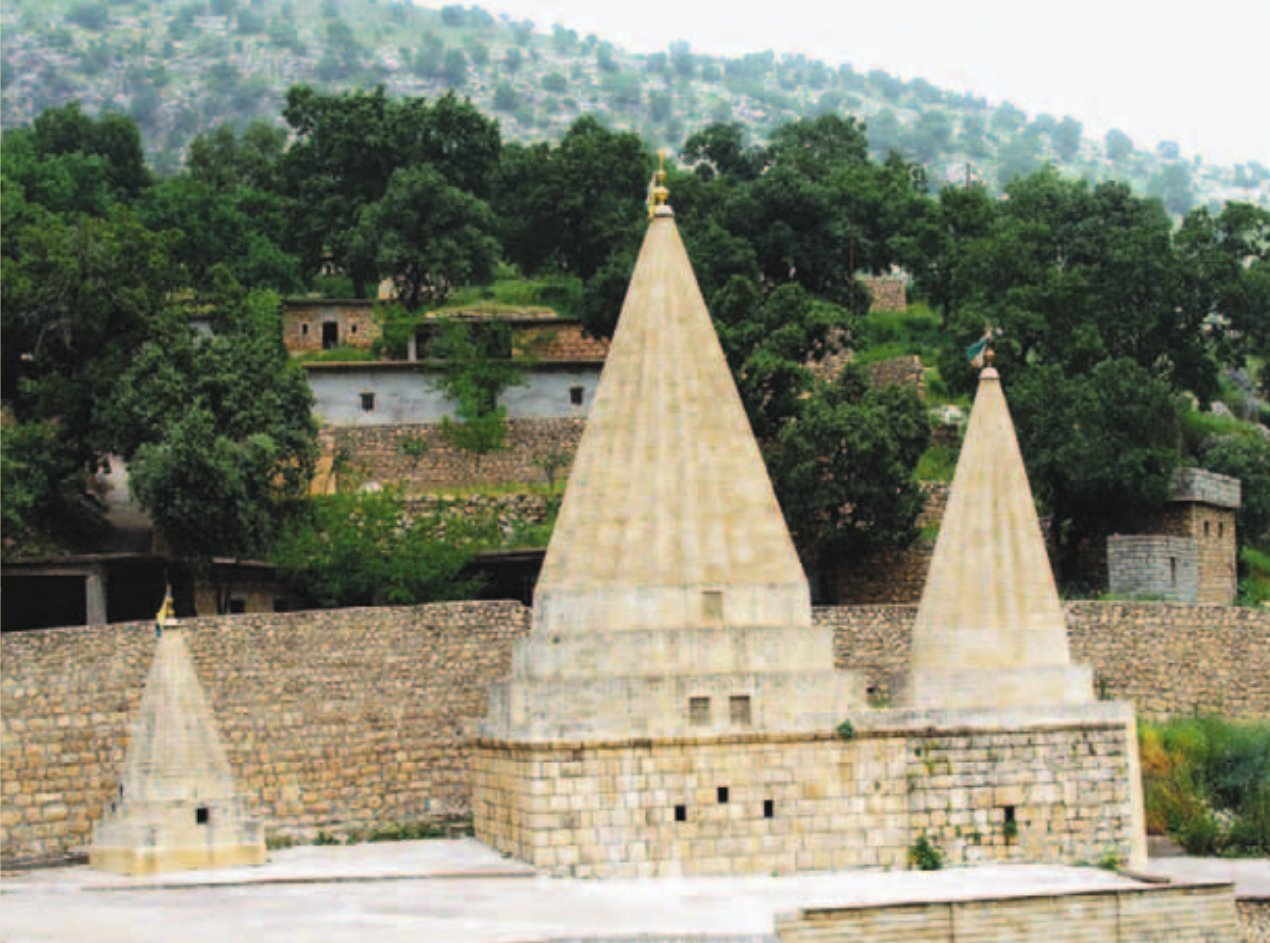
The holy beings at a glance
| Being | Who is it? | Article |
|---|---|---|
| Tawûsî Melek | the "Angel-Peacock", head of the seven angels | Tawûsî Melek |
| The seven angels | the "seven mysteries" to whom God handed over the world | The seven angels |
| Şêx Adî | the great figure of the 12th century; his tomb is in Lalîş | Şêx Adî |
| Siltan Êzîd | highest figure, namesake of the Ezidis | Siltan Êzîd |
| Şerfedîn | saint of Şengal and redeemer of the end times | Şerfedîn |
| Şêx Hesen (Şêx Sin) | ancestor of the Adanî, lord of the pen | Şêx Hesen |
| Şêxûbekir | ancestor of the Qatanî and of the Mîr, servant of the Xerqe | Şêxûbekir |
| Şêşims | saint of the sun | Şêşims |
| Fexredîn | saint of the moon, poet of the hymns | Fexredîn |
| Sicadîn and Nasirdîn | stand at the deathbed | Sicadîn and Nasirdîn |
| Xatûna Ferxa | protector of pregnant women and children | Xatûna Ferxa |
| Xidir Nebî and Xidir Elyas | fulfill wishes, protect lovers and travelers | Xidir Nebî and Xidir Elyas |
| Xas and Mêr | the many saints, patron saints and intercessors | Xas and Mêr |
Order of the holy beings
Kreyenbroek proposes three levels as a working hypothesis (Kreyenbroek/Rashow 2005, pp. 21–22):
- Highest beings: God, Tawûsî Melek, Şêx Adî and Siltan Êzî;
- holy beings such as the seven angels;
- beings in human form such as the saints.
The holy beings have little personality of their own in the hymns; verses that deal with God appear elsewhere about another being (p. 13). An inner essence (sur) can appear in different forms at different times (p. 21).
According to Pirbari, the seven angels form a hidden council (dîwana batinî), which appears on earth as the visible council of the seven saints: Şêx Adî, Şêxsin, Şêxûbekir, Fexredîn, Şêşims, Sicadîn and Nasirdîn (Pirbari 2016, p-052–053).
The trinity
Several sources speak of a holy trinity of Tawûsî Melek, Şêx Adî and Siltan Êzîd. A Qewl says that the three are one (Grigoriev et al. 2008, p. 6; Pirbari 2016, p-052).
Differing traditions
Are the highest beings manifestations of God? - Pirbari: Yes – God shows himself as Siltan Êzîd, as Şêx Adî and as Tawûsî Melek (Pirbari 2016, p-052). - Lalîş photo book: In Şêx Adî the Ezidis saw Tawûsî Melek in human form (Grigoriev et al. 2008, p. 6). - Şêx Mak’sîm: No – Tawûsî Melek, Şîxadî, Siltan Êzîd and Melek Şemsedîn are archangels created by God and bow before him. The statement that the three are "one" does not mean one being in three forms (Şêx Mak’sîm 2017, PDF pp. 114–129).
Angels and archangels - Pirbari calls angels higher beings whom God created from light (Pirbari 2016, p-246). - Şêx Mak’sîm distinguishes Melek (archangels, directly from God) and Milyak’et (angels, brought forth by the archangels) (Şêx Mak’sîm 2017, PDF pp. 40–41).
See also
Sources
- Philip G. Kreyenbroek, Khalil Jindy Rashow: God and Sheikh Adi Are Perfect. Sacred Poems and Religious Narratives from the Yezidi Tradition. Wiesbaden: Harrassowitz 2005, p. pp. 12–13, 21–22
- Khanna Omarkhali: The religious textual tradition of the Ezidis – from the oral to the written. Saint Petersburg 2023 (Russian translation of the English original, Wiesbaden 2017), p. 23, 102
- Dimitri Pirbari (P’îr Dîma), A. Ščedrovickij: Тайна жемчужины (The secret of the pearl). Moscow/Tbilisi 2016, p. p-040, p-052–053, p-246
- S. A. Grigoriev, L. V. Ivasko, D. V. Pirbari (P’îr Dîma): Lalişa Nûranî / Святой Лалыш / Holy Lalish. Yekaterinburg: Basko 2008, p. pp. 6, 44
- Şêx Mak’sîm (Maksim Ezdi): Grundpfeiler der Religion ScherfeDin, 2017 (on EZDIKI.COM in the Religion section and in the library), p. PDF pp. 40–41, 114–129
- Һ'әсәне Шех К'әләше (Hesenê Şêx Kelaşê, Hesen Hesenyan): Р'е-р'ьзма мьләте Эзди ангори qьраре дин (Rê-rizma mileta Êzdî angorî qirarê dîn). Şamîran 1995 (scan and new text edition in the EZDIKI.COM library), p. p. 4
Found a mistake?
Is something wrong – a fact, a spelling, a source, an image? Let us know: we check every report and correct the article.
Other spellings: Heilig Wesen · Chas · Khas · Mer · Tawuse Melek · Melek Taus · Taus-i Melek · Malak Tawus · Sheikh Adi · Scheich Adi · Shaikh Adi · Şêxadî · Shikhadi · Sheikh · Scheich · Shex · Lalish · Lalisch · Lalesh · Sultan Êzîd