
For centuries the tradition of the Ezidis was oral: history, songs, rules and also sacred poetry were passed on through listening, learning by heart and repetition. Only since the 1970s has this tradition been written down and printed on a larger scale. Khanna Omarkhali examined this transition in her book “The Yezidi Religious Textual Tradition: From Oral to Written” (English 2017, Russian 2023). This article describes only the cultural process – the contents of the sacred texts belong to the section Religion.
Writing in earlier times
One often reads that the Ezidis did not write at all, or that reading and writing were forbidden to all except a single Şêx clan. Omarkhali considers this claim doubtful:
- In the P’îr families, old manuscripts (mişûr) are kept, mostly in Arabic script. They are venerated as sacred objects, not used as texts for reading.
- According to Pirbari, many families of clergy in Iraq had records in Arabic script. The family of the Pêşîmam from the lineage of Şêxsin was regarded as the guardian of the knowledge of writing; its Şêx could read and write Arabic.
- Experts kept handwritten notebooks for their own use (keşkûl, defter, kitêb; in Armenia rather “Kitêba Qewla û Beyta”). They were not intended for circulation.
- In Armenia and Georgia, such texts were traditionally written in red ink; blue ink was avoided. A notebook of 151 pages compiled by a P’îr in Armenia around 1974 is written almost entirely in red.
According to Pirbari, texts that had already been written down earlier were again passed on only orally because of the persecutions. Some Ezidis still believe today that what is written down will be forgotten by the community.
Observations by Layard (1846) and Drower (1940)
- 1846: According to A. H. Layard, even the religious head Şêx Nasir did not know the alphabet; only one or two Ezidis could read. A letter from Şêx Nasir to Şengal was written by his secretary (nineveh1 p. 305, 307; see Baba Şêx Nasir). Layard states that reading and writing were considered forbidden and that a holy book was kept in Bahzanê or Başîqa (p. 305) – this is information he received, not his own observation.
- 1940: According to E. S. Drower, reading and writing had formerly been the business of the Şêx, especially of the line of Şêx Hesen (peacock p. 15, 197). 18 years before her visit, practically no Ezidi boy had gone to school; in 1940 many boys in Başîqa attended the state school, some also secondary schools, in Şengal there was already an Ezidi teacher, and in Êsiyan, too, the number of Ezidi pupils was increasing (p. 2–3, 14, 140).
- This information fits Omarkhali’s assessment that knowledge of writing was limited to a few families, but not entirely absent (above).
Languages of the transmitted texts
According to Majid Hassan Ali (2021), of about 175 transmitted sacred texts about 160 are recited in Êzdîkî and about 15 in Persian, Turkish or Arabic (kurds-yezidis-me p. 47; examples in the article Avoided words, names and dialects).
Reading and writing in the 20th century
Outside Armenia, according to Omarkhali, literacy spread among the Ezidis only from about the middle of the 20th century, at least among men. In the Soviet Union, by contrast, most Ezidis could read and write Êzdîkî as well as Russian and Armenian (see Schools and alphabets in Armenia). Nevertheless, the sacred tradition remained oral there. Many Ezidis of the Soviet Union grew up trilingual.
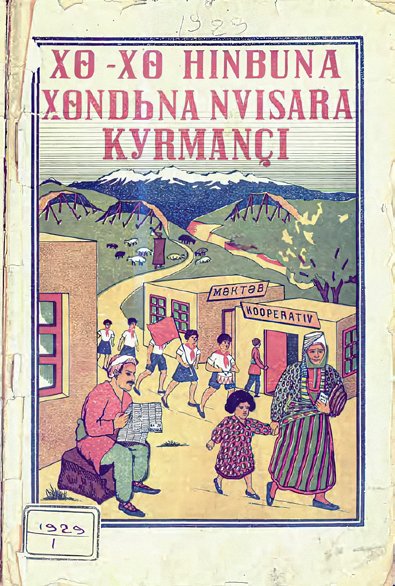
Êzdîkî is written in Arabic-Persian, Latin and Cyrillic script, formerly also in Armenian script (see Êzdîkî alphabet).
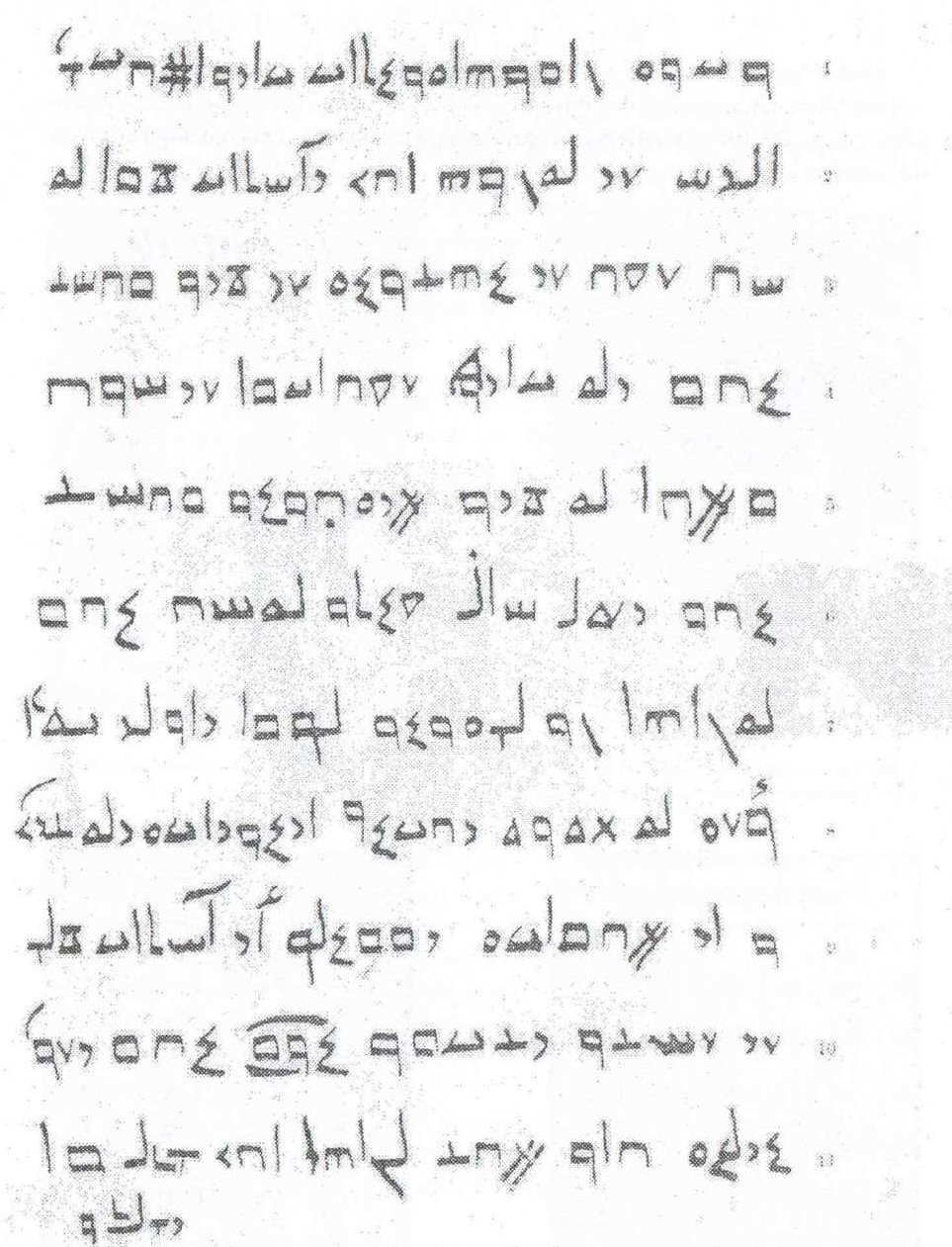
The so-called Ezidi secret script
In standard works on the history of writing (D. Diringer, Č. Loukotka, V. A. Istrin), a distinct “Ezidi script” is listed. Dimitri Pirbari and Kerim Amoev (Tbilisi 2013) summarize the state of research as follows:
- Origin: Loukotka and Istrin derive the characters from the Syriac-Nestorian script. Pirbari and Amoev, by contrast, follow G. Furlani and Diringer: the sound values correspond to the Perso-Arabic script, while the character forms (straight lines, small squares, triangles, angles) were deliberately newly designed.
- Features: 33 (with variants 35) consonant characters in the order of the Perso-Arabic alphabet, written from right to left, mostly unconnected, without vowel signs.
- Use: The script did not spread. Presumably only a small circle of clergy used it, which later went over to the Arabic script. Some attribute its invention to Şêx Hesen (Şêxsin); the Pêşîmam family from his line was regarded as the guardian of the script (see above). This is tradition.
The texts in Bittner and the question of their authenticity
The two texts that the orientalist Maximilian Bittner published in Vienna in 1911/1913 and that are known as “Cilwe” and “Mishefa Reş” are written in this script. Their authenticity is disputed: Alphonse Mingana and Roger Lescot considered them forgeries, Giuseppe Furlani did not; the highest clergy in Lalîş do not recognize them, and P’îr Xidir Silêman also doubts their authenticity. Pirbari and Amoev consider them a distorted abridgement of lost genuine books. On the origin of the manuscripts in the 19th century see History of the sources on the Ezidis; their content belongs to the section Religion.
Revival and reform proposal
- In Iraq, according to Pirbari and Amoev, narrow circles around an Ezidi party have been using the old script again since about 2003, so far without fixed rules.
- In 2013, Pirbari and Amoev proposed a “renewed Ezidi alphabet” with 37 letters, including eight vowel signs, based on the characters in Bittner and with new characters with diacritical dots. This was to allow the transmitted texts to be rendered in this script as well, alongside the Latin one; a primer was announced. Whether the proposal was adopted is not known.
The authors understand the script as an expression of Ezidi self-confidence; this is their concern.
The first collections (1978–1979)
In 1978 and 1979, four Ezidi scholars published three large collections:
- the brothers Ordîxanê and Celîlê Celîl in the Soviet Union (Moscow and Yerevan 1978; see Celîl family and Collection of folk poetry),
- P’îr Xidir Silêman and Şêx Xelîl Cindî Rashow in Iraq (Baghdad 1979).
The editors belonged to all three estates: the Celîl brothers are Mirîd, Xidir Silêman is P’îr, Xelîl Cindî Şêx. The Celîl volumes contain 57 sacred texts, the Baghdad edition 22; it was reissued in Latin script in 1995. In scholarship these books long remained almost unknown.
Resistance and approval
When the texts were recorded in the 1970s, many clergy in Iraq as in Armenia reacted negatively. According to Omarkhali, it was mainly Şêx who recited the texts for the Celîl volumes; the P’îr mostly refused. In Iraq the experts at first gave nothing to Xidir Silêman and Xelîl Cindî – until the then Baba Şêx granted permission and took the responsibility upon himself. Editors and informants were at first condemned in the community. Most lay people and the educated, by contrast, supported the books and bought them; after five years they were in many homes.
Journals and further editions
| Year | Event |
|---|---|
| 1942 | The journal Hawar (Damascus) prints individual texts. |
| 1985 | P’îr Xidir Silêman publishes “Gundiyatî” (“Village traditions”), Baghdad. |
| 1993 | First issue of the journal Laliş in northern Iraq; it is supported by local Ezidis and plays a key role in the writing down of the Iraqi tradition. |
| May 12, 1993 | Founding of the center Bingehê Laliş (“Lalîş Center”) in Duhok; in 2012 it has about 30 branches in northern Iraq and in Şengal. |
| 1996–2002 | Journal Roj in Germany. |
| 2002 | Badalê Feqîr Hecî publishes a collection; he had been recording the texts of his father Feqîr Hecî since the end of the 1960s. |
| 2004 | Largest collection: Xelîl Cindî Rashow, two volumes, Duhok (Arabic-Persian script). |
| from 2000 | Texts appear on websites, mostly from the diaspora; recitations on radio and television. |
Cassettes with recitations had existed in the homes of experts since the 1970s. Since about 2008, young people in Iraq have been listening to recordings on mobile phones and exchanging them among themselves. Publications on the internet were at first criticized as desecration around 2004; today the rejection is limited to a small group.
Instruction in schools
Formerly one learned only in the family or from a master (see Qewal and their training). In Iraq, instruction in schools was added:
- 1940–1963: At some schools there were classes in which experts taught without a fixed curriculum.
- 1963–1996: Interruption.
- 1994–1996: P’îr Xidir Silêman wrote the first basic course for grades 1–6 (84 pages, Latin script, 6,000 copies; 1996 in Arabic script, Duhok; reprint Baghdad 2004). In 2005, volumes for the middle and upper levels followed.
- 1998–1999: Instruction at 17 schools, among them in Xanke, Şarya, Ba’dre, Dasin and Pêşabûr.
- Today: Instruction from grade 1 to 12 with examinations in the schools of the Ezidi areas. The teachers are mostly not traditional experts; there is further training, among other places, in Xanke, Şarya, Ba’dre and Derabûn.
The textbooks arrange the material, select one version as authoritative and contain small glossaries. Teaching is in the mother tongue. Omarkhali sees the difference as follows: the old teaching trained a few experts, the school wants to give all children basic knowledge.
In Germany, there are Sunday schools in some Ezidi centers (Mala Êzdiyan). In May 2011 a meeting on instruction in schools took place at the Ministry of Education of Lower Saxony; in 2009 a textbook by E. Akbaş appeared in Bremen. There were also attempts in Armenia and Georgia.
Consequences
Omarkhali describes several consequences of the writing down:
- Language cultivation: In new editions, Arabic words are often replaced by words of Êzdîkî.
- Learning from books: After the end of the Soviet Union, many young Ezidis learned from the printed collections. A young P’îr in Zartonk (formerly Kamışlu, Armenia) learned an almost forgotten text from the Celîl volume and the melody from a cassette of his grandfather. But whoever learns only from books also adopts misprints and learns neither the melody nor the explanation.
- Memory: Experts who write things down complain that they are forgetting their repertoire.
- Standardization: Local versions are becoming alike; for some, a printed version counts as the only “correct” one.
- Language loss: Fewer and fewer young Ezidis have a good command of their mother tongue, especially in the diaspora. This makes transmission more difficult.
Omarkhali expects the diaspora to take on a leading role in the future; this is her assessment.
Sources
- Khanna Omarkhali: The religious textual tradition of the Ezidis – from the oral to the written. Saint Petersburg 2023 (Russian translation of the English original, Wiesbaden 2017), p. 10–11, 18, 20, 43–44, 59–61, 65–68, 228–245, 493–495, 528
- Dimitri Pirbari (P’îr Dîma), A. Ščedrovickij: Тайна жемчужины (The secret of the pearl). Moscow/Tbilisi 2016, p. p-015, p-024, p-026
- Khanna Omarkhali (Ханна Омархали): Йезидизм. Из глубины тысячелетий (From the depths of the millennia). Saint Petersburg 2005, p. 23
- Dimitri Pirbari, Kerim Amoev: Езидская письменность (The Ezidi script). Tbilisi: Nekeri 2013, p. p-006–p-027, p-030 (ill.)
- International Journal of Yezidi Studies, Vol. 2. Tbilisi 2025, p. 85 (ill.)
- Austen Henry Layard: Nineveh and Its Remains, Vol. 1. London 1849, p. p. 305, 307
- E. S. Drower: Peacock Angel. Being some Account of Votaries of a Secret Cult and their Sanctuaries. London 1941, p. p. 2–3, 14–15, 140, 197
- Güneş Murat Tezcür (ed.): Kurds and Yezidis in the Middle East. Shifting Identities, Borders, and the Experience of Minority Communities. London: I.B. Tauris 2021, p. Ali p. 47
Found a mistake?
Is something wrong – a fact, a spelling, a source, an image? Let us know: we check every report and correct the article.
Other spellings: Versdschhriftlidschhung · Versjhriftlijhung · Mündlidschhe Überlieferung · Mündlijhe Überlieferung · Mündlich Überlieferung · Mündlidschh Überlieferung · Bingehe Lalis · Bingehe Lalisch · Bingehe Lalish · Bingeh Lalis · Zeitschrift Lalis · Zeitsdschhrift Lalisch · Zeitsjhrift Lalish · Zeitsdschhrift Roj · Zeitsjhrift Roj · Sheikh · Scheich · Shex · Pîr · Qewl