
For the Ezidis clothing is not just costume. Some items of clothing are holy: they stand for the faith, for spiritual authority or for belonging to the people. The most important is the black Xerqe of the Feqîr. In addition there are the white shirt with the round neck opening (Toq), the holy belts and the head covering.
Everyday and festive dress is described in the section People & Culture: Traditional clothing and Colors and clothing rules.
The Xerqe
What it is
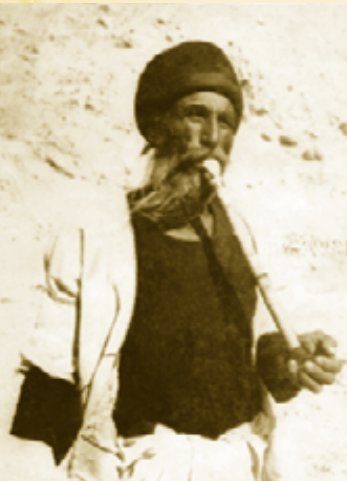
The Xerqe (also Xirqe) is the black, hairy woolen garment of the Feqîr. It is worn directly on the skin (Drower, p. 179). The Pirbari glossary calls it the "penitential garment of the saints" and one of the holiest signs of the religion (p. 258). Any violence against a Feqîr in the Xerqe is a grave sin (Kreyenbroek, p. 8).
Origin in the faith
The sources place the Xerqe at the beginning of the world:
- Şêx Mak’sîm: from a part of the original universe God created the first sacred object without a soul, the Xerqe Nûranî ("the Xerqe created from God's radiance"). It became the first testimony that God is the creator of everything. Afterwards it passed to the angel Şîxadî (short form of Şêx Adî), who thus became the head of the seven angels (pp. 12–13). Earth and heaven, he says, were "certified" by the Xerqe; the earthly Xerqe is made in Lalîş and has the same task "in human measure" (pp. 145–146).
- Kreyenbroek: in the hymns the Xerqe stands for spiritual authority, which already existed at the creation, came to Şêx Adî and was passed on to the Feqîr (p. 8).
- Feqîr Hecî from Baedrê (2008, according to Omarkhali): God said to Melek Fexredîn that he was going to heaven and would send them the Qewls and the Xerqe; knowledge and Xerqe came together from heaven (Omarkhali-prelim, pp. 150–151).
- Pirbari: in the Qewls the Xerqe appears as an archetype, arisen from love before heavens and times (pp. 72–73). The spring Kaniya Sipî, he says, is a "lock" whose key is the Xerqe (p. 78). According to tradition, Îdrîsê Xeyat, the prophet who was the first to sew clothes, was the first after Adam to sew the Xerqe (glossary, p. 250).
A saying quoted by Şêx Mak’sîm sums up its position: "Baweriya me Ulim, şe’de me Xerqe" – "Our faith is the sacred knowledge, our testimony is the Xerqe" (p. 203).
The Xerqe in ritual
- At the ritual Destdanîn, in which an Ezidi binds himself to his spiritual reference persons, a Xerqe is necessary according to Şêx Mak’sîm to "seal" the ritual; it lies in a cover during it (pp. 62, 65, 146).
- In a dispute, according to Lalişa Nûranî, the opponents handed each other the earth ball Berat over the Xerqe of a Feqîr (p. 204).
- In the presence of a Feqîr every quarrel must end immediately; even a Xerqe hung up ends fights (Feqîr Reşo according to Drower, p. 180).
Derba Xerqe
One of the three basic rules (sê herf) is called Derba Xerqe, "blow on the Xerqe". Whoever does violence to a Feqîr with Xerqe, to his own Şêx or P’îr, or rises up against them, leaves the religion (Lalişa Nûranî, pp. 12–13; Kreyenbroek, p. 18). Şêx Mak’sîm interprets Derba Xerqe more generally as the commandment to show respect to the servants of Şerfedîn (pp. 59–60). See Prohibitions and taboos.
How it is made
In the courtyard Gaykuj of Lalîş lies the Kela Xerqe: there branches of the Zergûz tree, a barren kind of walnut tree, are boiled and woolen yarn is dyed black in the brew; from it the Xerqe is knitted (Lalişa Nûranî, p. 30; Engl. p. 35). The English version says it is boiled for two days and dyed black or dark brown (p. 35). The wool comes from the sheep, which is therefore regarded as a special animal (Kreyenbroek, p. 8).
What belongs to the Xerqe
According to Lalişa Nûranî, the Xerqe lies on a red belt with copper rings; the Feqîr wear the neck thread Meftûl and on their heads the Kulik (pp. 204–205). Feqîr Reşo described this in more detail in 1940 (Drower, pp. 179–180):
- black woolen shirt of lamb's wool, reaching to the hips, slit at the sides, with a round neck opening sewn with red wool;
- red woven belt (Şûtik), almost twice around the body;
- neck thread Meftûl of red and black wool, which is never taken off;
- turban and black felt cap (Kulik); nothing white.
Açıkyıldız calls the neck cord mehek or meftûl and the belt qemberbest (p. 108). According to Şêx Mak’sîm, by contrast, the first Feqîr wore white clothing and over it an "earthly form of the Xerqe", whose cover was not allowed to hang below the navel (p. 96).
Who can become a Feqîr and what duties he has is explained in the article Feqîr.
Tac û hil – the garment of Şîxadî
A special garment is kept in Lalîş, Tac û hil – according to the English version of Lalişa Nûranî, a woolen cap and a hair shirt of Şîxadî. At the Sema a Feqîr puts it on in the sanctuary and leads the round dance. At the end all present kiss this garment (pp. 26–28/29–31). See Cejna Cimaiyê.
The white shirt and the Toq
Every Ezidi traditionally wore a white shirt (kiras) with a round neck opening, the Toq (Toqa Êzîd, also tok, gerîvan). Instead of the shirt one can wear a braided cord of sheep's wool around the neck (Omarkhali 2005, pp. 66–67).
- Holy: Kreyenbroek calls the shirt kirasê/girivan a holy shirt. Kissing its collar was regarded as an essential part of religious practice (p. 15).
- Prayer: there is a prayer of its own for the Toq, the Du’a Tokê; in it the Toqa Êzîd is regarded as a sign of belonging (Omarkhali-prelim, pp. 175–177).
- Teaching today: in the school textbook tok and berat are taught as "symbolic clothing" (Omarkhali 2023, p. 237).
- Sacrilege: tearing the Toq was regarded as a grave sacrilege (Edmonds, p-058).
- Image of death: the transmigration of souls is called kirasgorîn, "change of shirt"; of a deceased person the Ezidis in Iraq say kiras gorî, "he has changed the shirt" (Omarkhali 2023, p. 21).
Forms of the neck opening and the differences between the regions: Colors and clothing rules.
Belts: Rist and Şûtik
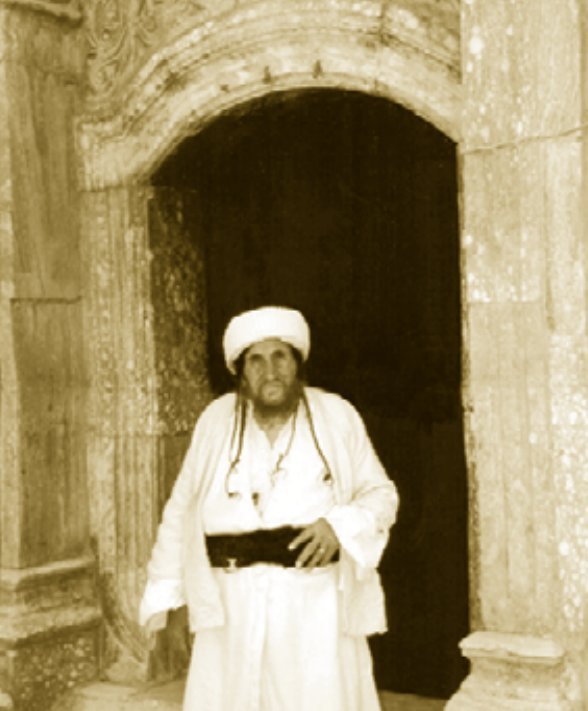
According to Kreyenbroek, high dignitaries – Baba Şêx, Baba Gavan, Baba Çawîş, the Koçek – wear the black belt Rist, other traditional Ezidis the Şûtik. One ties it on in the morning with a prayer (p. 15). The Babê Şêx wears white and the Rist, which is wound seven times around the body and bears holy copper rings (Lalişa Nûranî, p. 204). The Bavê Çawîş, too, wears white clothing with the Rist (p. 204).

The head covering
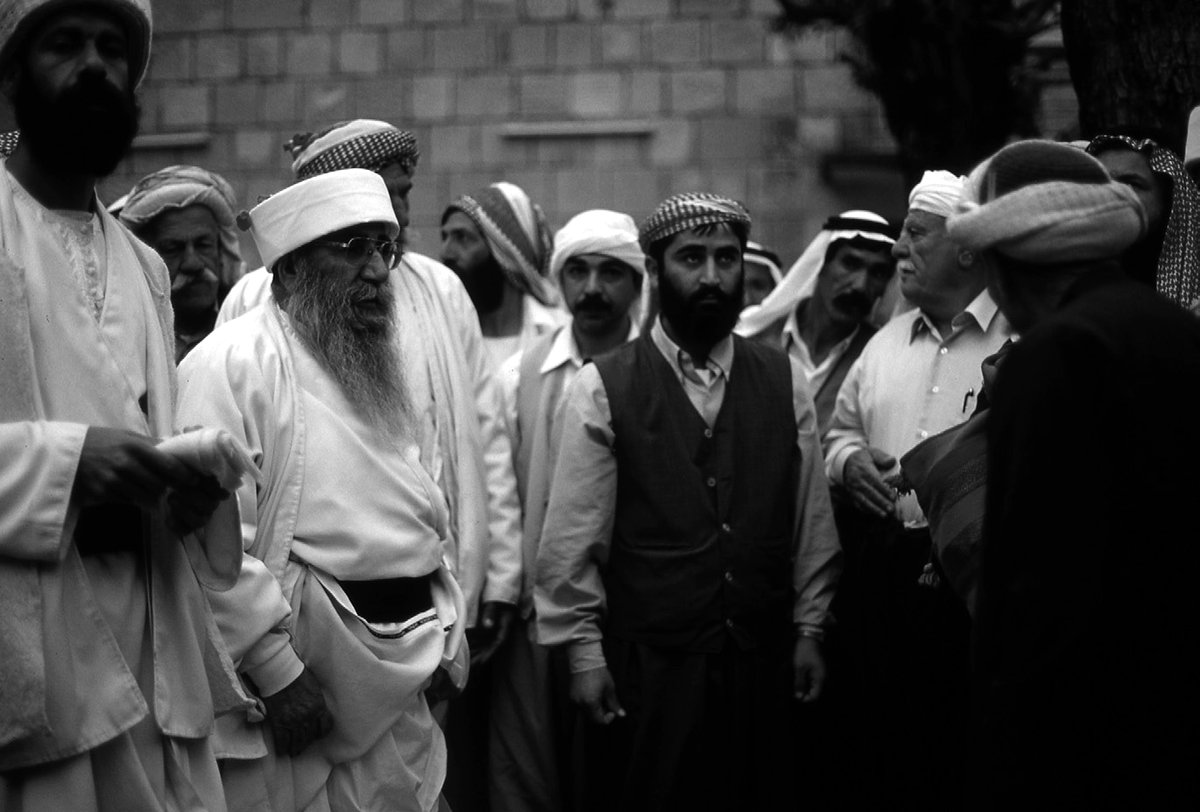
- According to Omarkhali, the Kulik is an indispensable part of the dress of the clergy (2005, p. 137). The Mîr always wears a Kulik of black or white wool, which only a Feqîr, a Feqra or the Baba Çawîş may wash (Açıkyıldız, p. 105).
- According to Kreyenbroek, the head covering stands in the texts for holy power (pp. 36–39). One does not enter a sanctuary bareheaded (Lalişa Nûranî, pp. 20/25).
- The Şêx wash their turban cloths themselves (Edmonds, p-059).
White for the clergy
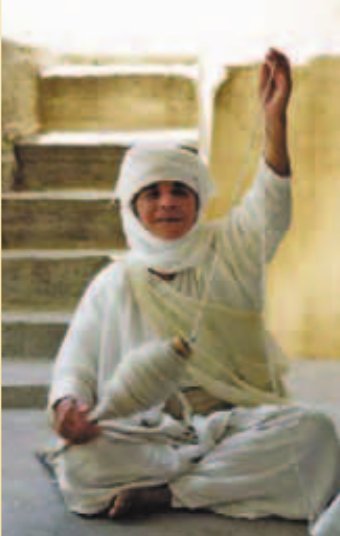
Clergy usually dress in white; holy objects in the house are wrapped in white cloth (Omarkhali 2005, p. 65). White is worn by the Babê Şêx, the Bavê Çawîş, the Koçek and the women in the service of Lalîş (Lalişa Nûranî, pp. 204–205). The exception are the Feqîr with their black Xerqe. On the meaning of the colors: Colors and the prohibition of blue.
The white shroud of the dead (kefen) is described in the article Burial and mourning.
Sources
- Şêx Mak’sîm (Maksim Ezdi): Grundpfeiler der Religion ScherfeDin, 2017 (on EZDIKI.COM in the Religion section and in the library), p. pp. 12–13, 52–55, 59–62, 95–96, 145–146, 203
- Philip G. Kreyenbroek, Khalil Jindy Rashow: God and Sheikh Adi Are Perfect. Sacred Poems and Religious Narratives from the Yezidi Tradition. Wiesbaden: Harrassowitz 2005, p. pp. 8, 15, 18, 36–39
- S. A. Grigoriev, L. V. Ivasko, D. V. Pirbari (P’îr Dîma): Lalişa Nûranî / Святой Лалыш / Holy Lalish. Yekaterinburg: Basko 2008, p. pp. 12–13, 17, 20, 25–31, 34–35, 158, 204–205
- Dimitri Pirbari (P’îr Dîma), A. Ščedrovickij: Тайна жемчужины (The secret of the pearl). Moscow/Tbilisi 2016, p. pp. 72–73, 78, 250, 258 (glossary)
- Khanna Omarkhali: The religious textual tradition of the Ezidis – from the oral to the written. Saint Petersburg 2023 (Russian translation of the English original, Wiesbaden 2017), p. pp. 15 (n. 15), 21, 125, 237, 520
- Khanna Omarkhali: Yezidi Religious Oral Poetic Literature: Status, Formal Characteristics, and Genre Analysis. With some examples of Yezidi religious texts. In: Scrinium VII–VIII.2 (2011–2012): Ars Christiana, Leiden: Brill, pp. 144–195, p. pp. 150–151, 175–177
- E. S. Drower: Peacock Angel. Being some Account of Votaries of a Secret Cult and their Sanctuaries. London 1941, p. pp. 179–180
- Khanna Omarkhali (Ханна Омархали): Йезидизм. Из глубины тысячелетий (From the depths of the millennia). Saint Petersburg 2005, p. pp. 65–67, 137
- Birgül Açıkyıldız: The Yezidis. The History of a Community, Culture and Religion. London 2010, p. pp. 105 (text and ill.), 108
- C. J. Edmonds: A Pilgrimage to Lalish. London (Royal Asiatic Society) 1967, p. p-058–059
Found a mistake?
Is something wrong – a fact, a spelling, a source, an image? Let us know: we check every report and correct the article.
Other spellings: Cherqe · Kherqe · Chirqe · Xerqe Nurani · Cherqe Nurani · Kherqe Nurani · Xerq Nurani · Toqa Ezid · Gerivan · Grivan · Meftul · Sutik · Schutik · Shutik · Tac u hil · Tadsch u hil · Khirqa · Faqir · Fakir · Sinjar