
Leader of the civil rights movement of 1988/1989, chairman of the National Union of Ezidis and champion of the official recognition of the people and their language
Chairman of the National Union of Ezidis of Armenia (1989–2021) and of the World Union of Ezidis. In the late 1980s he led the civil rights movement that ended Soviet forced categorisation and won the official re-recognition of the Ezidis as a distinct people with their own language (Êzdîkî).
Origins and historical background: Soviet forced categorisation
E’zîz T’amoyan was born on 1 July 1933 in the village of Zovuni in Armenia. Like almost all Ezidi families in the Armenian SSR, his ancestors came from the Ottoman Empire and had escaped persecution and forced Islamisation to Eastern Armenia during the genocide of the First World War (1915–1918).
His youth and adult life were shaped by the consequences of Soviet nationalities and religious policy:
- In the first all-Union census of 1926, the Ezidis were still officially recorded as a distinct ethnic group.
- However, since the Ezidi faith forms an inseparable unity of descent and religion (an ethnoreligion), a distinct Ezidi identity contradicted the strictly atheist state doctrine under Joseph Stalin.
- From the census of 1937/1939 the Soviet authorities struck the category “Ezidis” from the state registers. All Ezidis were entered across the board as “Kurds” in their internal passports, birth certificates and official documents against their own will, and the people’s own name could no longer be used in schools or state publishing houses either.
The civil rights movement of 1988/1989 and the founding of the National Union
When at the end of the 1980s Mikhail Gorbachev’s policy of perestroika and glasnost allowed public assemblies and free expression for the first time, a broad civil rights movement formed in Armenia from the heart of the Ezidi villages and communities.
E’zîz T’amoyan took the lead of this movement and gave the community’s long-suppressed wish an organised political voice:
- Peaceful protests in Yerevan (1988–1989): from 1988 T’amoyan mobilised hundreds of community members for peaceful rallies in the capital Yerevan and addressed official petitions to the leadership of the Armenian SSR and to the authorities in Moscow. The central demand was to lift the outside designation imposed since 1937 and to recognise the Ezidis officially again as a people of their own (Miletê Êzdî) with their own mother tongue (Êzdîkî).
- Founding of the National Union (30 September 1989): in order to represent the community’s rights permanently, E’zîz T’amoyan and his companions founded the National Union of Ezidis of Armenia. On 30 September 1989 he was elected its chairman at the founding congress – an office he held for over three decades until his death in 2021 (later also as chairman of the World Union of Ezidis).
Official re-recognition in 1989 and legal anchoring
Thanks to the sustained support of the Ezidi population and the negotiations led by T’amoyan, the state leadership gave way: in 1989 the Presidium of the Supreme Soviet of the Armenian SSR officially recognised the Ezidis again as a distinct ethnic minority.
After the collapse of the Soviet Union and the independence of the Republic of Armenia (1991), this success was permanently anchored in national and international law:
- A category of their own in the censuses: in all official censuses of the Republic of Armenia (2001, 2011 and 2022) the Ezidis are again recorded separately as an ethnic group of their own and form the country’s largest national minority.
- Recognition of the Êzdîkî language: the mother tongue Êzdîkî is recognised by the state in Armenia and is protected by the Council of Europe’s European Charter for Regional or Minority Languages. Since then, Ezidi children in the schools of Armenia’s Ezidi villages have again received textbooks that officially bear the name of their own language and identity.
Commitment to culture, education and international solidarity
Beyond legal re-recognition, E’zîz T’amoyan devoted his work to preserving religious traditions, media presence and the cohesion of Ezidis across national borders:
- Cultural and educational work: he supported the publication of Ezidi newspapers (among them Dengê Êzdiya / Голос езидов), the preservation of mother-tongue radio broadcasts in Yerevan and the development of new textbooks in the Cyrillic alphabet which, for the first time since the 1930s, openly dealt with Ezidi history and religion.
- Solidarity in times of crisis: in the early 1990s he organised support for Ezidi volunteer units in the defence of Armenia (including members of families from which young heroes such as K’eremê Sloyan later came). After the genocide by the so-called “Islamic State” (IS) in Şingal from 3 August 2014, he mobilised international appeals and humanitarian aid for the survivors in Iraq and supported the building of new Ezidi sanctuaries in Armenia.
Death and lasting legacy
E’zîz T’amoyan died on 2 January 2021 in Vagharshapat (Etchmiadzin) at the age of 87. He was buried amid great sympathy from the Ezidi community, Ezidi clergy (Şêx and P’îr) and state representatives.
In the recent history of the Ezidis in the post-Soviet space, E’zîz T’amoyan is regarded as the decisive figure who prevented the distinct identity of the Ezidis from being absorbed into the administrative categories of the Soviet era, and who laid the foundation for today’s generations to bear their people’s name and their language Êzdîkî freely and officially again.
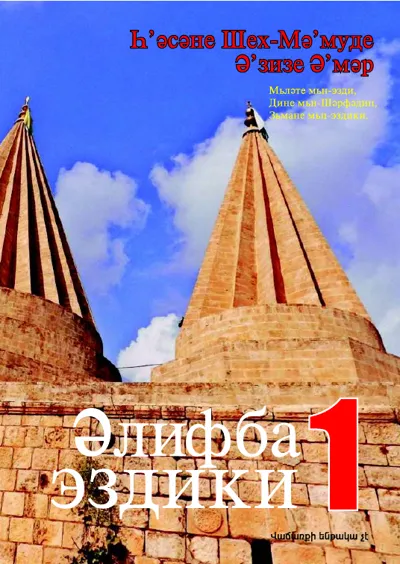
His books in our library

Sources
- Armradio: Head of the National Union of Yezidis Aziz Tamoyan dies (2021)
- Onnik Krikorian: Yezidi identity battle (Antrag 1988)
- EVN Report: Yet beyond the mountains there was war (rund 500 Eziden im ersten Karabach-Krieg)
- Zartonk Media: Armenia’s Yezidi leader (Einheit „Jhangir Aghai“), 2020
- Wikipedia: Khdr Hajoyan (Schulbücher, Zeitung Yezdikhana)
- Public Radio of Armenia: Yezidi National Union to elect new chairman (2021)
- Wikipedia: Aziz Tamoyan
- Hetq.am: Yezidi identity in Armenia (1989 census)
Other spellings: Eziz Tamoyan · Jerewan · Eriwan · Erivan · Ezidiki · Ezdeki · Şengal · Sinjar · Sindschar · Shingal · Shengal · Sheikh · Scheich · Shex · Pîr
Found a mistake?
Is something wrong – a fact, a spelling, a source, an image? Let us know: we check every report and correct the article.