
Resistance to recruitment (1890)
In 1890 the Ezidis rose up against the conscription of their young men into the Ottoman army. After two unsuccessful attacks, the authorities for the time being refrained from recruiting Ezidis.
Ömer Vehbi Pasha and Lalîş (1892)
In 1892 the Ottoman general Ömer Vehbi Pasha gave the Ezidis of Şêxan an ultimatum: they were to accept Islam and pay taxes. The Ezidi Mîr refused. Thereupon the army laid waste the Ezidi settlements and plundered Lalîş. The sacred objects were taken to Mosul, and the sanctuary of Şêx Adî was turned into a school for twelve years. After protests by the envoys of European states, Ömer Vehbi was recalled to Istanbul in 1893.
Additions according to Guest: the years 1885–1893
John S. Guest (1987) describes the persecution under Sultan Abdülhamid II in detail according to British, French and American reports.
Conscription and pressure to convert (1885–1891)
- Until 1885 Ezidis could buy themselves out of military service for 50 Turkish pounds per recruit. In 1885 the government decided to conscript them like Muslims and nevertheless to continue demanding the exemption fee.
- In November 1890 the Briton Wallis Budge learned of acts of violence by a special detachment under Ayub Bey in Şengal, which was also to force the Ezidis to convert to Islam.
- In the spring of 1891 a commission from Istanbul declared that the Ezidis had originally been Muslims. Mîr Mîrza Beg and the Şêx replied that their religion was thousands of years older than Islam.
- In July 1891 the Mîr, his brother Elî Beg, the chief Şêx and village headmen were summoned to Mosul. They had to draw lots; 22 of 38 – among them the Mîr and his brother – were put into the Ottoman uniform, whose blue color is forbidden to the Ezidis.
Ömer Vehbi Pasha (1892)
- At the beginning of July 1892, Lieutenant General Ömer Vehbi Pasha came to Mosul with far-reaching powers. An expedition to Şengal killed 10 Ezidis and brought 120 prisoners to Mosul.
- On August 19, 1892, before the provincial council, he demanded conversion to Islam from about 40 Ezidi chiefs. About a quarter refused and were beaten; one died of it. The others, with the Mîr at their head, pronounced the Islamic creed under compulsion; Mîrza Beg received the title of pasha.
- Elî Beg, the Mîr’s brother, refused, was tortured and exiled to Kastamonu.
- In mid-September 1892, Ömer Vehbi’s son Asım Bey went through Şêxan with several hundred soldiers: villages were destroyed, people murdered and raped. Young girls who had hidden in a wheat field burned to death when soldiers set the field on fire. According to Ömer Vehbi’s own statement there were 300–400 dead.
- During the plundering of Lalîş, bronze peacock figures (Sencaq) and numerous other cult objects were taken to Mosul. At the end of September came destructions in Başîqa and Bahzanê; the word “Ezidi” was banned.
- In Şengal, in the autumn of 1892, chiefs who had converted only in appearance lured an Ottoman force into an ambush; about 100 soldiers died. The captured rifles went to Hemo Şero.
- On December 9, 1892, the sultan dismissed Ömer Vehbi by telegram and had him investigated.
Outcome (1893–1904)
- In 1893 Brigadier General Bekir Pasha marched against Şengal; in October there were battles with about 100 dead on each side, then peace and a strong garrison in Beled Sinjar.
- Under the governor Aziz Pasha the Ezidis in Şêxan were allowed to practice their religion again; Mîrza Beg returned to the old faith. The price: conscription, Islamic village schools and the handing over of Lalîş to Muslim dervishes as a Koran school.
- Only in 1904 did the governor Mustafa Nuri Pasha return the sanctuary to the Ezidis. The cult objects remained confiscated.
Thus, departing from the account above, according to Guest it was not the Mîr himself who refused conversion but his brother; and Ömer Vehbi was dismissed as early as December 1892.
Additions according to Guest: 1908 and 1918
- 1908: After the uprising of Ibrahim Pasha, chief of the Millî, Ottoman troops attacked Viranşehir and Haleli, the fortress of the Ezidi chief Hesen Cancî. According to the missionary Andrus, of 4,500–5,000 Ezidi followers of Ibrahim Pasha 400 were killed; about 300 women and children were missing.
- February 1918: By order of Enver Pasha, an expedition marched against Şengal. It demanded the surrender of the Armenian refugees whom the Ezidis had taken in, and of the rifles. The tribesmen tore up the ultimatum; since women, children and herds were not brought into the mountains in time, there were heavy losses in the villages.
- September 10, 1918: An Ottoman force with machine guns, airplanes and howitzers occupied Beled Sinjar and attacked the larger villages. The inhabitants withdrew under Hemo Şero and Dawûdê Dawûd with families and herds into the caves. It was the last Ottoman punitive expedition against Şengal.
Additions according to Shammo (2026)
For these years Qader Saleem Shammo (Berlin 2026) relies on Ottoman files (according to Gölbaşı and Deringil) and on the eyewitnesses Parry, Budge and Oppenheim. Among the Ezidis the campaign is called “Fermana Ferîkî” or “Ferîk Pasha” (after Ömer Vehbi’s rank, Ferîk = lieutenant general).
Preparation (1890–1892)
- At the end of April 1890, Sultan Abdülhamid II sent a “Commission for Instruction and Persuasion” (Heyet-i Tefhimiyye) to Şêxan, which was to induce the Ezidis to military service and conversion; military compulsion followed.
- In 1890/91 Eyüp Beg (in Guest “Ayub Bey”) was in Şengal with soldiers to “convert” the Ezidis. According to Budge, those who refused were tortured or shot; the soldiers plundered houses and committed violence against girls.
- On May 9, 1892, the sultan appointed Ömer Vehbi commander of a “Reform Force” (Fırka-i İslahiye). His mission in Mosul, according to the Ottoman files, was the “correction of the faith” (tashih-i itikad) of the Ezidis – that is, their conversion to Islam.
The campaign (1892–1893)
- On August 20, 1892 – one day after the meeting in the provincial council – Ömer Vehbi reported by telegram to Istanbul that 80 Ezidi and 30 Shiite villages had accepted the “true faith”; in Mosul a celebration took place with the mufti and a military band.
- Ömer Vehbi’s son, in Shammo Âsım Beg (in one place “Umar Beg”; in Guest Asım Bey), according to Parry, Oppenheim and Sachau had the men who refused conversion killed, and women and girls carried off for forced marriage. Shammo names about 500 men killed; Guest gives 300–400 dead according to Ömer Vehbi’s own statement.
- According to Parry, Osman Beg (or Osman Pasha) had an olive grove in Başîqa and Bahzanê set on fire in which girls had hidden; all perished. Guest speaks of a wheat field – presumably the same event in different traditions. The village headmen were threatened with plundering and death; children had to learn Islam from a mullah in the mosque.
- According to Oppenheim and Parry, Muslim Kurds of the surrounding area also took part in the campaign.
- According to al-Damlūǧī, Âsım Beg plundered the Mîr’s palace in Bacidrê, occupied sanctuaries and destroyed spires in Lalîş. In Başîqa and Bahzanê soldiers destroyed numerous shrines.
- According to Shammo, Mîr Mîrza Beg converted out of fear – in agreement with Guest.
The sacred objects of Lalîş
- Ömer Vehbi occupied Lalîş and, according to Shammo, used it for twelve years as an Islamic school – in agreement with Guest (until 1904).
- According to a list (according to Gölbaşı and Guest), among other things five bronze Sencaq, a bronze figure in the shape of a ram, a bronze staff, a bronze snake, a bronze nightingale (Şahrur) and several staffs, a comb, a rosary and a cup attributed to venerated saints were taken to Mosul.
- According to Nuri Pasha, the objects went to the army headquarters in Baghdad. They were returned only in 1914 under the governor of Mosul, Süleyman Nazif Pasha (see The Mîrs of Şêxan).
- According to Empson (1928), the Ezidis later declared that the Sencaq confiscated in 1892 had been replicas. According to Hubbard (1914), a governor of Baghdad had a few years earlier sent a Sencaq to Constantinople, which was later said to have been returned.
Divergent information
- Mîr Elî Beg: According to Shammo, who relies on Parry, Elî Beg refused conversion and was “executed near Istanbul” with others. This contradicts Guest, according to whom Elî Beg was exiled to Kastamonu, returned in 1898 and was Mîr from 1899 to 1913 (see Mîr Elî Beg). The statement is not adopted here as fact.
- Name of the son: Âsım Beg / “Umar Beg” (Shammo), Asım Bey (Guest).
- End of the campaign: Shammo dates the violence to 1892–1893; according to Guest Ömer Vehbi was dismissed on December 9, 1892, according to Perminov recalled in 1893.
1917–1918
According to Shammo (after al-Mawlā 2000), the last great Ottoman campaign against Şengal was led by Ibrahim Pasha in the years 1917–1918; the Ezidis fled into the mountains, their villages were plundered and destroyed. Guest dates the campaigns to February and September 1918 (see above).
The genocide 1915–1918
In the First World War the Ottoman Empire committed genocides against the non-Muslim peoples – against Armenians, Assyrians, Greeks and Ezidis. The number of Ezidi victims is not exactly known; estimates speak of several hundred thousand.
At the same time the Ezidis saw in the war a chance of liberation. Ezidi horsemen fought on the side of the Armenians and the Russian troops – above all the formations of the tribal leader Cangîr Ax’a, which in 1918 contributed decisively to the victories at Bash Aparan and Sardarapat.
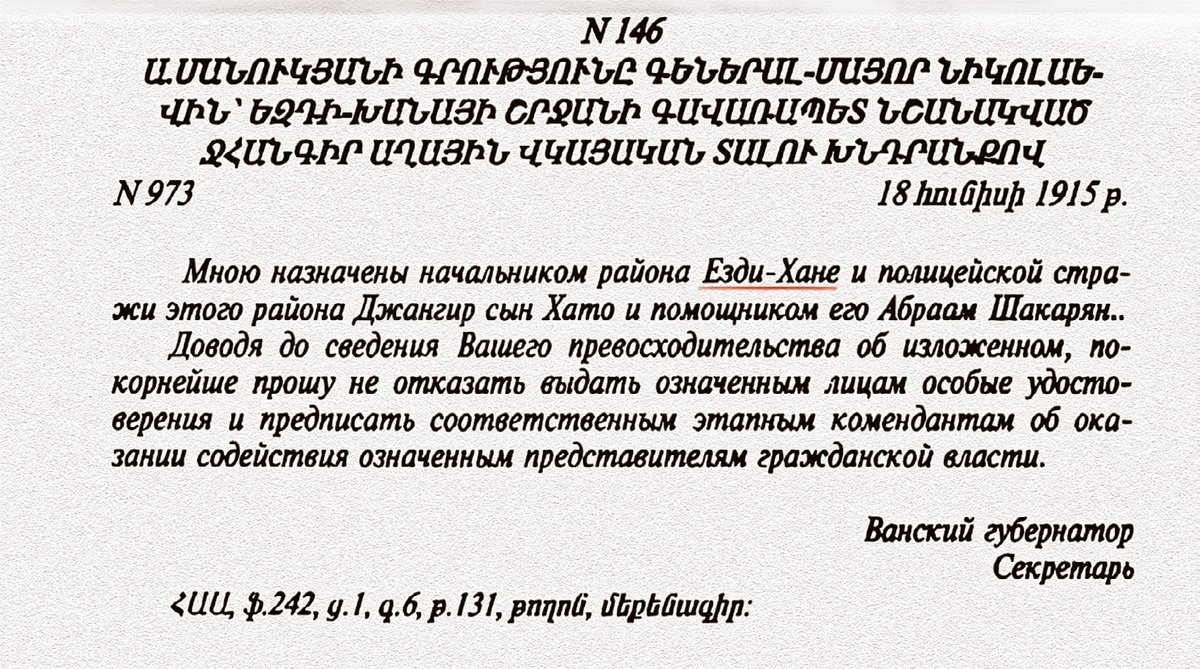
Many Ezidis from the Ottoman Empire fled to Transcaucasia, to present-day Armenia and Georgia, where they found a second homeland.
The list of victims in T’amoyan’s school textbooks
The Ezidi school textbooks of Armenia (grade 6, 2014; repeated in grade 9 and grade 11) contain a list by E’zîz T’amoyan of the affected areas and places in 1915–1918. It is valuable above all because of the place names. The figures are undocumented estimates of the source without indication of origin; their total (“about 500,000”) lies far above other estimates. They are given here only as statements of the textbook. The spelling follows the book.
| Area | Places (selection) | Statement of the textbook |
|---|---|---|
| Iraq | Şengal, Sînûn, Gobal, Digûr, Gelîê E’lî begê, Dihok, Zorava, K’êrsê, Barê, Sîba, T’ilîzer, T’ilzafê, Xirbê Qewala, Girzerk, R’ibûsî, Şarok, T’ilkezev, T’ilbenda, Koco, Xotemî, R’indewan, Amedîa | “approx. 200,000” |
| Vilayet of Van, Xanesor plain | Evexe, Axûrîk, Angûzek, Anzava, Acalî, Arç’eq, Bêgrîb, Havasî, Bêcermo, Bêrtîs, Gondûrma, Zêwa, Dêrcemed (Jêrin/Jorin), Duavan, Erciş, T’endûrek, Xaçan, Qereqele, Kolzot, Mêrvanê, Mûradîn, Noşar, Şahmanîs, Şerefxanê, Çaldiran, Çîbûxlû, P’işîk’ûmbat’, Seray, T’imar, Ût’ê, Orênê etc. | “approx. 100,000” |
| Vilayets of Muş, Diyarbakır (Bişêrî plain), Xezalî near Mardin (Xerza), Cizîr | Azika Jêrin/Jorin, Alkayê, Bazîdan, Basmût, Baximsê, Gelîê Zîlan, Xinûs, Qubildor, Ç’inêrî, Hacir, Meymûnî, Şemzê, R’amê etc. | “approx. 60,000” |
| Vilayet of Erzurum (Bayazit–Eleşkirt) | Ort’il, Diyadin etc. | “approx. 7,500” |
| Kars district | valley of Ozirlû (Oğuzlu), Alaca | “approx. 5,000” |
| Qulp near Kağızman | – | “approx. 3,000” |
| Digor district etc. | Eleşkirt, Bacelî, Gogormes, Digor, H’esencano, Ûlîk’end etc. | “9,000 forcibly Islamized” |
| Surmelî (Iğdır) | Xerfelû, Alçalû, Eslanlû, Bendemûrad, Baş Sinek, Zor, Xanê, Xirbê Sor, Qerext’în, Qereqû, Qûç’, Taşûşan, Gundê K’elo etc. (see Surmelî) | “approx. 10,000” |
| River crossings 1918 | Akhurian (Arpaçay) and Aras | “approx. 4,000 drowned” |
| Axbaran (Armenia) 1918 | Elegez, Qundexsaz, Qur’ibog’az, Cercerîs, Karvanserê, Giresor | see Genocide of 1918 in Armenia |
Other statements in the same books contradict each other: grade 6 elsewhere gives for Xanesor “100,000 in one night”, without evidence. On April 28, 2012, the National Academy of Sciences of Armenia and the Genocide Institute declared the crimes against the Ezidis in 1915–1918 a genocide (see The Ezidi movement in Armenia since 1988).
On Şengal in 1915: according to the grade 11 textbook, the Ezidis there took in “6,000” Armenian refugees and fought for 35 days against the attackers; according to the chronicle in the grade 8 textbook, they saved “approx. 20,000” Armenians. The figures contradict each other (see Şengal 1915–1918).
The tradition of the Ferman
According to Ezidi tradition, the people has survived 72 or 74 Ferman in the course of its history. The count is based on oral tradition; written evidence exists only for some of them.
Sources
- A. V. Perminov: Езиды – древний народ Адаби (The Ezidis – the ancient people Adabi). Sharya 2016, p. 68–70
- International Journal of Yezidi Studies, Vol. 1. Tbilisi 2024, p. 133 (ill.)
- John S. Guest: The Yezidis. A Study in Survival. London/New York 1987, p. 176–189, 222–224
- Qader Saleem Shammo: From Fatwā to Genocide. Historic and Contemporary Manifestations of the Islamic Genocide against the Yezidis (Yezidi Studies 5). Berlin 2026, p. 100, 156–159, 165, 173–176
- E’zîzê E’mer, H’esenê Şêx-Me’mûdê: E’debyet û zimanê êzdîkî, grade 6. Yerevan: Spîka 2014, p. p-039, p-070–072
- E’zîzê E’mer, H’esenê Şêx-Me’mûdê: E’debyet û zimanê êzdîkî, grade 8. Yerevan: Spîka 2011, p. p-062
- H’esenê Şêx-Me’mûdê, E’zîzê E’mer: E’debyet û zimanê êzdîkî, grade 9. Yerevan: Spîka 2012, p. p-023, p-053–055
- E’zîzê E’mer, Omerê Şero (Omar Mamoyan), Xidirê Sûrên (Chidir Hadschojan): E’debyet û zimanê êzdîkî, grade 11. Yerevan: Spîka 2014, p. p-019, p-024–026
Found a mistake?
Is something wrong – a fact, a spelling, a source, an image? Let us know: we check every report and correct the article.
Other spellings: Ömer Vehbi Pasdschha · Ömer Vehbi Pasjha · Firman · Fermans · Lalish · Lalisch · Lalesh · Shekhan · Scheichan · Shaikhan · Emir · Mossul · Mûsil · Sheikh Adi · Scheich Adi · Shaikh Adi · Şêxadî · Shikhadi · Sindschar · Shingal