
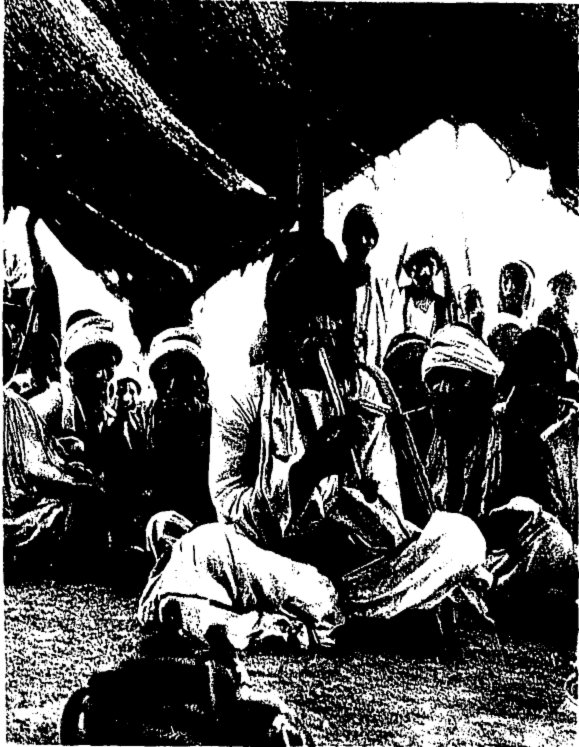
The Ode was the guest room of an Ezidi farmhouse. Here guests were received, here the elders of the village sat together in the evenings. S. M. Polatov describes as an example the farmstead of Usoyê Polat in the village of Susiz in the Kars region around 1900.
The farmstead
The house was built with its back wall into the slope. On the right was the sheepfold, on the left the stable for cows, oxen, buffaloes and horses. Behind these came the threshing floor and a long clay barn for the hay; between the house and the sheepfold lay underground grain stores.
Sowing, harvest, haymaking and grazing were largely managed by the extended family itself; every day 12 to 15 men went to work. Before the field work the family held council: the elders sat at the top on carpets, the younger ones lower down; the older women stood at the door in order to hear where and how many lunches they had to send.
The Ode
The Ode was a large room with three windows, carpets on the floor and on the walls. On one wall hung weapons – sabers, daggers, shields, carved bows, lances with silk tassels and silver-mounted whips –, as well as antlers. In walnut cupboards lay tobacco, long pipes, and a jug and basin for washing the guests’ hands.
In the evenings the village elders gathered here. In winter the young people listened in the Ode to the old men and the clerics, who told heroic and instructive stories. According to Polatov, after settling in the Russian Kars region many wealthy families built their own guest rooms.
Hospitality
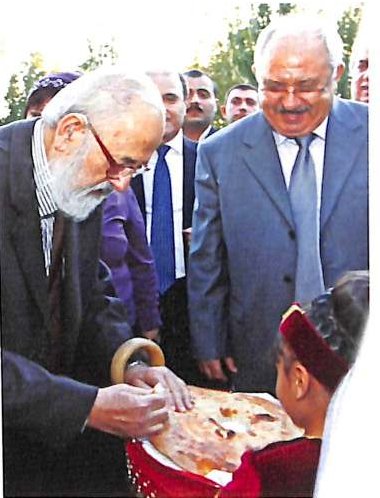
Hospitality was regarded as a highly respected law: the poor were to be received just like princes and officials. Polatov records the proverb “It is good as long as one has and gives”. Because of his hospitality, Usoyê Polat was called “Uso Axa”.
Eyewitness accounts from 1846 and 1940
- Bacidrê 1846: A. H. Layard describes the reception room (Selamlik) of Mîr Huseyn Beg with carpets and cushions; a spring-fed stream flowed right through the middle of the room. The villagers stood in silence at the lower end of the room.
- Başîqa 1940: In the house of the landowner Sadiq the rooms lay around a courtyard with a stream and a vine arbor; at the gate was a stone arch with seats. During the New Year festival the door stood open to all. According to E. S. Drower, tea and coffee are always prepared by the host or his son himself, not by the women; this is considered an act of honor. Coffee was served bitter in handleless cups (see Sersal in Başîqa 1940).
Sources
- S. M. Polatov: Дети Солнца (Children of the Sun). Rybinsk 2011, p. 114–116, 140, 147, 159
- Roger Lescot: Enquête sur les Yezidis de Syrie et du Djebel Sindjār (Study of the Ezidis of Syria and of the Şengal mountains). Beirut 1938, p. Plate VIII (p-200)
- Mirza Sloyan (Mirzoyê Çolo Siloyan): Дорога, ведущая в храм. Три года спустя (The road leading to the temple. Three years later). Yerevan 2015, p. p-374 (ill.)
- Austen Henry Layard: Nineveh and Its Remains, Vol. 1. London 1849, p. p. 272 (PDF 325)
- E. S. Drower: Peacock Angel. Being some Account of Votaries of a Secret Cult and their Sanctuaries. London 1941, p. pp. 13, 35, 132 (PDF 24, 50, 163)
Found a mistake?
Is something wrong – a fact, a spelling, a source, an image? Let us know: we check every report and correct the article.
Other spellings: Qers · Sinjar · Sindschar · Shingal · Shengal · Singal · Emir · Bashiqa · Baschika · Eziden · Ezidis