
The Mîrs of Şêxan are the hereditary secular heads of the Ezidis and guardians of the sanctuary of Lalîş. The family that leads today is called Çol (after an ancestor, Çolo Beg). According to John S. Guest, it came to power in the 17th century. Its seat has long been Bacidrê (Baadri) in Şêxan.
Origin
- Before the Çol family, the Ezidis around Lalîş were ruled by a line descended from Şêx Hesen, the great-grandnephew of Şêx Adî (see The Adawiya community). Its sphere of power was the Dasinî tribe, which in the 16th century inhabited the foothills north and east of Mosul as far as Lalîş. The area has been called Şêxan for about 200 years.
- According to tradition, the progenitor of the Çol family is Şêx Ebû Bekr, a relative of Şêx Adî’s father. His tomb lies in the sanctuary of Lalîş.
The change of power in the 17th century
In a turbulent period, a chief from the mountains beyond the Great Zab who descended from Şêx Ebû Bekr overthrew the old ruling line. He killed the previous Mîr of the Dasinî and 80 of his followers. This Şêx Mihemed (with the epithets el-Erbili and el-Batini) is regarded as the founder of the Mîr dynasty, which exists to this day.
As administrators the new Mîr appointed followers from the related noble family Basmariya. For a long time it was the only other family into which princes of the Çol were allowed to marry.
Mîrza Beg – an Ezidi pasha of Mosul
Separate article: Mîrza Beg Dasinî (Mîrza Pasha).
- In December 1638 a contingent of the Dasinî under Mîrza Beg distinguished itself in the conquest of Baghdad by Sultan Murad IV.
- In 1649 the grand vizier Kara Murad Pasha appointed Mîrza Beg governor (pasha) of Mosul.
- After a change in the office of grand vizier, Mîrza Pasha traveled to Istanbul in 1650. The new grand vizier Melek Ahmed Pasha distrusted the Ezidis: Mîrza Pasha was intercepted on the way back and executed, his head displayed at the gate of the Topkapı Palace. The traveler Evliya Çelebi was present.
Around 1656 Evliya Çelebi visited the chief of the Dasinî in the Dohuk district. He described him as hospitable, spirited and of perfect manners; he commanded 10,000 musketeers.
Under the rule of Amadiya (18th century)
In the 18th century the Mîrs of Şêxan became subjects of the Sunni Kurdish princes of Amadiya (Behdînan). According to the Dominican Maurizio Garzoni (in Amadiya 1759–1779), the princes always gave the office of executioner to an Ezidi.
- In 1770/71 Mîr Bedagh Beg took part in an uprising against Ismail Pasha of Amadiya; he was captured and fined.
- In 1786/87 his son Çolo Beg was involved in a further uprising and fled into the mountains. In 1789/90 he fought against plundering Arab tribes in Şêxan.
- In 1790/91 Ismail Pasha had Çolo Beg and his brother executed. Xencer Beg of the Basmariya family became the new Mîr.
- In 1791/92 the old line was restored: Çolo’s son Hasan Beg became Mîr.
Votive inscriptions of 1779 and 1781 in Lalîş testify that numerous pilgrims, many from Şengal, visited the sanctuary.
Hasan Beg, Salih Beg and Elî Beg (1792–1832)
- Mîr Hasan Beg had the sanctuary of Lalîş rebuilt in 1806. Some years later he was treacherously murdered by a Kurdish prince of Amadiya. In 1820 the Briton Claudius Rich heard a lament for him in an Ezidi village, sung by a blind singer named Lasso.
- His successor Salih Beg, highly respected, was murdered in Mosul. Turmoil in the family followed.
- Finally Elî Beg, “the Great”, a son of Hasan Beg, became Mîr. He was beheaded in 1832 by the Kurdish emir of Soran, Mîr Mihemed of Rewandiz – see The massacre of 1832.
Position of the Mîr
According to Guest, the Mîr appoints the Baba Şêx, the highest religious office. He is entitled to the revenues from the circuits of the Qewal with the Sencaq (peacock standards) and from the donations at the sanctuaries. Around 1840, because of the tribute payments, the Mîr combined all collections into a common fund. The princely family marries only within its own family or into the Basmariya family.
The Mîrs of Şêxan (according to Guest)
| Mîr | Time | Remark |
|---|---|---|
| Şêx Mihemed | 17th c. | founder of the dynasty |
| Mîrza Beg | around 1638–1650 | 1649 pasha of Mosul, executed 1650/51 |
| Bedagh Beg | around 1770 | uprising against Amadiya |
| Çolo Beg | until 1790/91 | executed by Amadiya |
| Xencer Beg | 1790/91 | from the Basmariya family |
| Hasan Beg | 1791/92 – after 1806 | rebuilding of Lalîş, murdered |
| Salih Beg | early 19th c. | murdered in Mosul |
| Elî Beg “the Great” | until 1832 | beheaded in Rewandiz |
| Cesim Beg | 1832 – around 1842 | from the older branch of the family |
| Huseyn Beg | around 1842–1879 | briefly deposed in 1853 |
| Mîrza Beg | 1879–1899 | forced conversion in 1892 |
| Elî Beg | 1899–1913 | murdered |
| Seîd Beg | 1913–1944 | under the guardianship of Mayan Xatûn |
| Tahsîn Beg | 1944–2019 | until 1957 under the regency of Mayan Xatûn |
The events from 1832 are treated in the article The Mîrs of Şêxan 1832–1913.
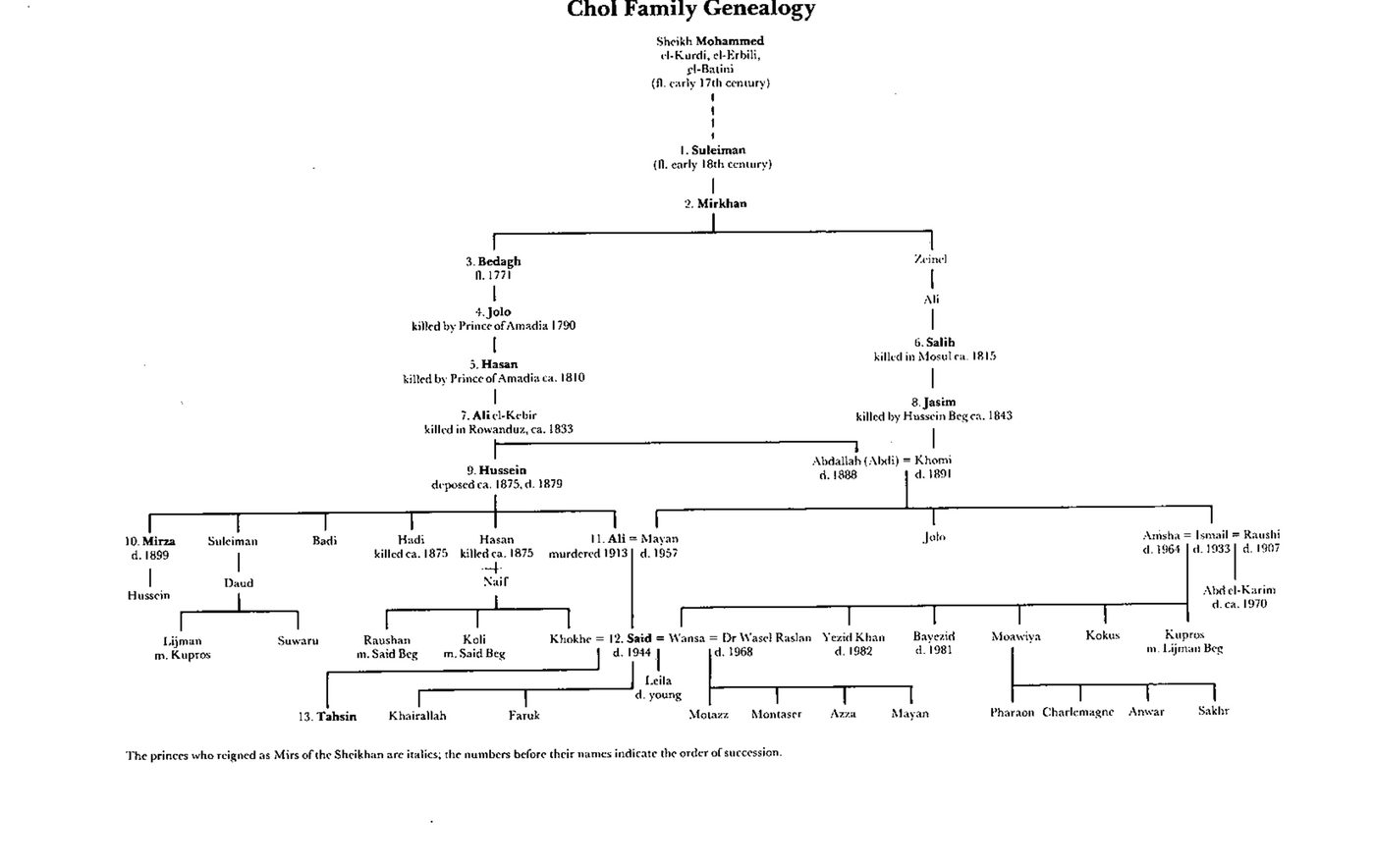
Family tree of the Mîr family according to Edmonds
In 1967 the British official C. J. Edmonds published a family tree of the Mîr family covering the last eight generations down to Mîr Tehsîn Beg. The following rendering follows the illustration in his book (image page p-044); the numbering (Elî I, II, III etc.) is Edmonds’. Names in the spelling of this site, “∞” = married to.
The two lines
| Generation | Older line | Younger line |
|---|---|---|
| 1 | Zeynel | Bedax |
| 2 | Şelih | Çolo I |
| 3 | Elî I | Hesen I |
| 4 | children of Elî I: Casim I, daughter Mamya, daughter Ne’am | sons of Hesen I: Elî II (∞ Ne’am and ∞ Mamya), Çolo II, Sefer |
The descendants of Elî II and Mamya
- Huseyn I (Mîr Huseyn Beg)
- Gulê ∞ Feqîr Hesen → son Feqîr Cindî
- Hadî
- Hesen II → son Nayif → daughters Xoxê and Gulê (both ∞ Seîd)
- Mîrza (Mîr Mîrza Beg) → sons Huseyn III and Saydo
- Elî III (Mîr Elî Beg) ∞ Mayan (Mayan Xatûn)
- Seîd (Mîr Seîd Beg) ∞ Amşa and ∞ Xoxê
- with Amşa: Xêrî
- with Xoxê: Tehsîn (Mîr Tehsîn Beg)
- Evdî
- Çolo III → son Selîm II
- Îsmaîl ∞ a daughter of Selîm I → children Evdilkerîm, Kokus, Mu’awiya, Bayezîd, Yezîd, Wensa
- Selîm I
- Hemze → Huseyn II → Casim II
What Edmonds relates about the family tree
- Bloody feud of the lines: Elî I, son of Şelih and last Mîr of the older line, murdered Çolo II and Sefer, sons of his relative Hesen I of the younger line, but gave his daughters Ne’am and Mamya in marriage to Hesen’s other son, Elî II. Huseyn I, son of Elî II and Mamya, killed his maternal uncle Casim and thus secured the succession for the younger line.
- Hadî and Hesen: Huseyn married Ghazzo, a girl from the Şemsanî family – an impermissible marriage according to the marriage rules. His two eldest sons from lawful marriage, Hadî and Hesen, rebelled against him, stole the Sencaq of Şêxan and collected its offerings for a year. The Ottoman authorities supported Huseyn, and the two were killed.
- Elî Beg: In the night before the autumn festival of 1846, A. H. Layard was the guest of Huseyn Beg and, at his request, chose the name Elî for the son born that night. This Elî Beg succeeded his brother Mîrza as Mîr and lost his life in 1913 under unexplained circumstances (see Mîr Elî Beg).
- Guardianship: His widow Mayan Xatûn was officially recognized as guardian, first of her son Seîd, in 1944 of her grandson Tehsîn.
- Succession in 1944: Tehsîn, whose mother Xoxê came from the Mîr family, was preferred to his elder brother Xêrî, whose mother came from the Ewdilqadir family.
- Feqîr Cindî, son of Gulê and Feqîr Hesen (a Şêx of the Ebû Bekr line), became administrator of the sanctuary of Şêx Adî.
- Mîr Hec: In 1944 Selîm Beg, son of Çolo III (in the family tree Selîm II), led the autumn festival as Mîr Hec.
Marriage, Şêx and P’îr of the family
- For the marriage rules (endogamy), according to Edmonds the Mîr family counts among the Qatanî Şêx; daughters of the family also marry Qatanî, as the example of Gulê and Feqîr Hesen shows. One informant considered this a more recent relaxation: formerly the Çol family had been allowed to marry only among themselves.
- According to Edmonds, the Şêx of the Mîr family is Şêx Hesen, its P’îr P’îr Jarwan.
- According to the tradition reproduced by Edmonds, Şêx Adî was succeeded as head of the community first by his brother Sexer, then by the latter’s son Berekat, whose tomb is said to lie in the sanctuary of Lalîş. A transmitted saying of Şêx Adî recommends not to offend “the heart” of Çol Beg and to give the family of Çol Beg the benefit of “soup and lamp” (şerbik û çira).
Comparison with Guest
The names can probably be connected with the list according to Guest (above) as follows – this is a comparison by this site, not a statement of the sources:
| Edmonds (family tree) | Guest (list above) |
|---|---|
| Bedax → Çolo I → Hesen I | Bedagh Beg → Çolo Beg (until 1790/91) → Hasan Beg (from 1791/92) |
| Şelih → Elî I (older line) | Salih Beg? (early 19th c.) |
| Elî II, son of Hesen I | Elî Beg “the Great”, son of Hasan Beg, until 1832 |
| Casim I (older line) | Cesim Beg, 1832 – around 1842, “from the older branch” |
| Huseyn I | Huseyn Beg, around 1842–1879 |
| Mîrza, Elî III, Seîd, Tehsîn | Mîrza Beg, Elî Beg, Seîd Beg, Tahsîn Beg |
Open points:
- Marriage circle: According to Guest, the princely family marries only within its own family or into the Basmariya family; according to Edmonds it counts among the Qatanî for marriage.
- Îsmaîl Beg: In the text Edmonds calls him the “own brother” of Mayan Xatûn; in the family tree he appears as a son of Evdî, thus as a cousin of Elî III. Other sources call him a half-brother of Mayan (Guest) or a brother of Elî Beg (Fuccaro) – see Îsmaîl Beg.
- Tehsîn’s age in 1944: “about twelve” (Edmonds), 13 years (Guest).
Divergent information
In the chronicle according to Perminov (Ferman in the Ottoman period), the ruler of the 17th century is called “Şêx Mirza”; he is said to have risen up in 1647/48 and been executed in Van. According to Guest, Mîrza Beg was an Ottoman governor and was executed in 1650/51 on the way back from Istanbul.
Sources
- John S. Guest: The Yezidis. A Study in Survival. London/New York 1987, p. 50–51, 54, 60–66, 75, 78, 83, 109, 168, 186, 217, 234
- C. J. Edmonds: A Pilgrimage to Lalish. London (Royal Asiatic Society) 1967, p. p-020, p-043–045, p-054, p-068–069
Found a mistake?
Is something wrong – a fact, a spelling, a source, an image? Let us know: we check every report and correct the article.
Other spellings: Col · Tschol · Dschhol · Jhol · Malbata Mir · Miren Sexane · Miren Schechane · Miren Shekhane · Dasini · Emir · Shekhan · Scheichan · Shaikhan · Lalish · Lalisch · Lalesh · Sheikh · Scheich · Shex · Sheikh Adi