
Between the end of the First World War and the crisis of 1935/36, Şengal became the borderland of the new state of Iraq. The British relied on the Feqîr Hemo Şero, against whom a coalition formed around Dawûdê Dawûd. At the same time the issues were land, taxes, the border with Syria and finally conscription.
The overview of the whole period, including Şêxan and the Mîr family, is given in The Ezidis in Iraq 1914–1957 (according to John S. Guest). This article goes deeper into the events in Şengal according to three further sources:
- Nelida Fuccaro (1999) relies above all on British files (Colonial Office, Royal Air Force) and French files. Her ethnic classification of the Ezidis is not adopted here.
- C. J. Edmonds (1967) was a British official and adviser in the Iraqi Ministry of the Interior; he prepared Iraq’s submission in the border dispute and knew many of those involved personally. He writes from the point of view of the administration but criticizes the punishments of 1935. His disparaging judgments of the inhabitants are not adopted.
- Roger Lescot (1938) questioned refugees from Şengal in Syria in 1936 and wrote from the point of view of the French mandatory power, which took in the refugees.
Where the sources differ, this is noted.
Background
- At the beginning of the 1870s the Ottoman Kaymakam of Şengal appointed the chief of the Musqora, Sufuq Axa, as “chief Şêx of the mountain”. Hemo Şero began as his adviser. After Sufuq’s death (between 1890 and 1892) he declared himself head of Şengal without Ottoman consent (Fuccaro).
- In the First World War Şengal took in Christian refugees; Hemo Şero was their most important protector. His refusal to hand them over led in 1918 to the last Ottoman campaign against the mountains. See Şengal 1915–1918.
- In 1916/17 a coalition formed against Hemo Şero of the Musqora and Mihirkan, the Mandikan, the Arab Albu Mutaywid and the Haskan, led by Dawûdê Dawûd (Fuccaro).
- In November 1917 Hemo Şero wrote to the British Chief Political Officer in Baghdad: the letter had been read out to the Ezidi chiefs; they wanted to cooperate with the British but could not act alone (Fuccaro). In 1917 he led a mixed tribal force against Ottoman convoys on the road to Nusaybin.
Hemo Şero as Hakim (1919–1921)
-
According to Edmonds, in 1918, during the British army’s advance up the Tigris, Hemo Şero, head of the Dinadî, offered the British commander cooperation against the Ottomans and, because of his military strength, was recognized as “head of the mountain”. Edmonds traces his rise back to 1892, when Hemo Şero captured breech-loaders from the Ottomans during the campaign of Ömer Wehbî Pasha; before that Sevok “Pasha”, the head of the Musqora, had held this position (Fuccaro names Sufuq Axa, see above).
-
At the beginning of 1919 Şengal came to the British-occupied territories. The British appointed Hemo Şero Hakim (administrator) of the mountain, responsible for administration and security, with 600 rupees a month and auxiliary policemen of his own (şabana) (Fuccaro).
- Lescot writes that Hemo Şero became “representative of the government” on the proposal of Îsmayîl Beg; the British called him “pasha of the mountain”, and his pension amounted to 600 rupees. According to Guest, Îsmayîl Beg declined the governorship in favor of Hemo Şero. The statements fit together.
- In July 1920 there was unrest in Tel Afer, in which the British official for Tel Afer and Şengal was killed. Hemo Şero supported the British operations and burned down the villages of the Albu Mutaywid, the only group in Şengal that had supported the insurgents.
- In August 1920 Şengal became a separate district (qadha) with two sub-districts: Sinjar in the south and Şimal in the north with its seat in Karsî. From the autumn of 1921 the Kaymakam in Beled Sinjar was subordinate to the Iraqi governor of Mosul.
The Kaymakams (according to Fuccaro)
| Time | Kaymakam |
|---|---|
| 1920/21 – July 1922 | Yusuf Rassam (Christian from Mosul) |
| 1922 – 1927 | Ibrahim Efendi (Muslim, previously in Tel Afer; deposed for illegal land seizure) |
| 1927 – March 1929 | Yusuf Rassam |
| from 1929 | a Christian who had previously headed the administration in Şêxan |
| 1934 | a Muslim replaces the Christian Kaymakam (Lescot) |
According to Fuccaro, the Ezidis regarded Christian officials as the best solution. There were no Ezidi officials, because hardly any Ezidi had attended a school. Under the British, according to Lescot, they asked for a Christian secretary.
Hemo Şero’s position after 1921
- After 1921 Hemo Şero remained Hakim in name only. He received British payments until the end of the mandate, but never an official administrative office. In 1921 he had to move his seat to Jaddala and Bardahalî; Beled and Mamîsî now had garrisons with Arab soldiers.
- After 1925 his monthly allowance was cut from 300 to 240 rupees, as punishment for lack of help against Dawûd; in 1926 and at the beginning of 1931 it was temporarily stopped (Fuccaro). When it fell from 600 to 300 rupees is not clear from the sources.
- From 1921 a secret league, the “Muslim League”, of officials and policemen not from Şengal worked in Beled against Hemo Şero and the British. In 1928 the Habbabat chiefs Etû and Metû, opponents of Hemo Şero, began a campaign of violence against the Christians in his circle; Christian merchants who had been his advisers in 1919 were murdered (Fuccaro).
The land dispute over Jaddala
Most land disputes in Şengal were between Ezidis and Arab neighbors, who in the late Ottoman period had received most of the title deeds (tapu). From 1919 the British supported Ezidi claims; after 1925 the Iraqi authorities promoted a stronger Arab presence (Fuccaro).
- Before 1918: In the previous 40 years Arabs from the area of Lake Xatûnîya had received Ottoman deeds for almost all the arable land of Jaddala, which Ezidis cultivated without official recognition.
- 1919: Colonel Leachman, the first British Political Officer of Mosul, gave Jaddala to Hemo Şero as a reward for his help against the Ottomans; the Arabs had to leave. Jaddala became the chief place of the Feqîran.
- After 1925: The Arab leader Askar sued, supported by a pro-Muslim lobby. In 1927 a court awarded Jaddala to the Arabs; the Feqîran, however, stayed.
- 1930: Askar was offered the state village of Eyn el-Hesen; Hemo Şero was to pay the difference in value. The high legal costs weakened him.
- 1940: Eyn el-Hesen was registered to the Arab Khawatina. For Jaddala there were no deeds; the Feqîran remained as holders of usage rights.
According to Fuccaro, the case strengthened the Ezidis’ fear of a state-sponsored Arab settlement in Şengal. Other chiefs secured their villages: Xudêda, the son of Hemo Şero, bought the village of Wardiyya from the government in 1928; Şêx Xelef had Juhbal transferred to himself (according to Fuccaro once 1925, elsewhere 1930).
The unrest of 1924/25
- In 1922 Dawûdê Dawûd understood vague promises of the Kaymakam as an announcement that Hemo Şero would be deposed, and marched against Jaddala and Bardahalî; the Kaymakam was thereupon replaced.
- In 1924 Dawûd and Şêx Xelef el-Haskanî were detained in Mosul for some months. In August 1924 the Iraqi administration asked the RAF in vain for help against Dawûd; at the beginning of September it sent gendarmerie against his chief place Zarwan. The Habbabat chiefs Etû and Metû warned Zarwan with fire signals; Murad Yusuf (an opponent of Hemo Şero among the Feqîran) and Şêx Xidir took Dawûd’s side; the police did not get through.
- In December 1924 there was fighting in Sinunî between Şêx Xelef and his rival Kimmo Emoka, who had asked Hemo Şero for help.
- In March 1925 sections of the Qiran took Hemo Şero’s side against their own leader Şêx Xidir.
- At the beginning of April 1925 Dawûd’s coalition prepared an attack on Jaddala, where Hemo Şero was gathering his forces.
Lescot names a different occasion: around 1925 Hemo Şero is said to have abducted the 15-year-old daughter of Mradê Serhan, leader of the Feqîran of Millik, and refused compensation. From this an almost general conflict arose, in which Dawûdê Dawûd stood on Millik’s side.
The bombings of April 1925
The RAF intervened only after the boundary commission of the League of Nations for the Mosul question had visited the mountains (end of January 1925). According to Fuccaro:
| Date | Event |
|---|---|
| mid-April 1925 | dropping of warnings (mostly six hours’ notice) |
| April 18 | heavy bombing of Mihirkan and Zarwan; men of the Mihirkan shoot down a British plane |
| April 19 | bombing of Sakiniyya and Sinunî, from where Şêx Xidir and Şêx Xelef had attacked Jaddala; Şêx Xidir surrenders, Şêx Xelef flees north |
| April 24 | renewed bombing of Mihirkan |
| beginning of May | all except Dawûd accept the conditions; Mihirkan and Zarwan are to pay a fine of 5,000 rupees within four days |
| July 1925 | Dawûd surrenders; banishment to Nasiriyya in southern Iraq until 1928 |
Guest mentions British armored cars and a reconnaissance plane shot down, in which two airmen died. The British Colonial Office gave only a brief report to the press because the air raids were criticized in Britain; the Daily Express published a detailed report by its correspondent (Fuccaro). At the end of 1924 Dawûd had written to the authorities in Mosul that he had done nothing against the government and owed neither the animal tax nor other taxes.
Şêx Xelef and Şêx Xidir were spared. Because they controlled the west of Şengal, which France claimed, the administration supported them after 1925.
The border between Iraq and Syria (1920–1932)
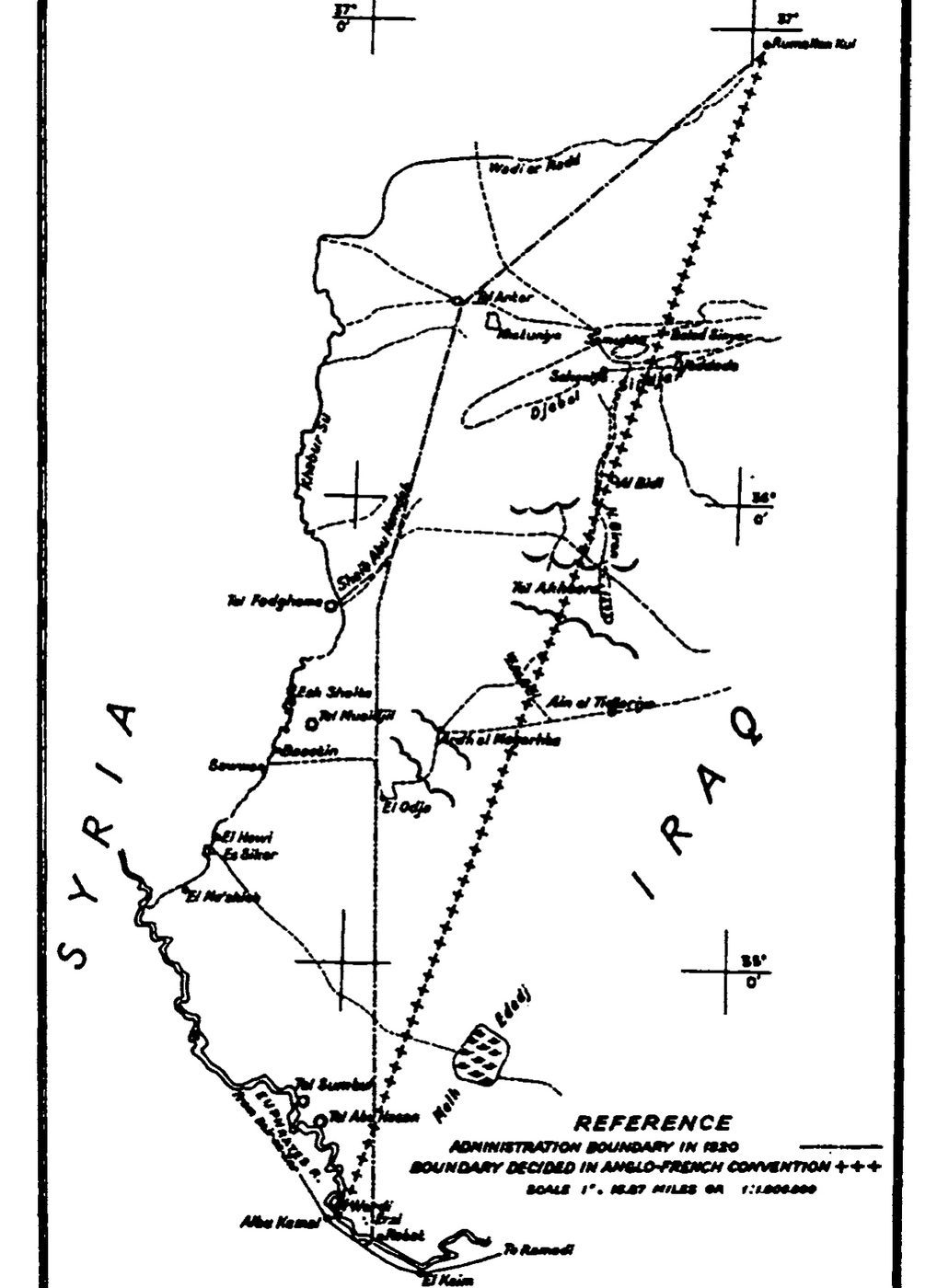
- The Anglo-French convention of October 1920 divided Şengal: the west, about one third of the mountains, was to belong to Syria. The wording was vague; a boundary commission never became active for this section.
- In fact the British had administered the whole mountain range since 1919; the administrative boundary ran from Roumelan Kewi to Tel Antar west of Lake Xatûnîya. High Commissioner Sir Henry Dobbs proposed it as a permanent border.
- France held to the line of 1920, also because of hopes of oil in the west. The French-Syrian authorities in Hesekê tried several times to collect taxes from Samuqa and Khawatina. In 1922/23 an Iraqi and a Syrian police post were set up in Xatûnîya one after the other and withdrawn again.
- After the bombings of 1925, followers of Dawûd fled into the western part.
- In October 1926 Bedouins of the Tayy plundered villages of the Haskan; Şêx Xelef threatened to support the French claims if the stolen livestock were not returned. In January 1927 Iraq and Syria deliberated in Deir ez-Zor on the claims.
- In 1931 Hemo Şero and Şêx Xidir asked the League of Nations to place Şengal under French administration (see Petitions of the Ezidis 1923–1932).
- In October 1931 the border question went to the League of Nations; from February 1932 a commission toured the area. The chiefs, Muxtars and tribesmen questioned mostly wished to remain with Iraq. The report was presented in October 1932. The Council of the League assigned the whole of Şengal to Iraq; the recommendation to give the western Cebel Ceriba to Syria was not adopted. In return Syria received Albu Kamal and the Xabur basin.
- Lescot places the tribes’ decision for Iraq in the year 1933, Guest also places the drawing of the border in 1933. Fuccaro dates the report and the decision of the Council of the League to 1932.
- From 1934 permanent border committees settled disputes.
- Edmonds gives the following dates: Anglo-French agreement in December 1920 (without a map), then a de facto line until 1932; referral of the dispute to the League of Nations in November 1931, commission of inquiry in the spring of 1932, decision of the Council in the autumn of 1932, demarcation in 1933. According to him, Şengal came to Iraq “partly thanks to the declared preference of the Ezidis themselves”. To accommodate France, the border in the north and west was drawn too tightly and cut off parts of the traditional grazing areas.
Taxes, school and complaints
- Until 1925 taxes were levied in the Ottoman manner in kind on harvest and livestock, then in money. This caused unrest especially in the north, where there was little cash. At the end of the 1920s assessment was made at a flat rate according to area and number of ploughs.
- In November 1930 the leaders of all the tribes forced the town council of Beled to support a petition against violent and extortionate officials and policemen. In 1931 Hemo Şero reported abuses and demands for advance payments before the harvest to the British High Commissioner.
- School: In 1918 the British Political Officer of Mosul opened a school in Şengal. According to Fuccaro it was attended almost only by Christian and Muslim children; according to Guest it was a school for Ezidi children that Hemo Şero supported. Lescot names two schools (in Şêxan and Balad), which were closed after the Anglo-Iraqi treaty because of low attendance.
The dispute over the Mîr and the Sencaq (1929–1932)
The dispute between Şengal and Mîr Seîd Beg over the revenues of the Sencaq and the rumors that the sanctuary of Şêx Adî was to become an Islamic endowment are described in the article The Ezidis in Iraq 1914–1957. Fuccaro adds:
- In June 1931 Hemo Şero proposed to the British Huseyn Beg, a cousin of Seîd Beg, as Mîr; in 1932 it was agreed in Şengal that he should reside in Jaddala.
- The Sencaq of Şengal remained for months in 1931 at the seat of government in Mosul. After the petition to the League of Nations, the government handed it over to Hemo Şero, who in February 1932 passed it on to Seydo, the brother of Huseyn Beg; the believers of Şengal proclaimed Huseyn Beg Mîr in his absence.
- According to Guest, Seîd Beg received the Sencaq back in September 1932. Both statements can be read as two phases of the same dispute.
Death of Hemo Şero and new leaders
- According to Fuccaro, Hemo Şero died in 1933; his son Xudêda was recognized by the Iraqi government as chief Şêx of Şengal. Lescot wrote in 1936 that he had died “a few years ago” almost a hundred years old.
- For 1936 Lescot describes in each tribe two parties around the rightful Axa and his rival. Among the Semmoqa, Xelefê Ehmed (with his brother-in-law Mradê Osmana of the Cefrîya and Hesenê Heşûr of the Dûxîyan) faced the group around Misîxê Bello, Xelîl Xidir and Slêmanê Iddo. On the tribes see The tribes of Şengal according to Lescot.
Conscription and uprising (1934–1936)
Conscription
- In 1934 Iraq passed the conscription law. According to Lescot, the chiefs of Şengal sent a telegram of congratulation and asked for a purely Ezidi unit; this was refused, and the press did not print their petition. Guest also reports that exemption or a separate unit was demanded and refused.
- According to Edmonds there was no conscription under the mandate; the law came in 1934, and in 1935 it began to be applied in Şengal. For him the main point of contention was not military service as such, but the incompatibility of service regulations with religious duties. On the requests of the Ezidis of 1936 see The Şêxan Memorial of 1930/31 (section Petition of 1936).
- Lescot emphasizes that the Ezidis did not reject military service as such, but service under Muslim soldiers; after the war many Ezidis served in the special troops of Iraq and Syria.
- In 1935 a delegation of notables traveled to Hesekê in Syria to ask for French support; the French advised calm. Mediation took place via Xudêda and Mîr Seîd Beg, who came to Şengal himself. Şêxan remained calm.
The uprising of autumn 1935
- In September 1935 Dawûdê Dawûd rose openly, without the support of other Axas; his opponents supplied the troops with guides and food. According to Lescot, at least 1,000 soldiers advanced with artillery, armored cars and airplanes.
- In the night of October 12 to 13 cavalry rode as far as Ûsivan; in the morning Bekiran was attacked. The first attack was repulsed; in the evening infantry attacked. Dawûd, wounded and without ammunition, lost about 100 men. At night he fled to his old opponent Kimmo Emoka, who gave him a horse and a coat, and with two wounded sons across the border to Syria.
- According to Edmonds, Dawûdê Dawûd’s refusal to have the Mahirkan registered was followed by a large military operation with artillery and airplanes. Martial law transferred all administrative and judicial powers in Şengal and in any neighboring area he designated to the commander of the north. Dawûd fled to Syria seriously wounded.
- Fuccaro writes that the government and the military presented the uprising as a revival of a “conspiracy” of the non-Muslims of 1930.
The punitive measures
| Source | Details |
|---|---|
| Lescot (1938) | most of the villages of the Mihirkan burned down; prisoners carried off to the south (for about a week, 10–15 trucks a day through Baghdad); General Bakr Sidqî had several chiefs and two Christian notables from Mosul hanged on the spot; announced but not carried out: the granting of large parts of Şengal to the Şammar sheikh Acil el-Yawer and Arab settlement |
| Fuccaro (1999) | the two Christians who had earlier supported the petitions – the merchant Abd el-Karîm Qaragulla and the lawyer Abdallah Faʾiq Paulus – were publicly executed in Şengal shortly before Bakr Sidqî’s coup of 1936; after 1934 Acil el-Yawer, with the government’s toleration, occupied parts of Şengal |
| Guest (1987) | courts-martial sentenced nine leaders to death and over 300 people to long prison terms; in 1936 many were released |
| Edmonds (1967) | a military court sentenced prisoners and those who had submitted: 9 to death, 69 to life imprisonment, 70 to 20 years, 162 to 15 years, 33 to 10 years, 20 to lesser penalties, 54 to banishment to the south; in addition two Christian intellectuals from Mosul were hanged. Dawûd stated in 1941 that his nephew, his cousin and seven followers who were hanged in 1935 had come under a promise of safe conduct |
After the uprising
- Martial law was lifted in November 1935. In July 1936 Edmonds pointed out to Interior Minister Rashîd Alî how harsh the sentences were compared with those in Barzan and on the Euphrates. Until the coup of October 29, 1936, only 29 pardons were granted. The new prime minister Hikmat Sulaymân then had all the convicted Ezidis released within a month (Edmonds).
-
After that, according to Edmonds, there were tensions at the call-up almost every summer; Ezidi village headmen were often deported and interned until someone obtained their release.
-
Many of the first recruits deserted with their families to Syria; conscription was temporarily suspended. Only in 1936 did the government succeed in conscripting Ezidis under the nisbî system: the chiefs selected the recruits according to a fixed share of the tribal population (Fuccaro).
- The Mihirkan were broken up as a tribe, the survivors scattered. In the spring of 1936 the numbers of the Semmoqa and Xîran had almost doubled through refugees (Lescot).
- In April 1936 Misîxê Bello and Hemo deposed the Semmoqa Axa Xelefê Ehmed as a “friend of the Iraqi authorities”; in June 1936 Hemwê Milhim was arrested. In May 1936 Xudêda too was arrested (Lescot).
- In the second half of the 1930s whole tribal sections moved with their leaders to Syria (Fuccaro); see Ezidis in the Cezîre.
Discrepancies between the sources
- Occasion of the uprisings: The Ezidi historian Majid Hassan Ali (2021) summarizes the fighting in Şengal between 1925 and 1935 under Dawûdê Dawûd and Hemo Şero as uprisings against the settlement of Arab tribes and for the return of Ezidi land (kurds-yezidis-me p. 48). Fuccaro and Lescot, by contrast, name above all disputes among the tribes, taxes and conscription as occasions (above). A land dispute with Arabs is also documented by the case of Jaddala (above). On the later uprising of 1966 under Saydo Hemo Şero see Xudêda Hemo Şero.
- Appointment of Hemo Şero: according to Fuccaro by the British at the beginning of 1919; according to Lescot on the proposal of Îsmayîl Beg; according to Guest Îsmayîl Beg renounced in his favor.
- Allowance: 600 rupees (1919, Fuccaro and Lescot); after 1925 cut from 300 to 240 rupees (Fuccaro).
- Occasion of the fighting in 1925: according to Fuccaro the power struggle of two coalitions and the dispute over taxes and land rights; according to Lescot the abduction of Mradê Serhan’s daughter.
- Military in 1925: Fuccaro names bombings on April 18, 19 and 24; Guest armored cars and a plane shot down.
- Border: League of Nations report October 1932 (Fuccaro); decision of the tribes or demarcation 1933 (Lescot, Guest).
- Death of Hemo Şero: 1933 (Fuccaro); “a few years ago”, almost a hundred years old (Lescot, 1936).
- Punishments 1935/36: see the table above – the sources complement each other, but give different figures and details. Edmonds’ individual figures (334 prison sentences from 10 years to life) fit Guest’s “over 300”; whether all nine death sentences were carried out is not clear from the sources (Dawûd named nine hanged men from his circle).
- Border dates: agreement October 1920 (Fuccaro) or December 1920 (Edmonds); referral to the League of Nations October 1931 (Fuccaro) or November 1931 (Edmonds).
- Predecessor of Hemo Şero as head of the mountain: Sufuq Axa of the Musqora (Fuccaro) or Sevok “Pasha”, head of the Musqora (Edmonds) – presumably the same person in different transcription; the sources do not say so.
Sources
- Nelida Fuccaro: The Other Kurds. Yazidis in Colonial Iraq. London 1999, p. 33–36, 49–50, 78–81, 88–101, 111–124, 139–149, 165
- Roger Lescot: Enquête sur les Yezidis de Syrie et du Djebel Sindjār (Study of the Ezidis of Syria and of the Şengal mountains). Beirut 1938, p. 172–195
- C. J. Edmonds: A Pilgrimage to Lalish. London (Royal Asiatic Society) 1967, p. p-018, p-077–083
- John S. Guest: The Yezidis. A Study in Survival. London/New York 1987, p. 157–158 (ill.)
- Güneş Murat Tezcür (ed.): Kurds and Yezidis in the Middle East. Shifting Identities, Borders, and the Experience of Minority Communities. London: I.B. Tauris 2021, p. Ali p. 48
Found a mistake?
Is something wrong – a fact, a spelling, a source, an image? Let us know: we check every report and correct the article.
Other spellings: Hemo Sero als Hakim · Grenz Irak–Syrien · Wehrpflidschht 1934 · Wehrpflijht 1934 · Sindschar · Shingal · Shengal · Singal · Faqir · Fakir · Shekhan · Scheichan · Shaikhan · Emir · Sheikh · Scheich · Shex · Mossul · Mûsil · Sanjaq