
In the valley of Lalîş, according to tradition, "every tree and every stone" has its holiness. Therefore no trees may be felled and no branches cut there; the servants fetch the firewood from outside (Lalişa Nûranî). According to the English version of the photo book, mulberry, oak, walnut and olive gardens grow on the slopes. Some trees bear names of their own and have a special task. The photo book lists them under the heading "The famous trees of Lalîş" (Darên Lalişê ên navdar).
The trees one by one
| Tree | Place | Significance |
|---|---|---|
| Dara Zengila ("tree of the little bells") | on the Meydana melekan, the square of the angels | When the collector (qintarçî) of Lalîş ends his donation journey through the land and returns, he hangs his little bells on this tree and rests there. According to the English version, returning clergy stop here first and hang holy objects on it. |
| Dara Singa ("tree of the pegs") | on the mountain on the way to Baedrê | Whoever wants to do a good deed for himself or a deceased person drives a peg (sing) into the ground in front of the tree. Next to it stands the Dara Birahîmê Leg. |
| Dara Qelendara | at the door of the bread store in the courtyard | Tree of the wandering dervishes (qelender), who gathered beneath it. |
| Dara Xewê ("tree of sleep") | at the door of the Kaniya Sipî | If a child sleeps badly, one ties a piece of bark or a twig to its cradle. |
| Dara Nezerê | behind the dome of the Kaniya Sipî, now withered | against the evil eye (nezer); the list of wicks still names a "wick of the Nezer behind the Kaniya Sipî". |
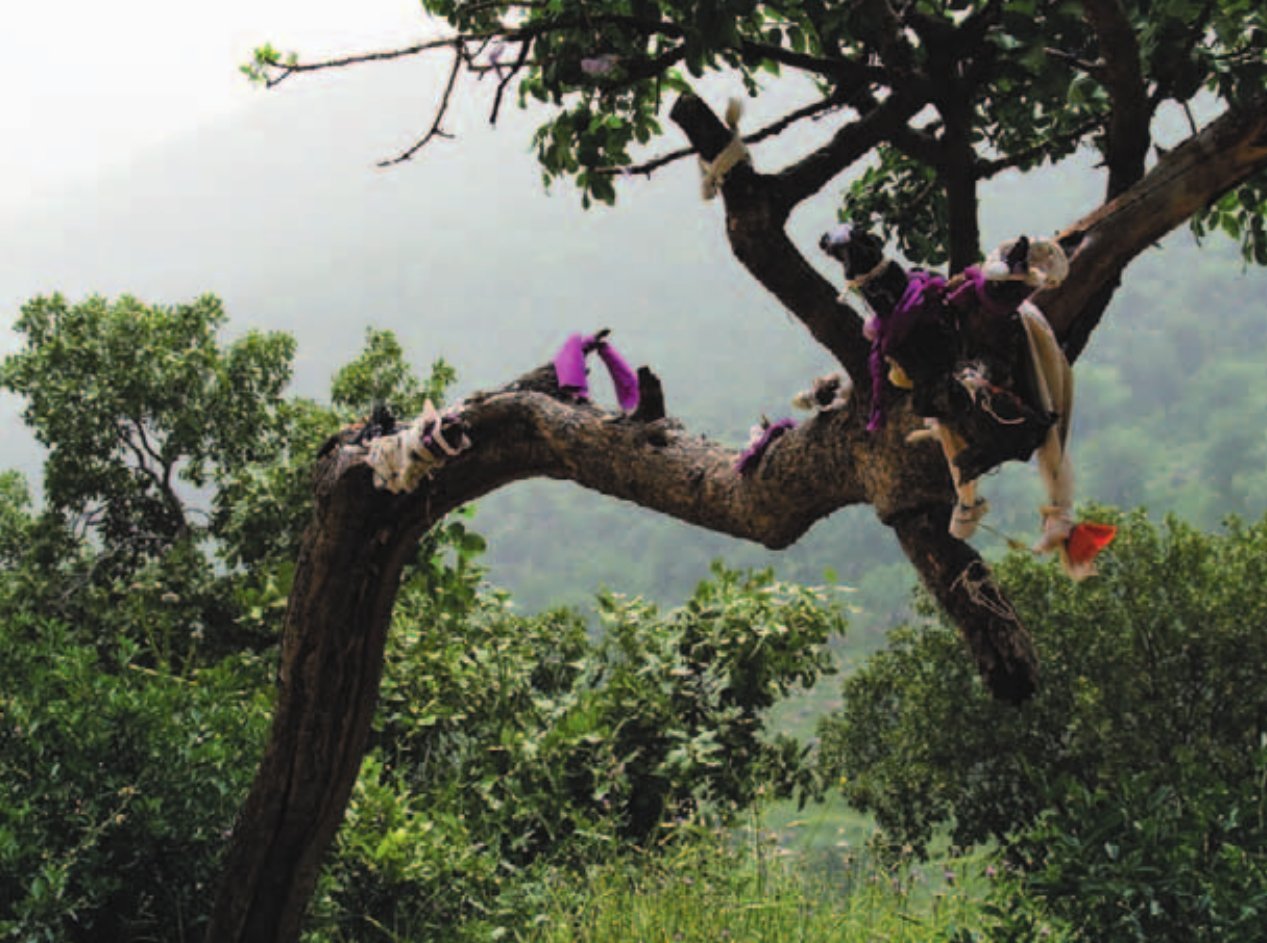
| Tree on the Erefat | on Mount Erefat | One goes to it for children, livelihood and blessing; according to the English version, one ties colorful ribbons to its branches and makes a wish. |
| Dara Hesenê Geyar | on the grave in the Geliyê miriya ("valley of the dead") | – |
| Oak of Babê Îso | behind the olive grove | Tree of the dervish Babê Îso, who prayed in the cave of Omer Xala. |
| Dara Leylê | in the Sûka Merîfetê | According to the English version, tree of Leylê, the mother of the Ezidis and wife of Şehîdê bin Cer. |
| Dara Zergûz | near Kaniya Şivana and Pira Selatê | With its twigs and leaves the Xerqe is dyed black. |
| Dara Ta û bawî ("fever tree") | – | Relatives of people sick with fever tie on a ribbon and ask for healing. |
Source of the table: Lalişa Nûranî, pp. 34–37, 104, 156, 204.
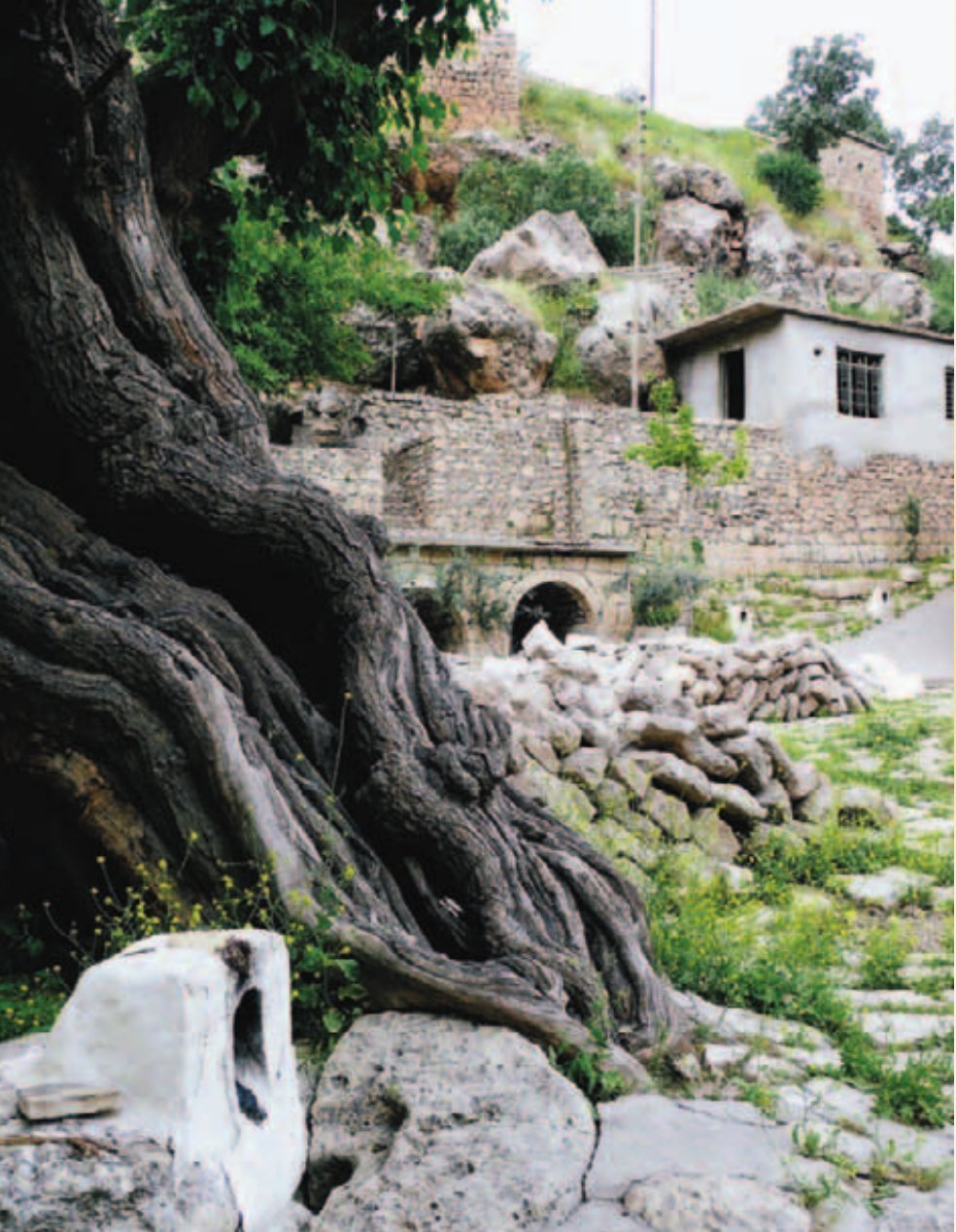
Zergûz – the tree of the Xerqe
According to the photo book, the Zergûz is a kind of walnut tree that bears no fruit. In the Kela Xerqe in the courtyard Gaykuj its twigs are boiled, and in the brew the wool for the Xerqe of the Feqîr is dyed black (Gaykuj). The Zergûz also has its place in the tradition of creation: according to Kreyenbroek, the King created it himself; according to Pirbari, fish, bull, Zergûz and sheep come from seeds of the Kaniya Sipî.
The olive grove
The old olive grove (rezê zeytûnê) of Lalîş was, according to tradition, planted by Şîxadî (Şêx Adî). Its olives are not eaten, for their oil is intended for the lamps of Lalîş. Special Xizmetkar (servants) tend the grove and make the oil (Lalişa Nûranî, p. 30). According to the photo book's glossary, it is done like this: the olives go into a special basin, water is added, they are pressed with the feet, and the juice is boiled until the water has evaporated and pure oil remains.
Before and after the time of Şîxadî the village of Behzan brought its tithe of oil in jars to Lalîş; this no longer happens today (Lalişa Nûranî). The oil is stored in large jars (Hesin Dena) and burns in the wicks (Nîşangeh and wicks).
Holy trees beyond Lalîş
According to Açıkyıldız, holy trees – olive, fig and above all mulberry – are hung with votive cloths at many Ezidi sanctuaries; the mulberry tree is considered to have healing power. Pilgrims take berries, leaves and fruits from the valley of Lalîş with them as having healing power.
Sources
- S. A. Grigoriev, L. V. Ivasko, D. V. Pirbari (P’îr Dîma): Lalişa Nûranî / Святой Лалыш / Holy Lalish. Yekaterinburg: Basko 2008, p. pp. 20–25, 30, 34–37, 104, 156, 202, 204, 206
- Birgül Açıkyıldız: The Yezidis. The History of a Community, Culture and Religion. London 2010, p. pp. 129, 143
- Dimitri Pirbari (P’îr Dîma), A. Ščedrovickij: Тайна жемчужины (The secret of the pearl). Moscow/Tbilisi 2016, p. pp. 83–84, 249
- Philip G. Kreyenbroek, Khalil Jindy Rashow: God and Sheikh Adi Are Perfect. Sacred Poems and Religious Narratives from the Yezidi Tradition. Wiesbaden: Harrassowitz 2005, p. pp. 27–28
Found a mistake?
Is something wrong – a fact, a spelling, a source, an image? Let us know: we check every report and correct the article.
Other spellings: Daren Lalise · Daren Lalische · Daren Lalishe · Dara Xewe · Dara Chewe · Dara Khewe · Dara Nezere · Dara Leyle · Dara Zerguz · Dara Ta u bawi · Reze zeytune · Rez zeytune · Rez zeytûnê · Lalish · Lalisch · Lalesh · Xirqe · Kherqe · Khirqa · Faqir