
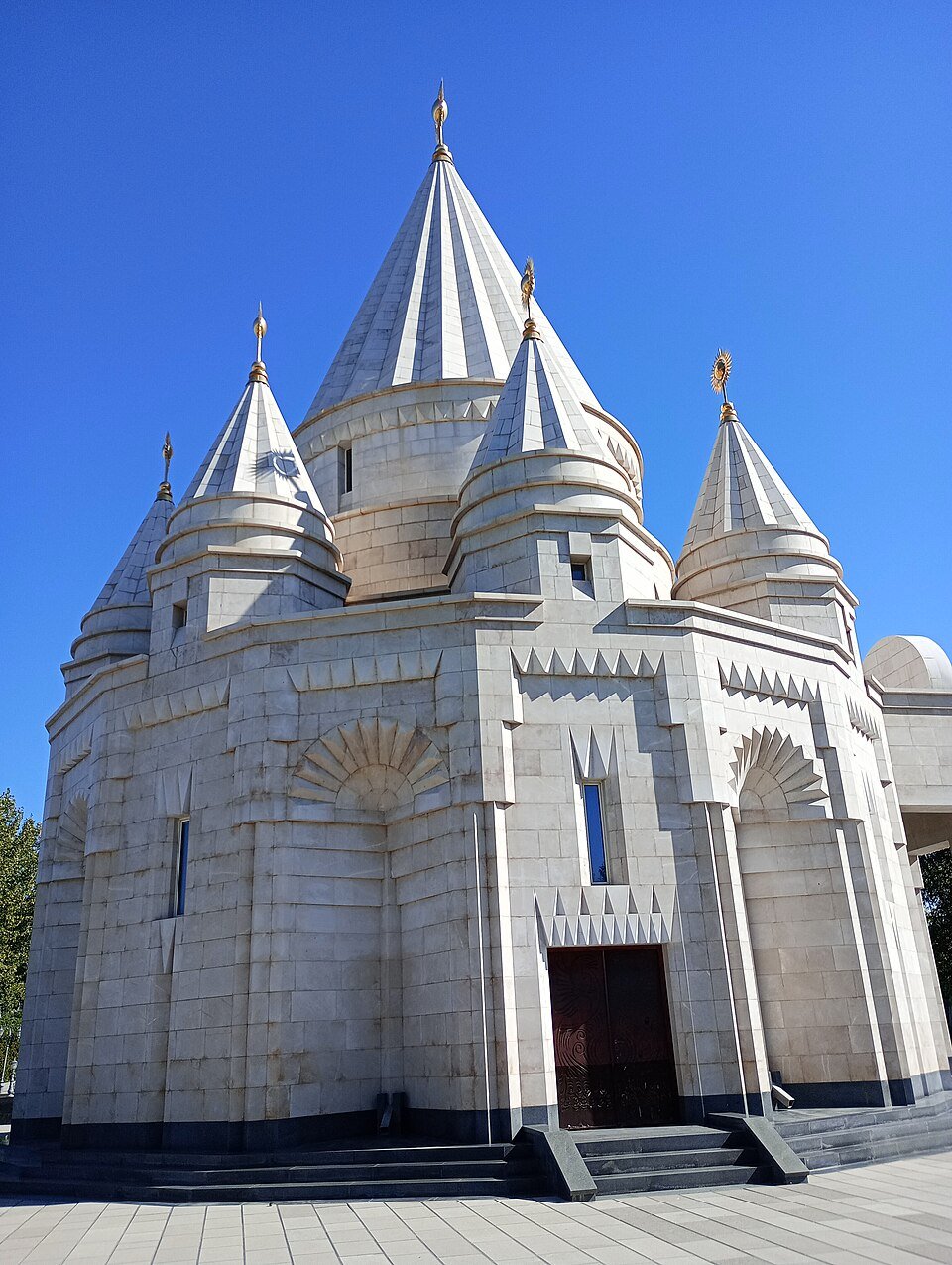
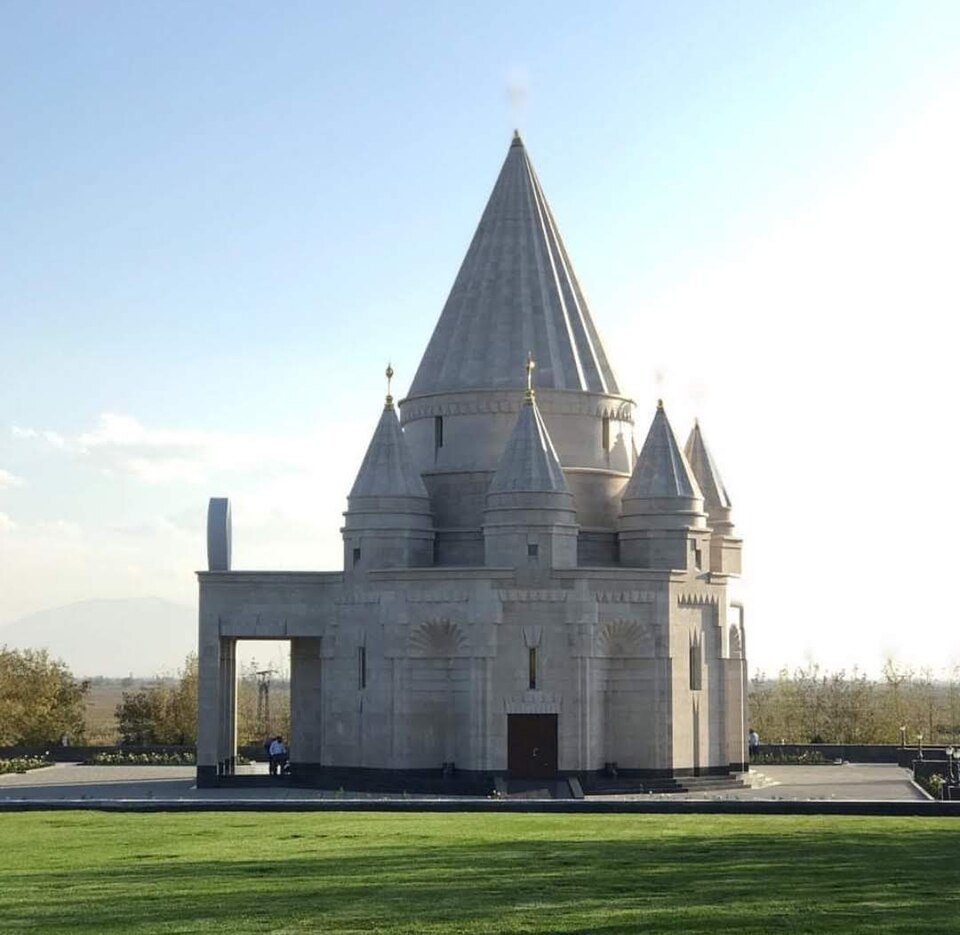
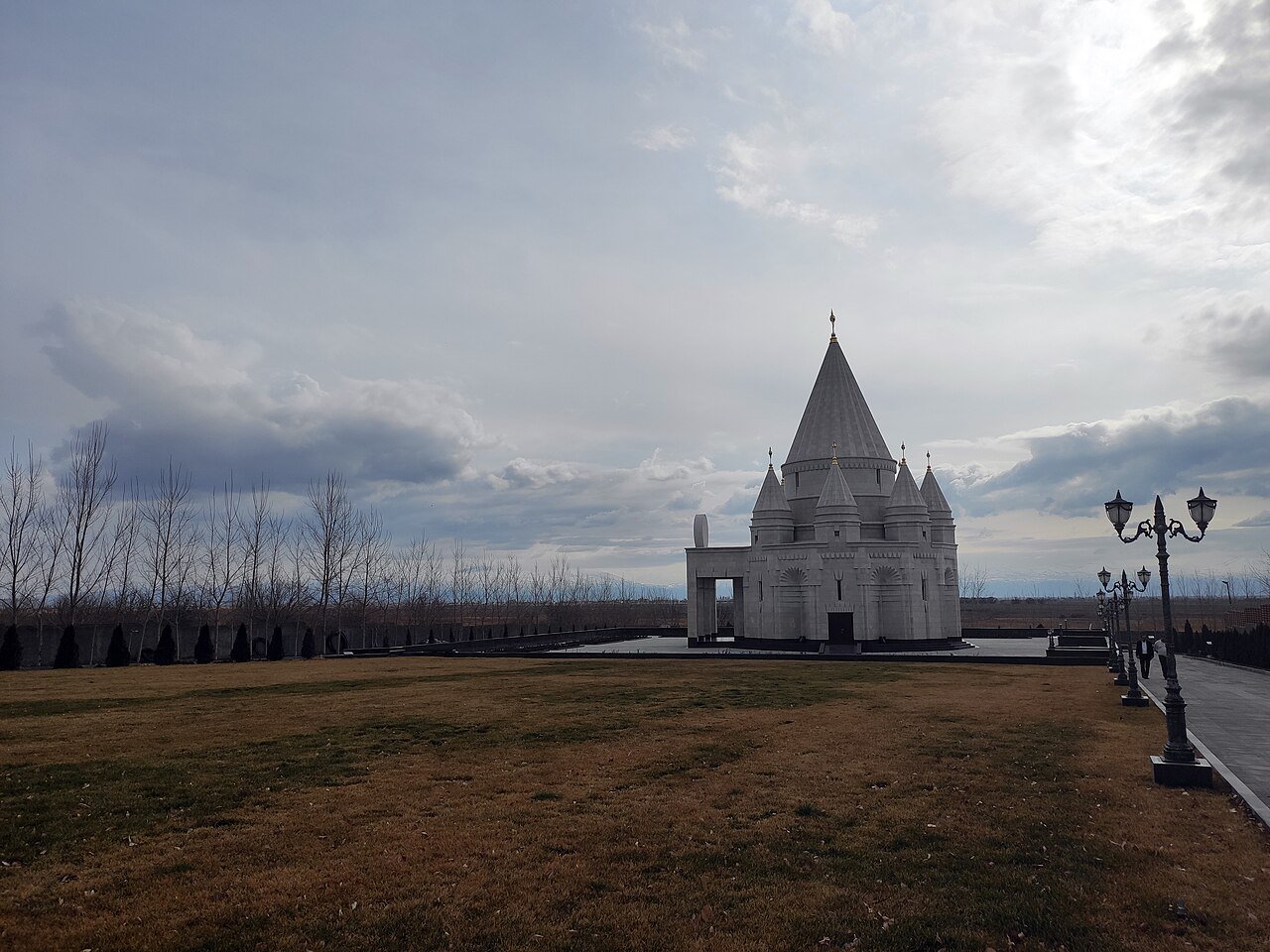
The Quba Mêrê Dîwanê in the village of Aknalitsch in Armenia is regarded as the largest Ezidi temple in the world (Rudaw 2019; Al Jazeera 2019). The foundation stone was laid on 22 April 2015, and the building was opened on 29 September 2019. It stands a few meters from the older Ziyaret of 2012, the first Ezidi sanctuary in Armenia (Rudaw 2019). Both buildings were paid for by the entrepreneur Mirza Sloyan (EurasiaNet 2016; Al Jazeera 2019).
The prehistory up to 2015 – construction and consecration of the Ziyaret, memorial complex, laying of the foundation stone – is described in detail in the article Sanctuary and temple in Aknalitsch. The main source for this period is the donor's own book (Sloyan 2015). It ends in 2015; for the finished building this article relies on press reports from 2016 to 2020 and on freely licensed photos from Wikimedia Commons.
Location
Aknalitsch lies in the province of Armavir, about 35 km west of Yerevan (Rudaw 2019). From there one can see Ararat across the Turkish border; the Metsamor nuclear power plant is nearby (RFE/RL 2019). According to RFE/RL, the site covers about four hectares with a cemetery and sanctuaries (RFE/RL 2019). The Ezidi cemetery of the village borders on the temples (Al Jazeera 2019). The Armenian place name means "eye lake", after a small, eye-shaped lake (Hetq 2020).
Name
In reports the name Quba Mêrê Dîwanê is rendered freely as "Everyone comes together" (EurasiaNet 2016; Hetq 2020). At the opening, Armenian Radio gave the full name "Quba heft mêrê dîwanê û Tawûsê Melek" – "dome of the seven Mêrê Dîwanê and of Tawûsê Melek" (Armenian Radio 2019). The full name thus names Tawûsî Melek and the seven angels; according to AFP, the seven domes also stand for the seven angels (Dawn 2019).
In the donor's book the planned building is still called the "temple of Tawûsî Melek" (Russian храм Таусе Малака; Sloyan 2015, p. 10), in the Êzdîkî edition Qubeya Tawûsî Melek (Siloyan 2015, p. 8).
Origin and donor
Why a second temple?
The Ziyaret consecrated in 2012 had become too small for the many visitors; the new temple was to hold more believers (Sloyan 2015, p. 10). According to the entrepreneur Telman Feroyan, Mirza Sloyan obtained the consent of the clergy of Lalîş for a "second temple" (Sloyan 2015, p. 67).
Laying of the foundation stone on 22 April 2015
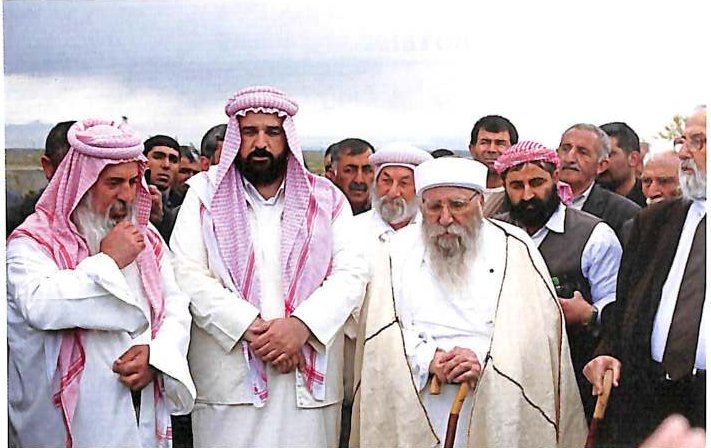
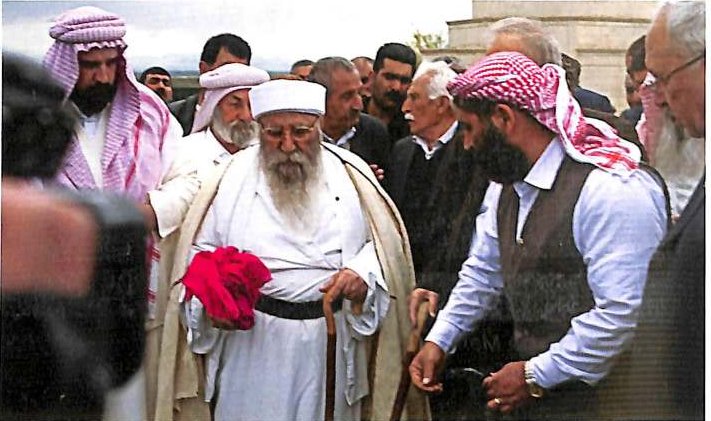
On 22 April 2015 the foundation stone was laid in the presence of Mîr Tahsîn Beg and clergy from Lalîş (Sloyan 2015, p. 10; picture section p-104). On the same day the victims of the genocide of the Armenians of 1915 were commemorated in Aknalitsch (Sloyan 2015, pp. 22–23).
- According to the Bavê Şêx, the delegation from Lalîş brought earth and holy water with them and consecrated with them the foundation of the temple "that will bear the name of our supreme archangel – Tawûsî Melek" (Sloyan 2015, p. 64).
- The picture section of the book shows the speech of the Mîr, the blessing of bread from Lalîş and the consecration of the building site by the Bavê Şêx; believers received the blessing and water from Lalîş (Sloyan 2015, picture section p-104, p-106, p-120–121).
- In a conversation the day after, the Mîr said he would consecrate the temple "with great joy" and hand it over to the people "if health permits"; the temple would be for the people "another gate of faith and hope" (Sloyan 2015, p. 59).
The donor
Mirza Sloyan (Êzdîkî Mirzeyê Çolo Siloyan) was an Ezidi entrepreneur born nearby and living in Moscow (Dawn 2019; EurasiaNet 2016). He had already paid for the Ziyaret of 2012 (EurasiaNet 2016) and also gave the money for the new temple (Rudaw 2019; Al Jazeera 2019). The construction costs were not published (EurasiaNet 2016). For imported building materials – marble from Iran – and for relics from Iraq, the Armenian state waived customs duties (Al Jazeera 2019). Mirza Sloyan died in November 2019 in Munich, a few weeks after the opening (Hetq 2020; Al Jazeera 2019).
Design and architect
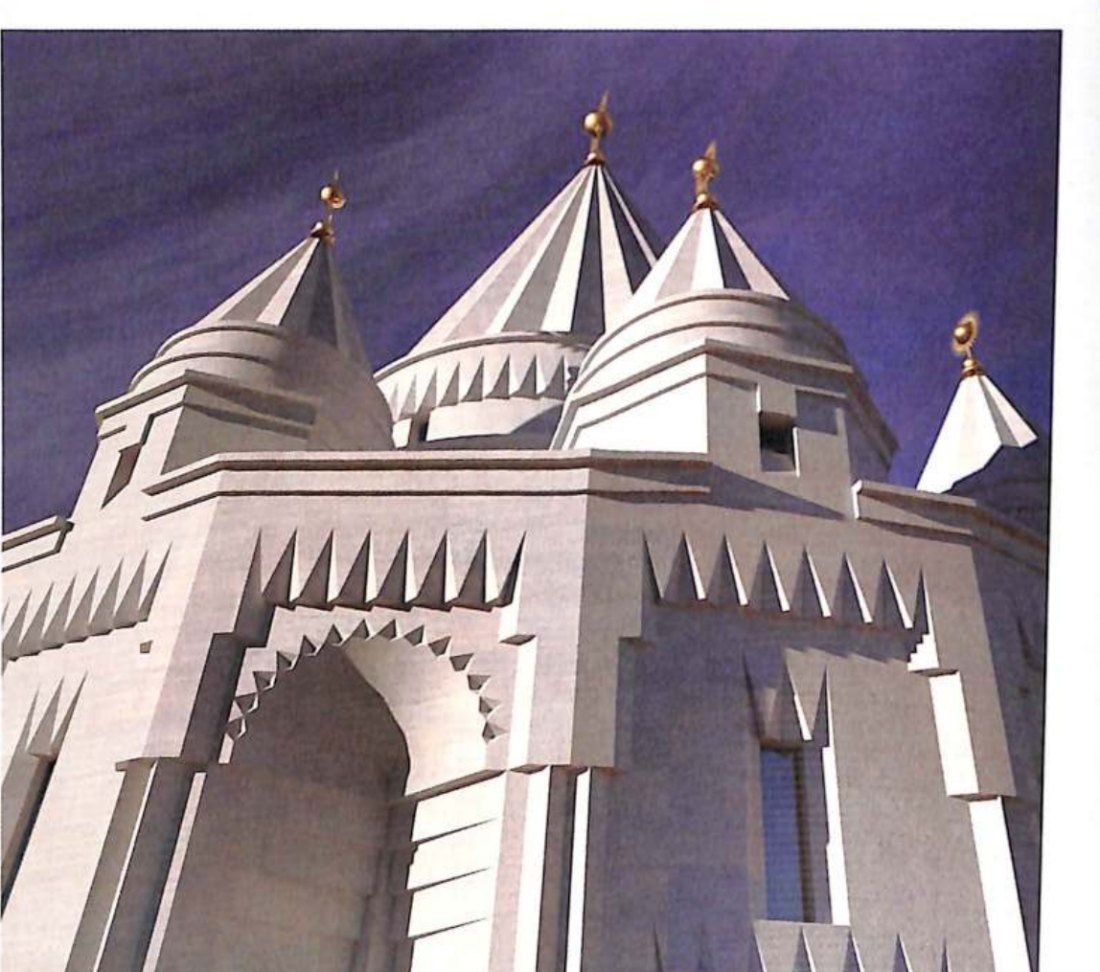
The temple was designed by Artak Guljan (Artak Ghulyan), an Armenian architect who mainly builds Armenian churches, among them the Armenian cathedral in Moscow (Hetq 2020; RFE/RL 2019). According to the book of 2015, he had designed over 20 churches in Armenia and abroad, among others in Yerevan, Abovyan, Artashat, Sevan, Moscow, Saratov and Vladimir (Sloyan 2015, p. 10).
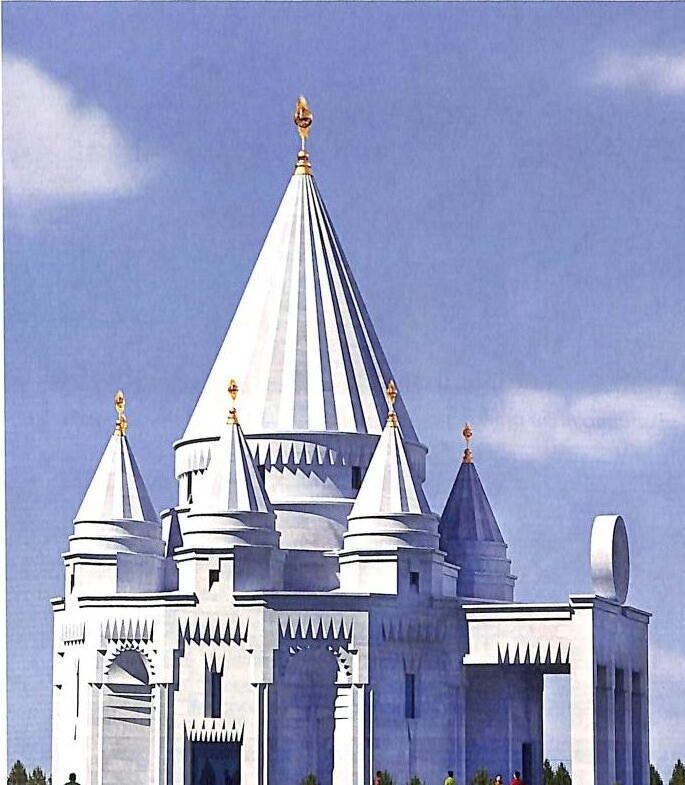
The design of 2015 envisaged (Sloyan 2015, p. 10):
| Feature | Design 2015 |
|---|---|
| Height | 25 m |
| Domes | one large and seven small |
| Interior | more spacious than in the Ziyaret, for more believers at the rites |
| Porch | a porch (vestibule) of its own |
| Layout | one complex together with the existing Ziyaret and recreational areas |
Guljan said that the simple traditional building style of Ezidi sanctuaries had on the one hand caused him difficulties and on the other hand left him freedom; he had tried to find a modern form "starting from the historical development" (Sloyan 2015, pp. 10–11, in the foreword by Sergo Jerizjan). According to RFE/RL, the building is strongly inspired by Lalîş (RFE/RL 2019).
Construction and architecture
In July 2016 the temple had been under construction for almost a year (EurasiaNet 2016). According to the reports, the finished building has:
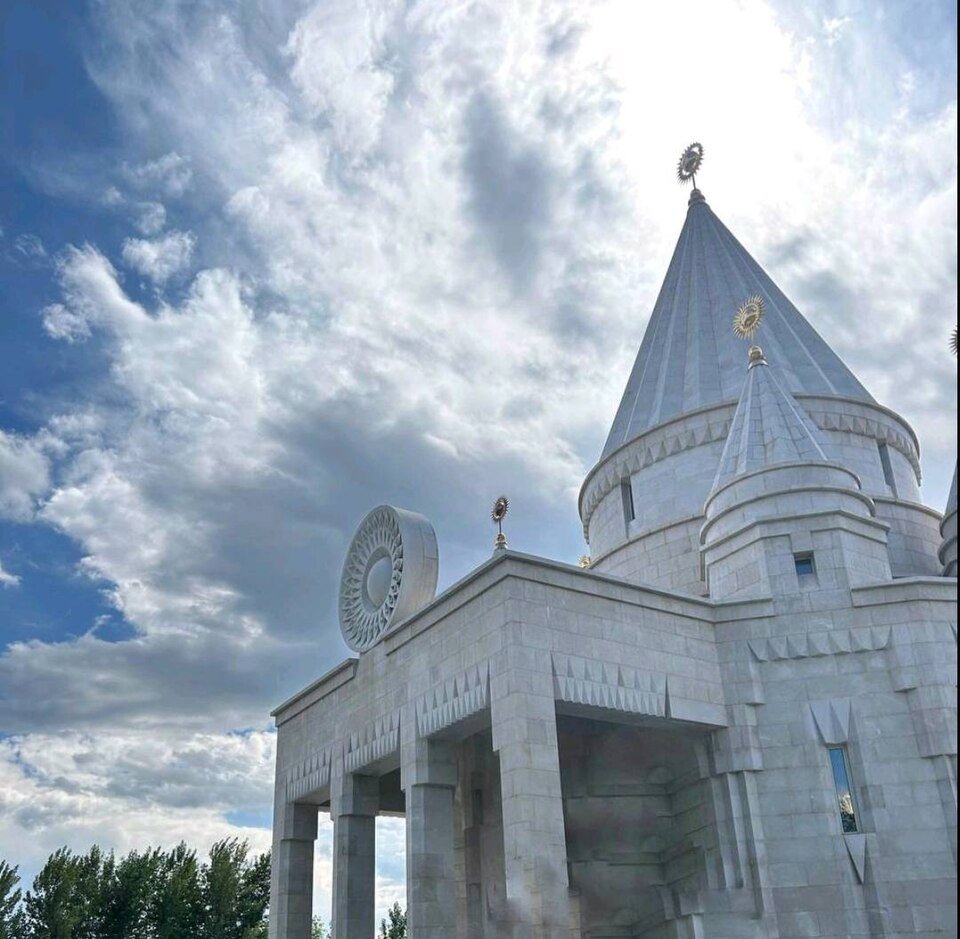
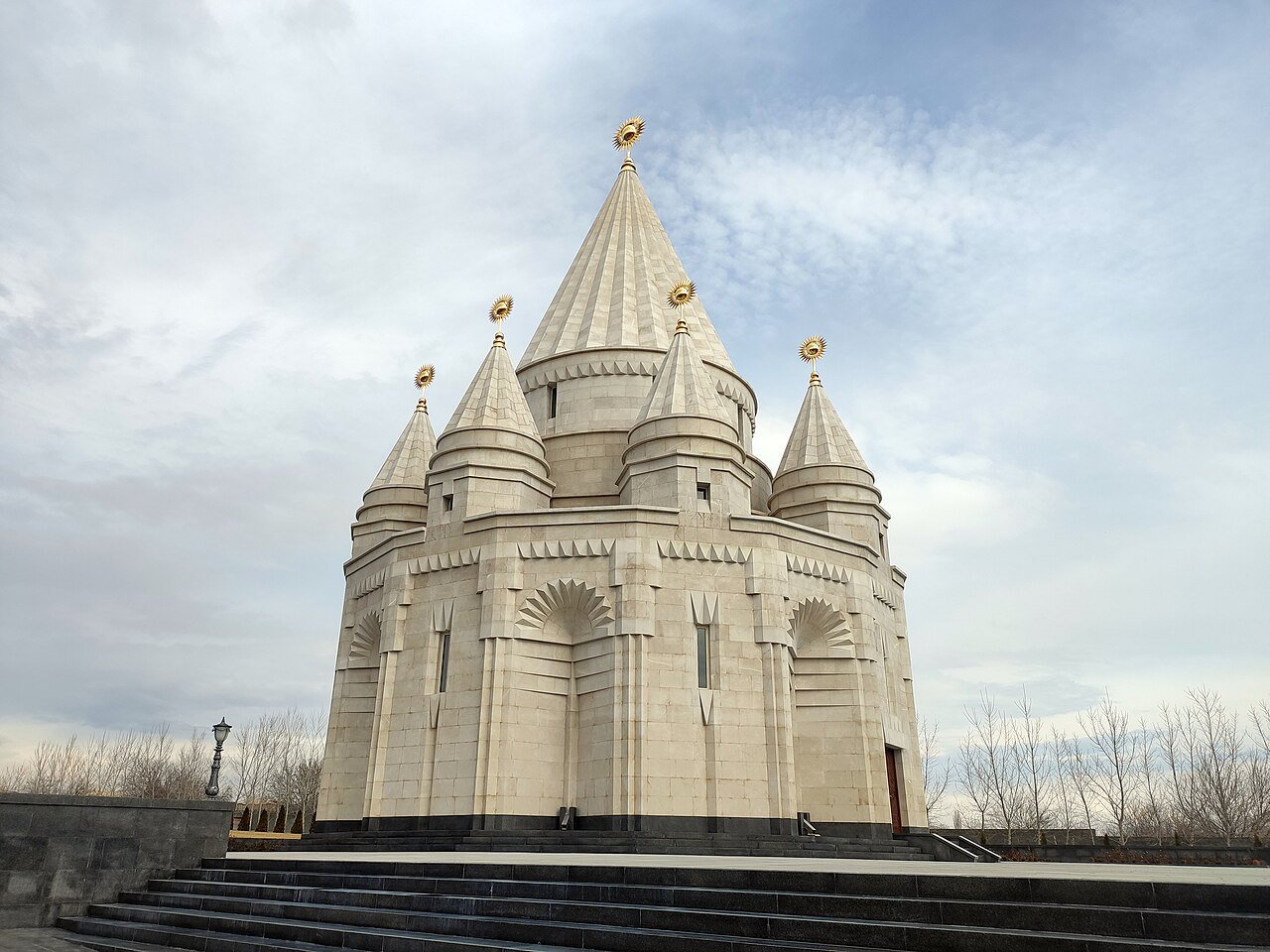
- Height: about 25 meters (Rudaw 2019); EurasiaNet gave exactly 25.3 m in 2016 (EurasiaNet 2016).
- Building materials: Armenian granite and Iranian marble (EurasiaNet 2016), according to AFP "milk-white Persian marble" and polished granite (Dawn 2019).
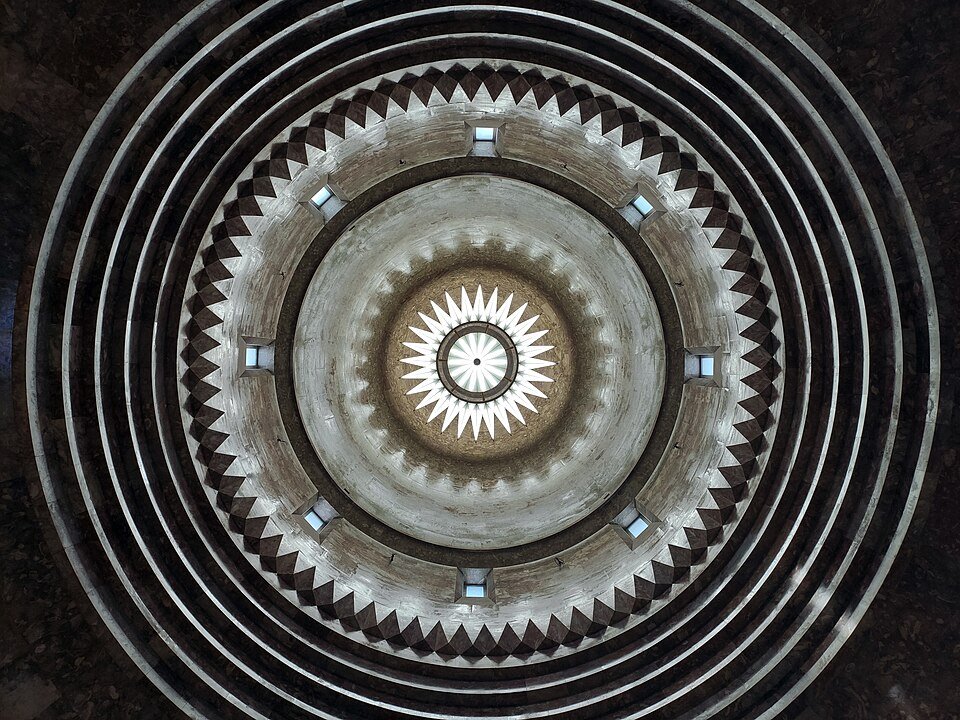
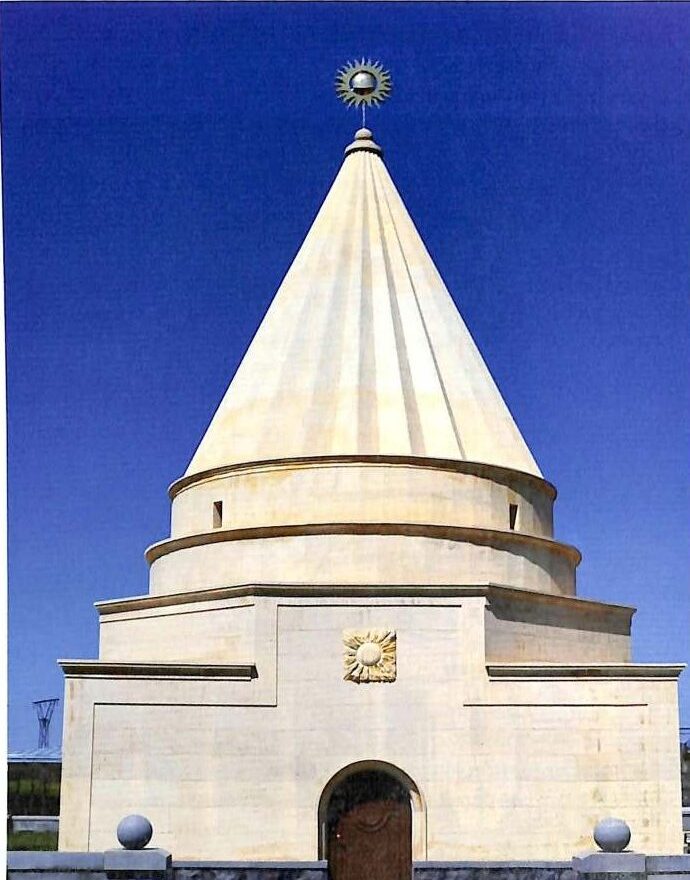
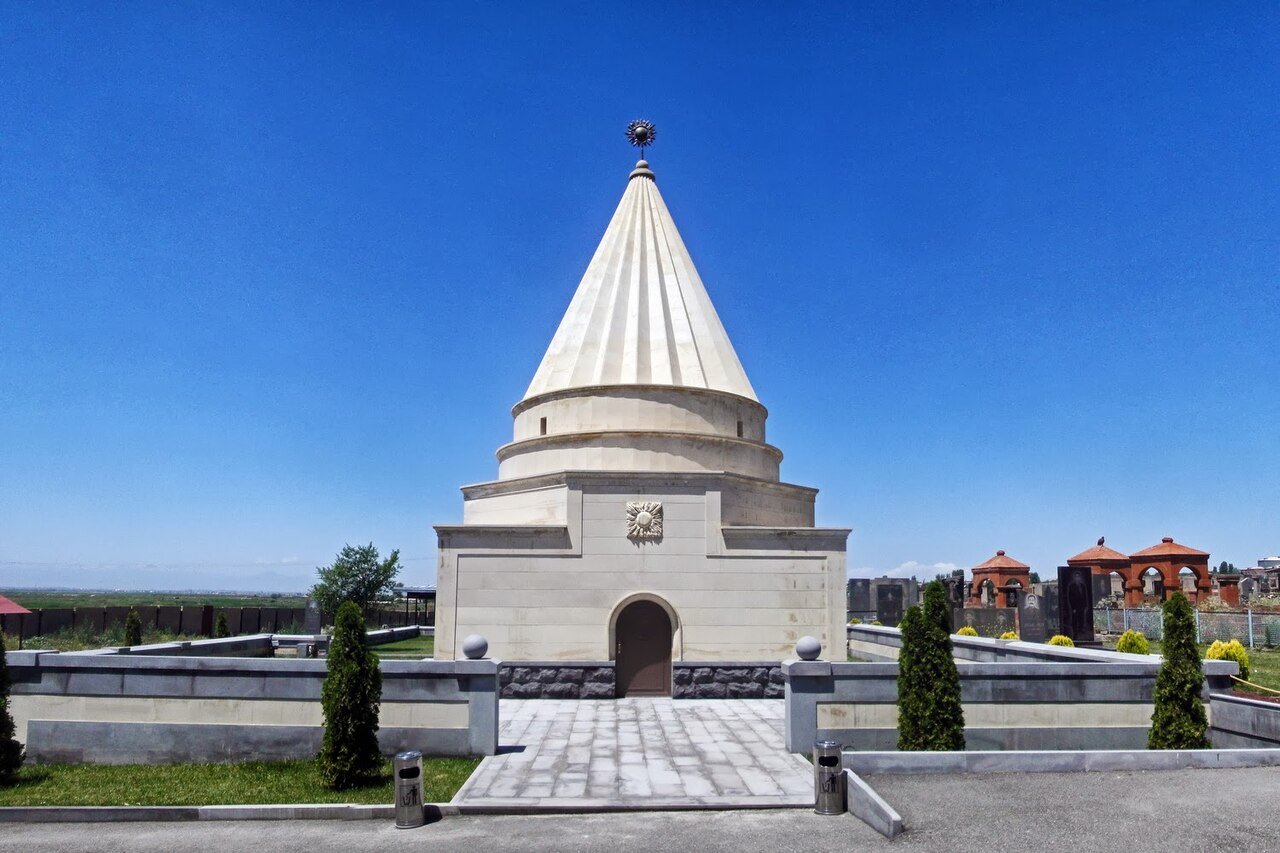
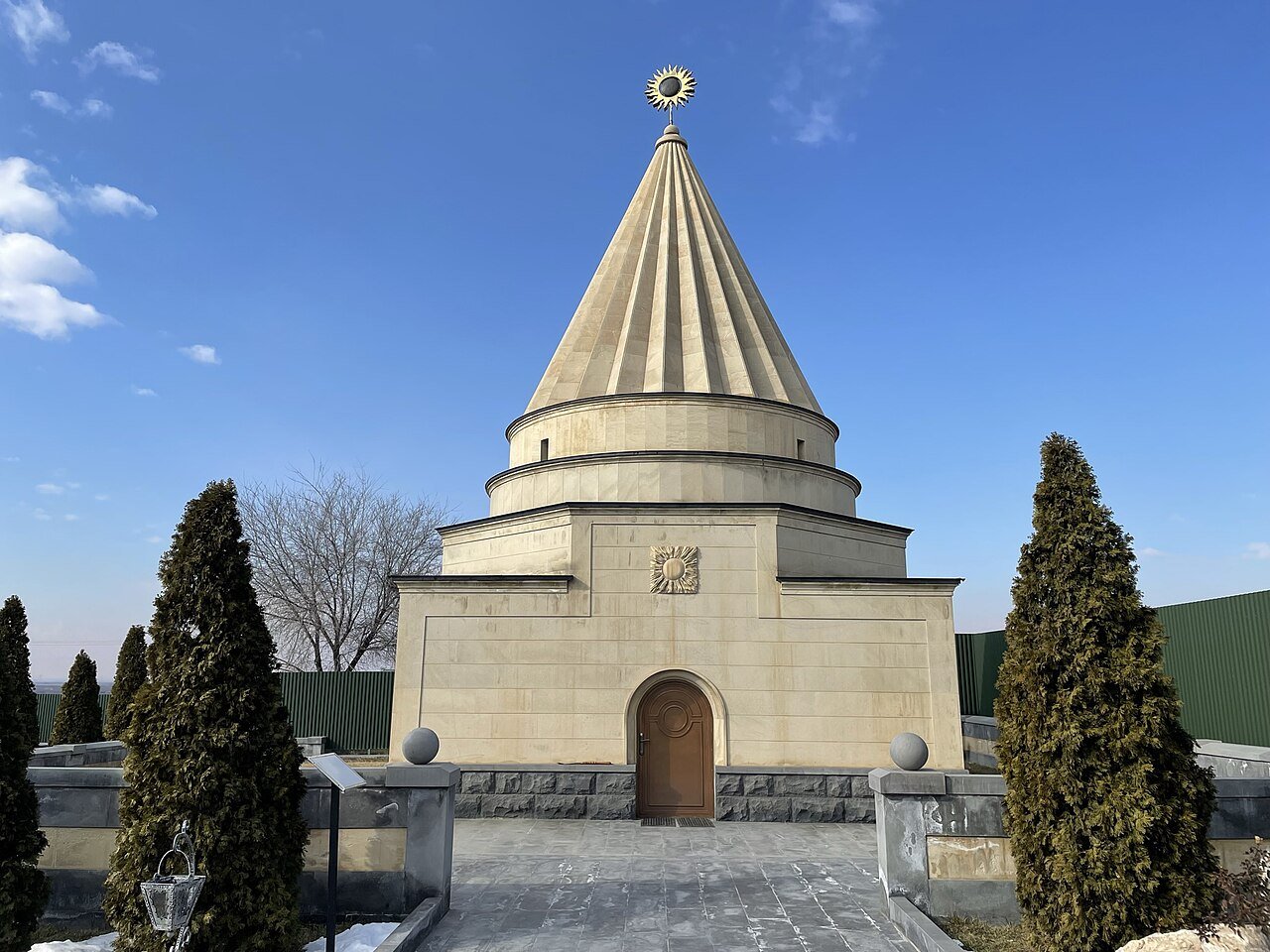
- Domes: seven domes stand around a high central vault (Rudaw 2019). The white, radially articulated conical roofs bear golden suns (RFE/RL 2019; Al Jazeera 2019). According to AFP, the seven domes stand for the seven angels (Dawn 2019).
- Rooms: a prayer hall, a school for clergy and a museum (Rudaw 2019; Dawn 2019). RFE/RL wrote in October 2019 that the school and museum were planned (RFE/RL 2019).
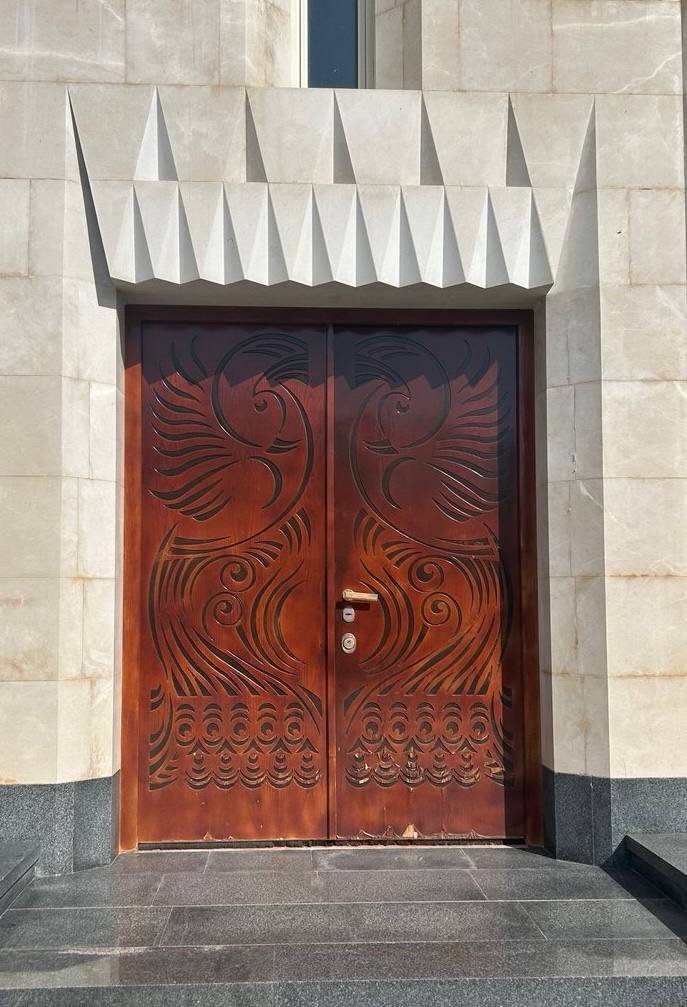
- Doors: wooden doors with peacock motifs (Al Jazeera 2019).
- Surroundings: the temple stands in a rose garden (Dawn 2019). On the site there is also a banquet hall in which weddings are celebrated (RFE/RL 2019).

Interior
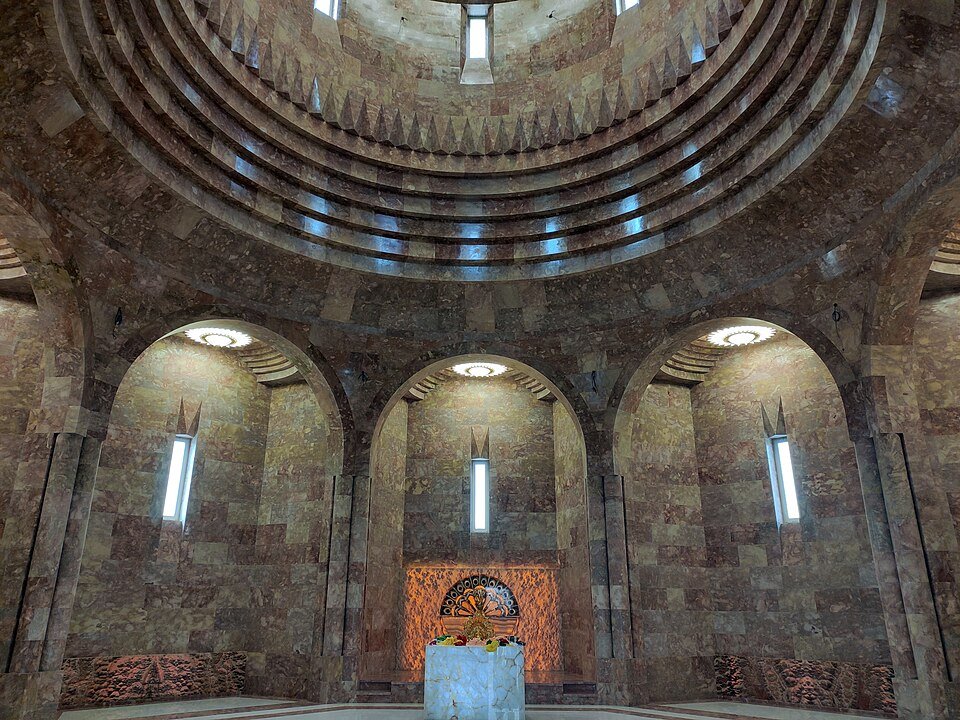
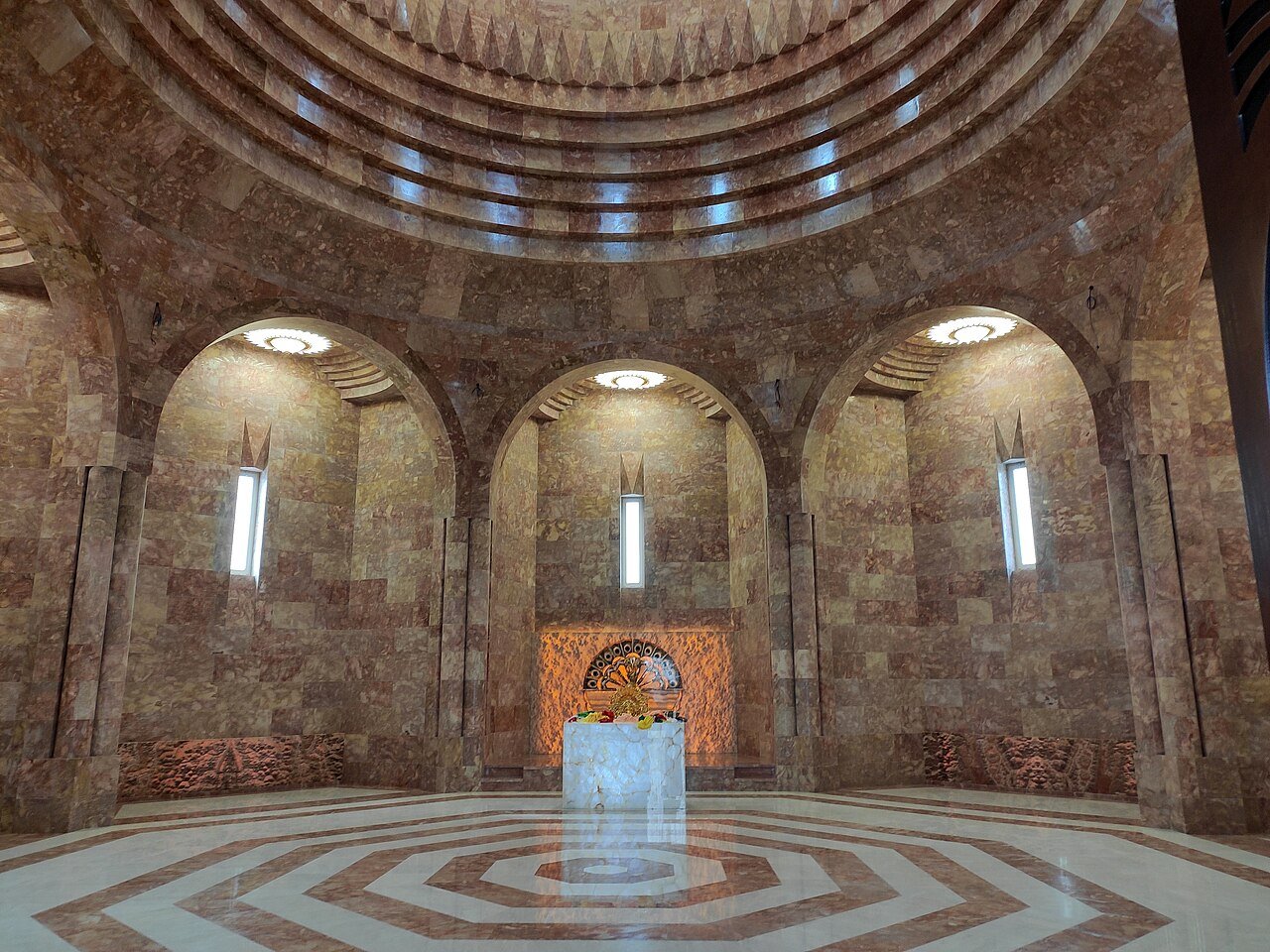
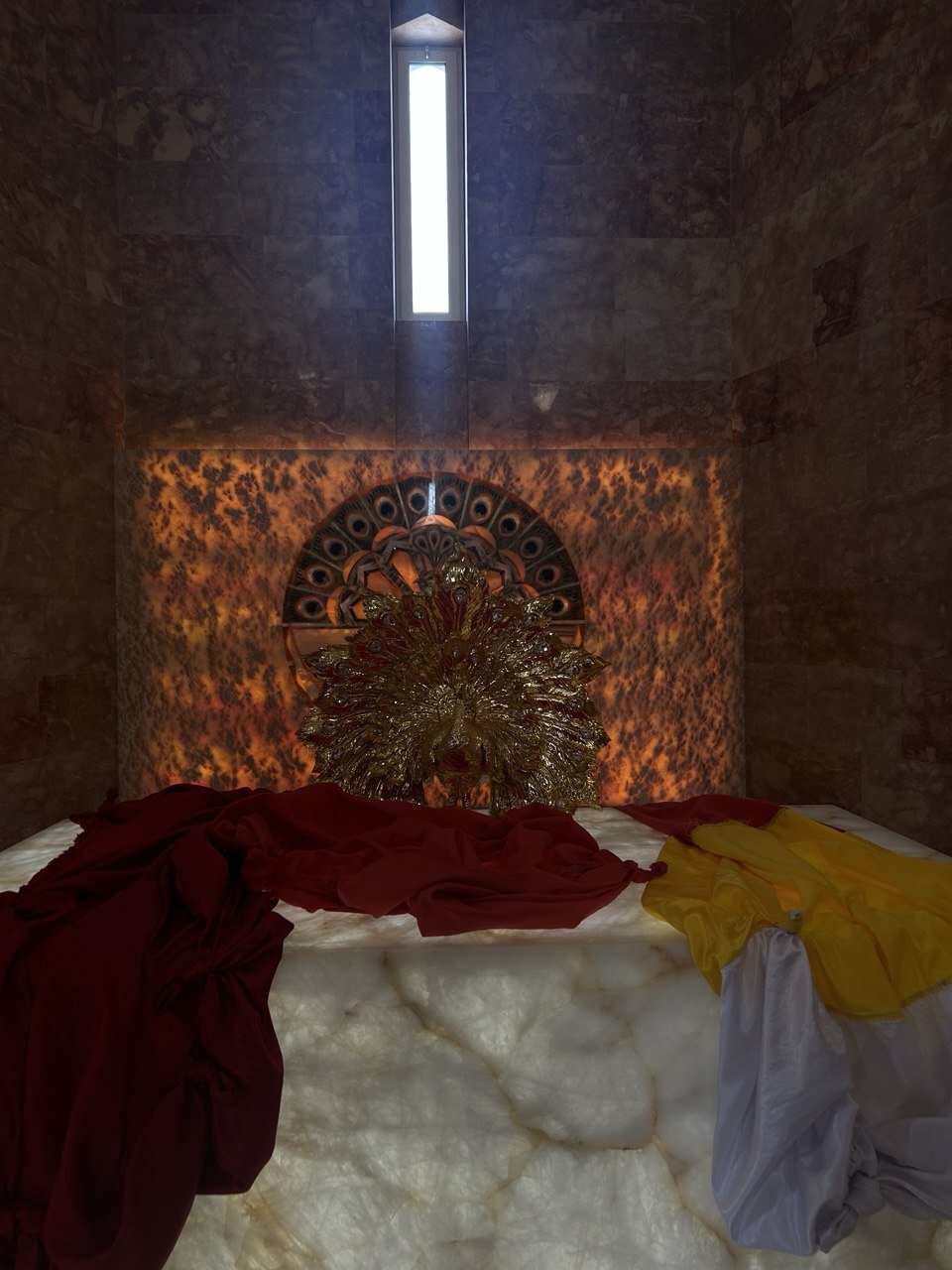
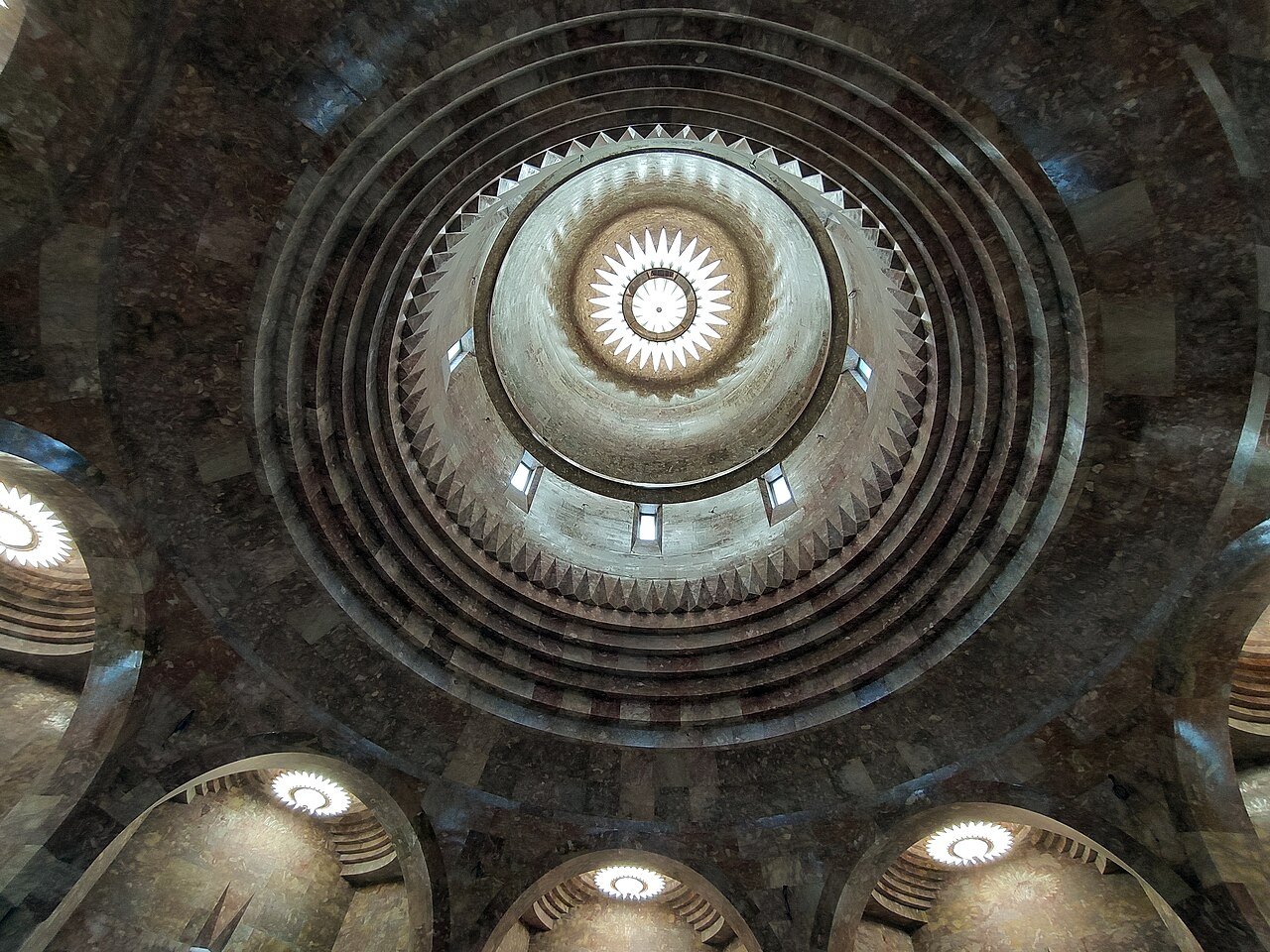
According to EurasiaNet, the prayer room is about 200 m² in size (EurasiaNet 2016). The walls are clad in marble, part of which is backlit; ceiling lights have the form of suns (RFE/RL 2019). Al Jazeera describes a gold-colored room with an altar; behind it stands a colored, backlit stone image of Tawûsî Melek that was specially ordered in Russia (Al Jazeera 2019). At the first anniversary in 2020, thousands of believers entered the temple to honor Tawûsî Melek (Hetq 2020).
The photos show a round hall under a high dome stepped in rings with a sun window in the middle; three round-arched niches with narrow windows open onto the room, and the altar stands in the middle one. On the holy objects see Sencaq and Tawûs.
Opening in 2019
The temple was consecrated on 29 September 2019 (Armenian Radio 2019; Hetq 2020). This is the annual day of the sanctuary that Mîr Tahsîn Beg had fixed at the consecration of the Ziyaret in 2012 (Sloyan 2015 – see P&C article). The celebration was attended by the deputy prime minister of Armenia and other representatives of the state (Rudaw 2019). In the first days pilgrim groups also came from outside, among them Ezidis from Krasnodar in Russia (RFE/RL 2019). According to AFP, the temple attracted pilgrims from abroad soon after its completion (Dawn 2019).
The Ziyaret of 2012
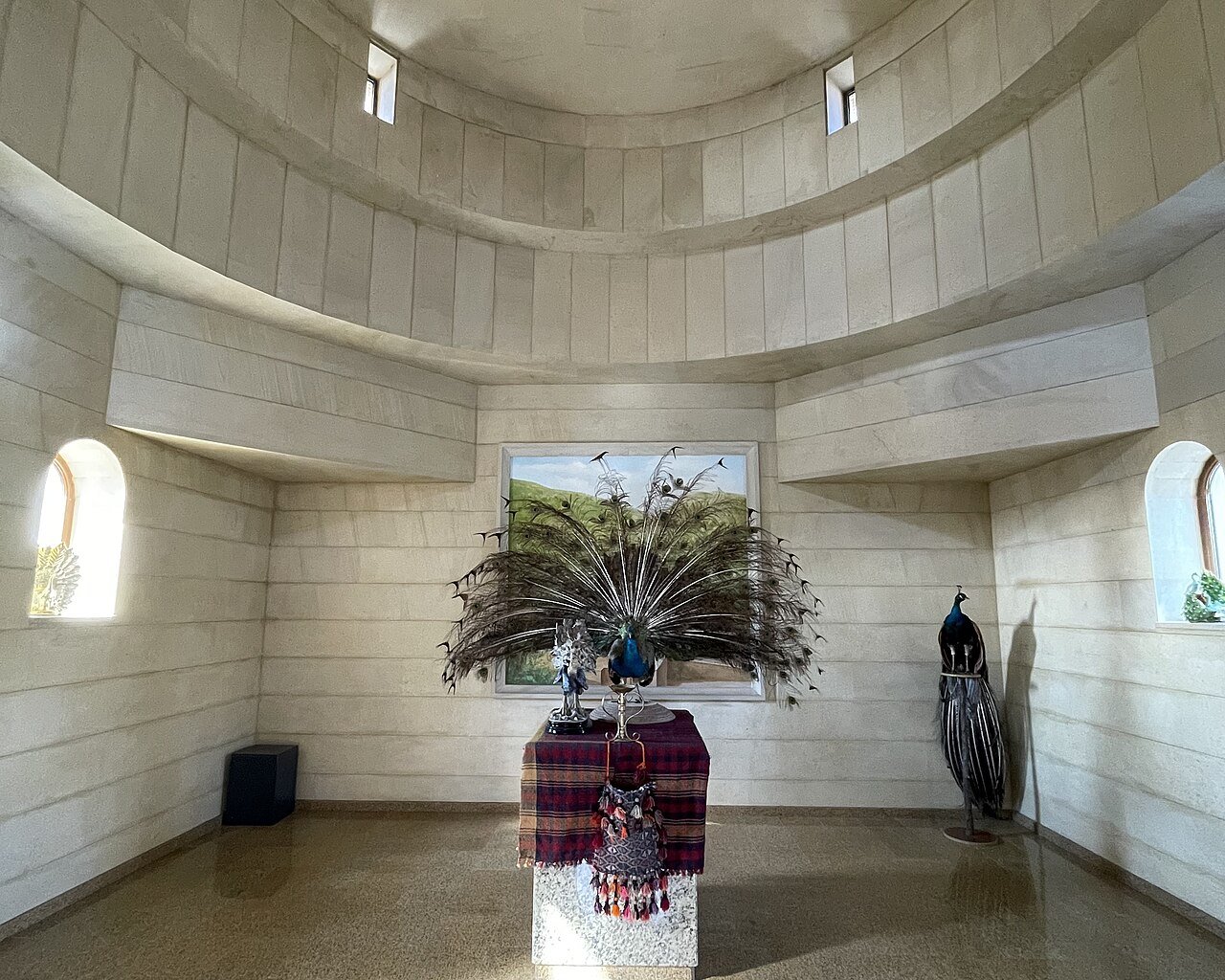
A few meters from the new temple stands the Ziyaret, the first Ezidi sanctuary in Armenia, consecrated on 29 September 2012 in the presence of Mîr Tahsîn Beg (Rudaw 2019; Sloyan 2015 – see Sanctuary and temple in Aknalitsch). RFE/RL calls it the first Ezidi temple in the post-Soviet space (RFE/RL 2019). It has a single conical roof; inside, a stuffed peacock with turquoise feathers stands on a pedestal (Al Jazeera 2019).
Memorial complex and statue park
On 29 September 2014 a memorial complex was opened in Aknalitsch, which Mirza Sloyan dedicated to Armenian-Ezidi friendship; it includes, among other things, the monument "Friendship and Brotherhood" and monuments to Ûsivê Beg and Cangîr Ax’a (Sloyan 2015, picture section p-132; details in the P&C article). Hetq describes the complex as a memorial to the genocide of the Armenians in 1915 and to the genocide of the Ezidis by IS in 2014 (Hetq 2020).
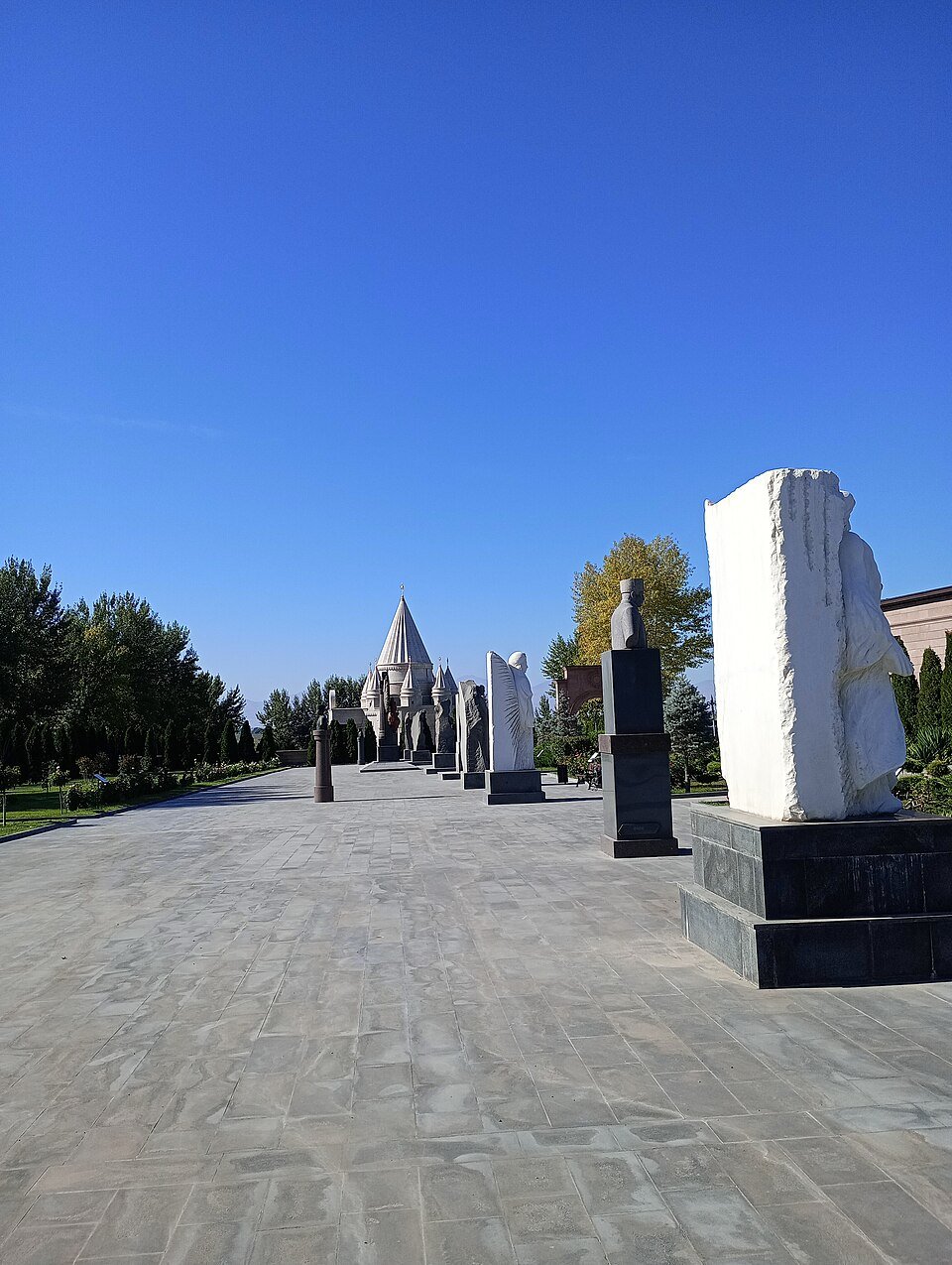
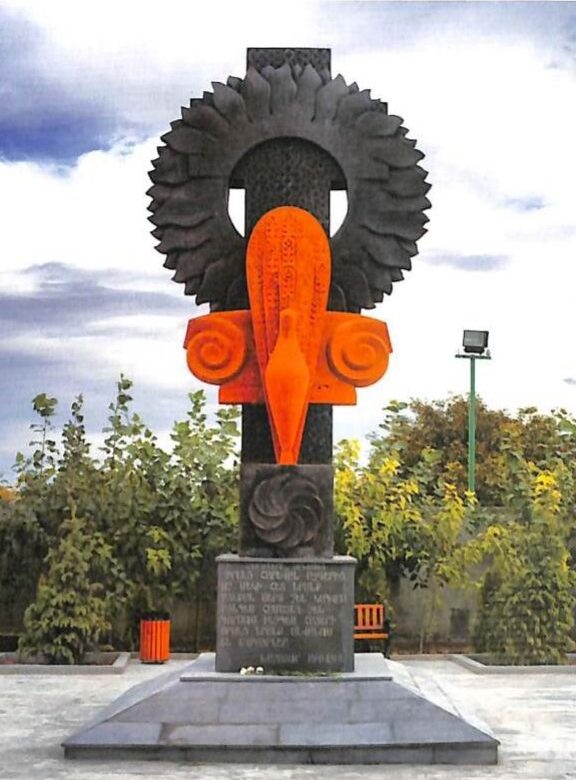
Opposite the temple lies a statue park. Al Jazeera names there a statue of Nadia Murad in broken chains, an equestrian statue of the Armenian military leader Andranik Ozanian and a monument in which an Armenian cross is combined with the Ezidi sun (Al Jazeera 2019). RFE/RL mentions a statue in honor of the victims of the massacres in Şengal in 2014 (RFE/RL 2019).
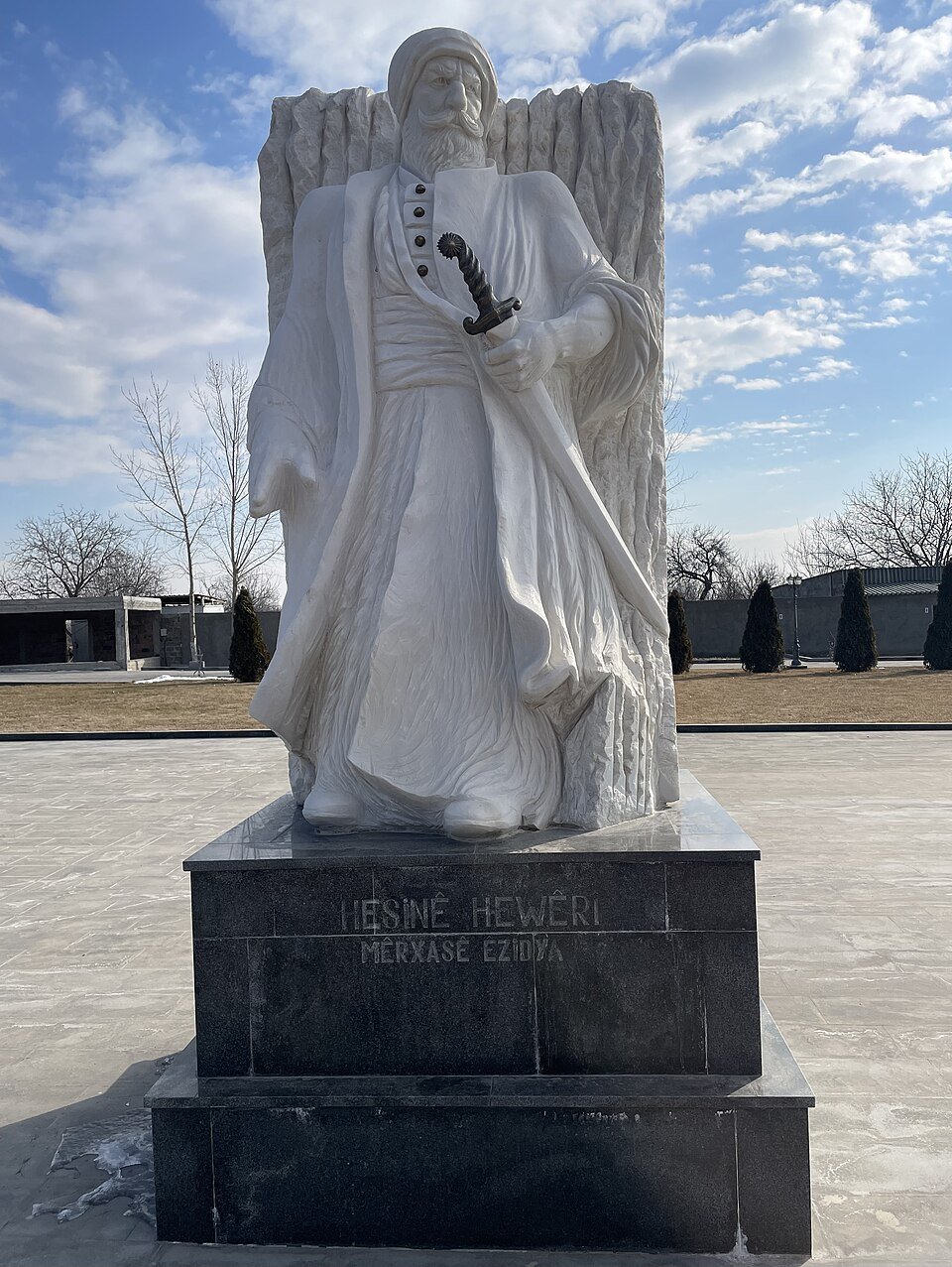
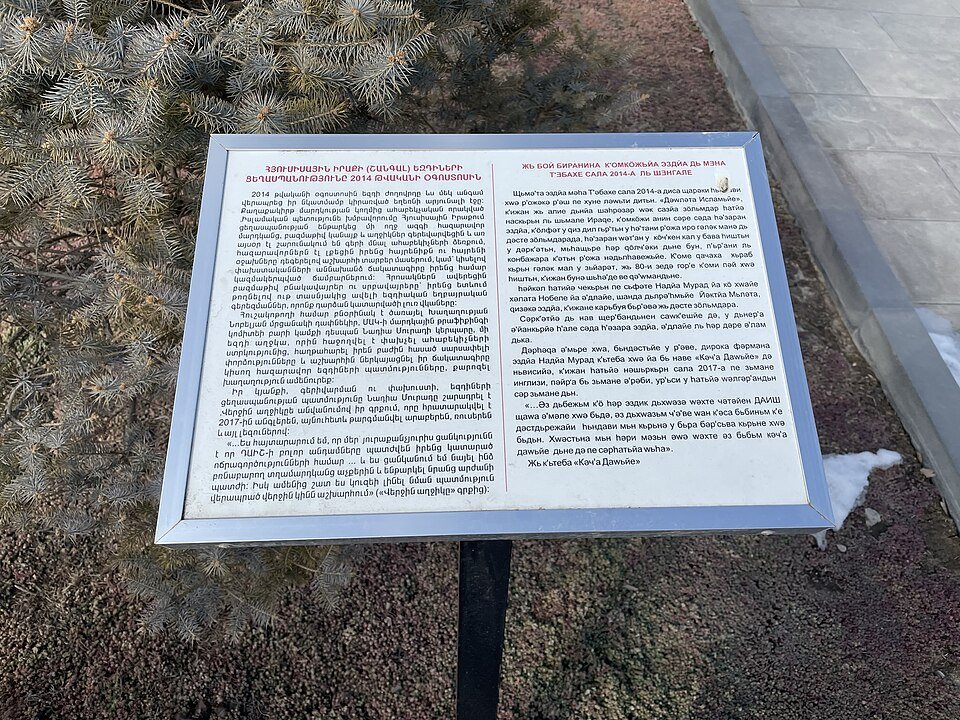
A bilingual plaque commemorates the genocide of the Ezidis in Şengal in August 2014. On the left the text is in Armenian, on the right in Êzdîkî in the Cyrillic script of the Soviet period, headed "Жь бой биранина к'омкожьйа эздийа дь мэха т'эбахе сала 2014-а ль Шьнгале" (Ji boy bîranîna k’omkujiya êzdiya di meha t’ebaxê sala 2014-a li Şingalê, "In memory of the genocide of the Ezidis in August 2014 in Şengal"). The text also names Nadia Murad and quotes from her book "Кәч'а Дамьйе" (Keç’a Dawiyê, 2017). See Şengal 2007 and 2014.
Graves
The temples lie by the Ezidi cemetery of Aknalitsch (Al Jazeera 2019); according to Mirza Sloyan, all the deceased members of his family are buried there (Sloyan 2015 – see P&C article). The Şêx and author Hesenê Şêx Kelaşê (Hesen Hesenyan) also lies in the cemetery. His gravestone bears in Cyrillic Êzdîkî script the inscription "Һәсәне Шех К'әләше" and the dates 22.05.1943 – 27.05.2017 (photo 2022, Wikimedia Commons).

Significance
- The Quba Mêrê Dîwanê is the largest Ezidi temple in the world (Rudaw 2019; Al Jazeera 2019; RFE/RL 2019) and, after the Ziyaret, the second completed Ezidi temple in Aknalitsch (Hetq 2020).
- Al Jazeera counts it among the few Ezidi houses of worship outside the mountains around Lalîş (Al Jazeera 2019).
- According to the census of 2011, the Ezidis, with over 35,000 people, are the largest minority in Armenia (Rudaw 2019).
- According to Sloyan, thousands of visitors have come to Aknalitsch every year on the day of the sanctuary since 2012 (Sloyan 2015 – see P&C article); thousands of believers came to the first anniversary of the new temple in 2020 (Hetq 2020). Further new sanctuaries in the Caucasus are named in the article Holy places in the Caucasus and in the diaspora.
More pictures
Sources
- Mirza Sloyan (Mirzoyê Çolo Siloyan): Дорога, ведущая в храм. Три года спустя (The road leading to the temple. Three years later). Yerevan 2015, p. pp. 10–11, 22–23, 59, 64, 67; picture section p-101, p-102, p-104–106, p-120–121, p-132
- Mirzeyê Çolo Siloyan: Riya ku ber bi ziyaretê dibe. Pey sê salan ra (Êzdîkî edition of “Дорога, ведущая в храм. Три года спустя”). Yerevan 2015, p. p. 8
- Rudaw (Shahla Omar): World’s largest Yezidi temple opens in Armenia, 30.9.2019, accessed 25.11.2026, p. online
- Public Radio of Armenia (en.armradio.am): World’s largest Yezidi temple Quba heft merê dîwanê u Tawûsê Melek opened in Armenia, 29.9.2019, accessed 25.11.2026, p. online
- Radio Free Europe/Radio Liberty (Amos Chapple): Proud As A Peacock – Armenia’s New Yazidi Temple Draws Attention And Awe, 3.10.2019, accessed 25.11.2026, p. online
- Dawn / AFP: Long-persecuted Yazidis welcome new ‘sanctuary’ temple, 22.10.2019, accessed 25.11.2026, p. online
- Al Jazeera (Ariel Sophia Bardi): Inside the world’s biggest Yazidi temple in Armenia, 11.11.2019, accessed 25.11.2026, p. online
- EurasiaNet (Maxim Edwards): Armenia to House World’s Largest Yazidi Temple, 6.7.2016, accessed 25.11.2026, p. online
- Hetq (Pietro A. Shakarian): Dispatches from Aknalich – Marking the 1st Anniversary of the World’s Largest Yazidi Temple in Armenia, 14.9.2020, accessed 25.11.2026, p. online
- Wikimedia Commons, files on Quba Mêrê Dîwanê and the Ziyaret of Aknalich (categories “Quba Mêrê Dîwanê”, “Ziarat Yazidi Temple”, “Aknalich”; author and licence for each image in the caption), accessed 25.11.2026, p. photos (author and license for each picture)
- Wikimedia Commons: File:Yazidi grave in Aknalich.jpg (photo: Dor Shabashewitz, 29.1.2022, CC BY 4.0), accessed 25.11.2026, p. photo of the gravestone
Found a mistake?
Is something wrong – a fact, a spelling, a source, an image? Let us know: we check every report and correct the article.
Other spellings: Quba heft mere diwane u Tawuse Melek · Tempel des Tawusi Melek · Qubeya Tawusi Melek · Aknalitsdschh · Aknalitsjh · Aknalidschh · Aknalijh · Akhnalidschh · Akhnalijh · größter ezidisdschher Tempel · größter ezidisjher Tempel · Jerewan · Eriwan · Erivan · Tawuse Melek · Melek Taus · Taus-i Melek · Malak Tawus · Ezidiki · Ezdeki