
The Ezidi tradition is above all oral. Nevertheless there are manuscripts – only they usually do not serve for reading. Omarkhali distinguishes five kinds (Omarkhali 2023, p. 27):
- Mişûr – the holy scrolls of the P’îr lineages;
- Keşkûl, Defter or Kitêb – private collections of religious poetry;
- Catechisms as an aid to memory;
- manuscripts mainly for divination, in Iraq often called Cilvê;
- "incantation manuscripts" and inscribed bowls (tas).
Everything is kept in families, and access is strictly limited (Omarkhali 2023, p. 27).
Holy objects, not books for reading
The manuscripts embody the holy word; they are venerated but hardly read (Omarkhali 2023, pp. 16, 26–27, 59). Omarkhali suspects: soon after the successors of Şêx Adî the religion became predominantly oral, and the written documents changed from objects of use into holy objects. From this, she says, arose the myth of Western researchers that writing and education were forbidden to the Ezidis (Omarkhali 2023, p. 489). Kreyenbroek reports the tradition that only Şêx of the house of the Adanî were permitted to learn to read and write (Kreyenbroek, pp. 9, 40); Omarkhali considers this doubtful because of the Mişûr (Omarkhali 2023, p. 60).
The early written tradition was mainly Arabic, the oral one Êzdîkî (Omarkhali 2023, p. 61). Ezidis in Armenia wrote sacred texts only in red or black ink, never in blue. Some believe that whoever looks at a sacred text can go blind (Omarkhali 2011/12, p. 146; Omarkhali 2023, p. 43, n. 86).
Mişûr – the scrolls of the P’îr
According to tradition, 40 Mişûr were written during the lifetime of Şêx Adî and given to 40 P’îr lineages (Omarkhali 2023, p. 27). A Qewl says that God gave the Şêx the lock of hair and the scissors, the P’îr the levies (zikat) and the Mişûr (Omarkhali 2023, p. 45).
- Content: above all the origin of the P’îr family and the list of the Mirîd tribes assigned to it with their places of residence, partly religious poetry (Omarkhali 2023, pp. 44–45; Kreyenbroek, p. 43). Pirbari calls the Mişûr a holy scripture with life stories of the saints and their followers (Pirbari, p. 253).
- Material and language: genuine Mişûr are written on gazelle leather, in Arabic (Omarkhali 2023, pp. 44–45; Lalişa Nûranî, p. 8). Omarkhali names eight known manuscripts from the 12th–13th centuries (Omarkhali 2011/12, p. 149).
- Veneration: people make pilgrimages to them (ziyaret); they are usually shown once a year at great festivals, covered, and may only be kissed (Omarkhali 2023, pp. 44–45).
The Mişûra Pîr Xetîb Pisî
Omarkhali edited and translated this scroll as the first Ezidi manuscript ever (Omarkhali 2023, pp. 329–347). According to her information (pp. 47–49, 58):
- It was probably written in the early 13th century in Lalîş on the order of Şêx Hesen at the spring Kaniya Sipî.
- It measures 283 × 12 cm, on stiff paper, in classical Arabic, with three seals (Şêx Adî, Şêx Şems, Şêx Hesen).
- It names the associated Mirîd lineages, their places of residence and levies as well as two lists of the "Forty", and contains a Qesîde of Şêx Adî.
- The villagers open it once a year after an animal sacrifice; today it is brought to Lalîş every year and "sealed" (morkirî) in the holy spring.
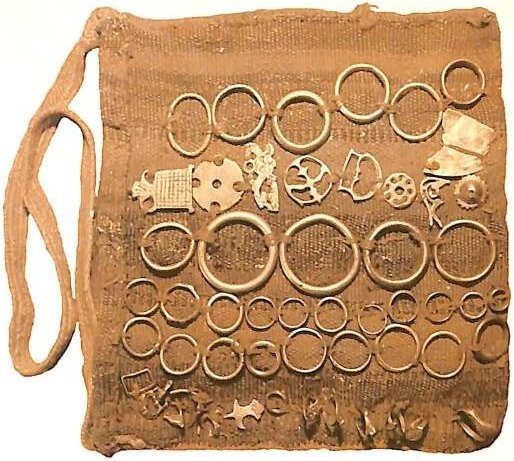
The picture above shows the scroll of the lineage Xetîbpisî in Kela Ba’drê (Pirbari, p. 66).
Fate of the scrolls
Many Mişûr are lost. In troubled times they were entrusted to friends of another religion (kirîv) or to other families; one scroll thus remained in the house of a Muslim after the Ferman of 1832 (Omarkhali 2023, pp. 49–51). Another, according to a note, was taken away by a Russian consul for a library in St. Petersburg (pp. 51–52).
Mişûra Reş Belek
The Mişûra Reş Belek ("black-speckled") does not belong to the 40 Mişûr, but is venerated like one. A P’îr family in Armenia brought it with them when fleeing at the beginning of the 20th century. It is opened only once a year at the festival of Xidir Nebî û Xidir Eylas, on its day (Monday), after the sacrifice of a chicken, the Terqîn and a Qewl. It lies at the holy place in the house (stêr) together with bowls and holy keys (kilît). It shows seven large figures that the head of the household calls "Heft Mêrê Dîwanê" – the seven angels (Omarkhali 2023, pp. 53–54). Omarkhali saw it in 2007: animal skin, four large sheets (Omarkhali 2011/12, pp. 192–193). Some equate Reş Belek with the Mishefa Reş (Omarkhali 2023, pp. 55–56), see Mishefa Reş and Kitêba Cilwe.
Keşkûl – private text collections
A Keşkûl (properly the begging bag or bowl of a dervish, Omarkhali 2011/12, p. 194, n. 115; Pirbari, p. 251) is, in a figurative sense, a handwritten collection of religious texts – prayers, history, some Qewl – that a devout expert compiled for himself. Each is unique (Kreyenbroek, p. 43; Omarkhali 2023, p. 27). The family of Xêrî Liyas Purto possessed such a Keşkûl, from which texts entered the collection of Kreyenbroek and Rashow (Kreyenbroek, p. XVII). Bedelê Feqîr Hecî thanks a Qewal who in 1978–79 copied the texts from the Keşkûl of his father Feqîr Hecî (Bedelê Feqîr Hecî 2002, pp. 3, 7).
The catechism of 1974
The only known example of an Ezidi catechism was written around 1974 by a P’îr of the Omerxalî lineage in Armenia: 151 pages, almost entirely in red ink, 33 texts and 70 answers. Its title translates as "Meaning. Explanation of veiled questions according to the understanding of the clergy". The questions are called pirs, the answers cihab or me’nî. Topics: creation, holy men, angels and intercessors, general knowledge, death and the hereafter. It was inherited from father to son and served as preparation for gatherings (Omarkhali 2023, pp. 42–44).
Divination manuscripts
In Iraq manuscripts of some Adanî families are called Cilvê or Cilwe. They contain a list of prophets from Adam to Şêx Adî, letter grids, interpretations and some Qewl and prayers (Kreyenbroek, p. 42; Omarkhali 2023, pp. 41–42).
Tas – the inscribed bowls
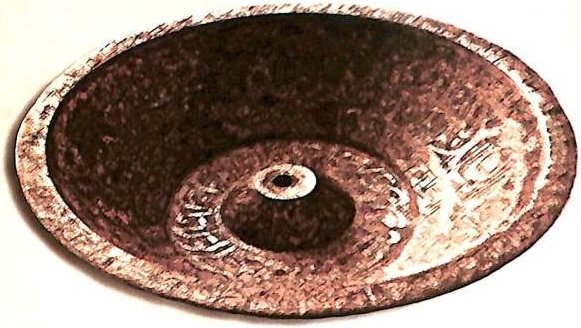
Tas are bowls of bronze or copper with inscriptions. The Ezidis do not regard them as "magical" but as part of religious practice: for healing, against the evil eye, for the blessing of an intercessor. One drinks water from them (Omarkhali 2023, pp. 56–58). Exorcism with the bowls is undertaken above all by the Şêx of the lineage Cin Teyar, who live only in Armenia and Georgia (pp. 56–57).
Manuscripts in archives
A manuscript of 8.7.1935 with the Qewlê Qiyametê (160 stanzas) is held in the Georgian National Centre of Manuscripts in Tbilisi (Omarkhali 2011/12, p. 155).
See also
Sources
- Khanna Omarkhali: The religious textual tradition of the Ezidis – from the oral to the written. Saint Petersburg 2023 (Russian translation of the English original, Wiesbaden 2017), p. pp. 16, 26–27, 42–61, 329–347, 489
- Khanna Omarkhali: Yezidi Religious Oral Poetic Literature: Status, Formal Characteristics, and Genre Analysis. With some examples of Yezidi religious texts. In: Scrinium VII–VIII.2 (2011–2012): Ars Christiana, Leiden: Brill, pp. 144–195, p. pp. 146, 149, 155, 192–194
- Philip G. Kreyenbroek, Khalil Jindy Rashow: God and Sheikh Adi Are Perfect. Sacred Poems and Religious Narratives from the Yezidi Tradition. Wiesbaden: Harrassowitz 2005, p. pp. XIV, XVII, 9, 40–43
- Dimitri Pirbari (P’îr Dîma), A. Ščedrovickij: Тайна жемчужины (The secret of the pearl). Moscow/Tbilisi 2016, p. pp. 66, 94, 105, 251, 253 (PDF)
- S. A. Grigoriev, L. V. Ivasko, D. V. Pirbari (P’îr Dîma): Lalişa Nûranî / Святой Лалыш / Holy Lalish. Yekaterinburg: Basko 2008, p. p. 8
- Bedelê Feqîr Hecî (Bedilê Feqîr Heci): Bawerî û Mîtologiya Êzidiyan. Çendeha Têkist û Vekolîn [Faith and mythology of the Ezidis. Some texts and studies]. Dihok 2002, p. pp. 3, 7
Found a mistake?
Is something wrong – a fact, a spelling, a source, an image? Let us know: we check every report and correct the article.
Other spellings: Mişûra Pîr · Misur · Mischur · Mishur · Misura Pir Xetib Pisi · Misura Res Belek · Mischura Resch Belek · Mishura Resh Belek · Keskul · Keschkul · Keshkul · Kiteb · Kiteba Qewla u Beyta · Katedschhismus · Katejhismus · Cilve · Sheikh Adi · Scheich Adi · Shaikh Adi · Şêxadî