
Qewl, Beyt and prayers are the best-known genres of the Ezidi tradition, but not the only ones. This article explains the others: the short hymn of praise Qesîde, the fixed sequences of the Sema, the dialogues Pişt Perde, the songs Lavij, Xizêmok, Payîzok, Robarîn and Xerîbo, as well as the prose. The texts themselves will go into the separate Prayers section (in preparation).
Qesîde – the hymn of praise
A Qesîde (also Qesîda) is a short hymn of praise to a saint, sometimes only six lines long (Omarkhali 2023, pp. 89–90). They are regarded as works of followers of Şêx Adî; some are attributed to Şêx Adî himself (Omarkhali 2023, pp. 89–90; Omarkhali 2011/12, pp. 182–183). Qesîde are partly in Arabic, partly in Êzdîkî; their rhyme does not follow the Arabic pattern (Omarkhali 2011/12, p. 182; Kreyenbroek, p. 51).
- Number: about 35–36 Qesîde: about 15 of the P’îr (Qesîdên Pîranî), 16 of the Şêx (Qesîdên Şêxanî) and some general ones (Omarkhali 2023, pp. 89–90; Omarkhali 2011/12, p. 182). Bedelê Feqîr Hecî counts 62 Qesîde in 230 stanzas in the "Beyta Şêx û Pîra" (Bedelê Feqîr Hecî 2002, p. 155).
- Rank: below Qewl and Beyt, although Qesîde and Qewl can have almost the same content (Kreyenbroek, p. XV; Omarkhali 2011/12, p. 182).
- Performance: always with melody, usually as part of the Sema; the main place is Başîqe and Behzanê (Omarkhali 2023, pp. 89–90). On the night of Şeva Berat Qewal in Lalîş sing the Qesîde as "Beyta Şêx û Pîra" with Def and Şibab (Bedelê Feqîr Hecî 2002, p. 154; Kreyenbroek, p. 216).
- Examples: Qesîde on the P’îr Alûbekir, Îsibiya, Memê Şivan, Pîr Kemal, Hesin Meman, Mehmed Reşan; on the Şêx Şêx Adî, Şêx Sin, Şerfedîn, Şêşims û Melik Fexredîn, Sicadîn, Nasirdîn, Xatûna Fexra; general ones such as the Qesîda Çopan ("shepherd") and the Qesîda Tawûsî Melek (Omarkhali 2011/12, pp. 183–184).
- The Qesîda Şêx Cencer is regarded as probably not genuine, the Qesîda Şerfedîn as clearly young (Omarkhali 2011/12, pp. 182, 184).
Already in the 19th century Layard and Badger knew an Arabic Qesîde attributed to Şêx Adî; several such hymns of praise were printed by Frank (1911), Joseph (1909) and Frayha (1946) (Kreyenbroek, pp. 40, 43).
The seven Sema
The Sema (Arabic samā, "hearing") is a ceremony at which sacred poems are sung with music, often with a solemn procession of the dignitaries. A Qewal who called it a "dance" was corrected by another: the Sema represents how the angels bow before God (Omarkhali 2011/12, pp. 184–185). The course is described in the article Sema. As a text genre, each Sema is a fixed sequence:
- There are seven Sema. Of each Qewl only the first seven stanzas are sung; between them stand Qesîde (Omarkhali 2011/12, p. 185).
- The seven are called (according to Omarkhali 2011/12, pp. 186–188; 2023, pp. 458–459): Semaya Bilind, Semaya Maka Êzî, Semaya Merkeba (Sema of the dead), Semaya Qanûnî (the most solemn), Semaya Şerfedîn û Şêx Hesen, Semaya Şêşims and Semaya Zerza(yî).
- When a Şêx of the house of the Adanî dies, the Semaya Şerfedîn û Şêx Hesen is performed; when a Şemsanî dies, the Semaya Şêşims. The Semaya Merkeba (Sema Miriya) is heard at the grave in front of the mourning women (Omarkhali 2023, p. 146; Kreyenbroek, p. 48).
- In the Caucasus these Sema do not exist; there Sema is the name of the religious dance to the Qewlê Şerfedîn (Omarkhali 2023, p. 147).
Xelîl Cindî Reşo recorded the list of the seven Sema in 2000 after conversations with Feqîr Xidir Berkat Keso and three Qewal (Cindî Reşo 2004, pp. 51–54).
Pişt Perde – "behind the curtain"
Pişt Perde are dialogues between experts or saints about religion and the world, in questions and answers. In Iraq they are called me’ne ("meanings"). Each has a melody of its own; in Iraq they often follow a Qewl. Today there are about seven, formerly over twenty. Omarkhali is the first to describe the genre; in the Caucasus the name is unknown, but similar texts are widespread (Omarkhali 2023, p. 93; Omarkhali 2011/12, pp. 180–182).
Lavij, Xizêmok, Payîzok, Robarîn
These four are songs with religious imagery whose main theme is love (Omarkhali 2023, p. 93). Kreyenbroek explains their names: xizêm is the nose ring of the beloved, payîz the autumn migration to the winter pastures, robar the river. He considers them folk songs that were reinterpreted religiously (Kreyenbroek, pp. 51, 398, 406, 410). Some experts count Xizêmok, Robarîn and Payîzok among the Pişt Perde (Omarkhali 2023, p. 93). Pirbari, by contrast, describes the Robarîn as a form for praising the religion and the Payîzok as chants in the temple at festive gatherings (Pirbari, p. 254).
Only a few texts are known: 5 versions of Lavij, 7 of Xizêmok, 3 of Payîzok, 3 of Robarîn (Omarkhali 2023, p. 355). According to Feqîr Hecî, Robarîn and Payîzok do not belong in a canon of sacred texts (Omarkhali 2023, p. 259).
Xerîbo
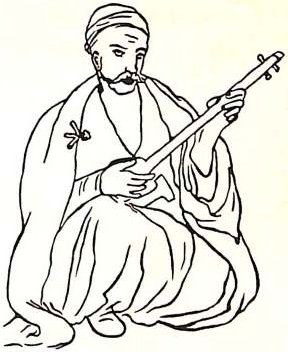
Xerîbo ("O stranger") is part of the Beyt and of the narrative of Mîr Mih. It belongs to none of the known genres and is accompanied, among other things, by the long-necked lute Tanbûr (Omarkhali 2023, pp. 78, 462).
The prose: sermon and narrative
The tradition also includes texts in prose (Omarkhali 2023, p. 94; Omarkhali 2011/12, p. 149):
- Mishabet (Mişabet, "sermon"): a didactic address by a Qewal or expert at great festivals, burials, at the Tawûs gêran, at the local festival or in the house of mourning. He sings stanzas of a Qewl, tells the story that belongs to it and draws a lesson. The topic is chosen by the performer or the audience; it is always free speech within the framework of the learned interpretation (Omarkhali 2023, pp. 146–147; Kreyenbroek, pp. XV, 47). The listeners are silent, no one may leave (Kreyenbroek, p. 47). Topics are, for example, "How an Ezidi should be", "On being a dervish and the pure heart" or "Death and the hereafter" (Omarkhali 2023, pp. 463–464).
- Çîrok and Çîvanok: narratives, often called "myths and legends". They explain the hymns; without them many Qewl are incomprehensible (Omarkhali 2023, pp. 96–97). One learns only the plot and tells it freely (Omarkhali 2023, pp. 163–164; Kreyenbroek, p. 44). The word efsane ("fairy tale") is regarded as pejorative; no expert calls an Ezidi çîrok that (Omarkhali 2023, p. 97, n. 5).
- Dastan (Destan): long narrative, for example the Dastana Mîr Mih about a prince who seeks a land without death (Omarkhali 2023, p. 466; Kreyenbroek, pp. 317–341).
- Me’na ("sense"), Pirs ("question"), Şirove ("interpretation"): explanations given between the stanzas or before and after the performance of a Qewl (Omarkhali 2023, p. 97).
Hymns are poetic, encoded and full of technical terms; trained men perform them. Narratives are simple, in colloquial language, and women tell them too (Omarkhali 2023, pp. 63, 98; Omarkhali 2011/12, p. 158).
See also
Sources
- Khanna Omarkhali: The religious textual tradition of the Ezidis – from the oral to the written. Saint Petersburg 2023 (Russian translation of the English original, Wiesbaden 2017), p. pp. 63, 70, 89–98, 139–140, 146–147, 163–164, 259, 355, 450–466
- Khanna Omarkhali: Yezidi Religious Oral Poetic Literature: Status, Formal Characteristics, and Genre Analysis. With some examples of Yezidi religious texts. In: Scrinium VII–VIII.2 (2011–2012): Ars Christiana, Leiden: Brill, pp. 144–195, p. pp. 149, 180–188
- Philip G. Kreyenbroek, Khalil Jindy Rashow: God and Sheikh Adi Are Perfect. Sacred Poems and Religious Narratives from the Yezidi Tradition. Wiesbaden: Harrassowitz 2005, p. pp. XV, 44–51, 398–410
- Dimitri Pirbari (P’îr Dîma), A. Ščedrovickij: Тайна жемчужины (The secret of the pearl). Moscow/Tbilisi 2016, p. pp. 27, 251, 254 (PDF)
- Bedelê Feqîr Hecî (Bedilê Feqîr Heci): Bawerî û Mîtologiya Êzidiyan. Çendeha Têkist û Vekolîn [Faith and mythology of the Ezidis. Some texts and studies]. Dihok 2002, p. pp. 6, 153–198
- Xelîl Cindî Reşo (Khalil Jindy Rashow): Perin ji edebê dînê êzdiyan [Leaves from the religious literature of the Ezidis], 2 volumes (1124 pp.). Dihok: Spîrêz 2004 (Arabic script), p. pp. 51–54, 72–98
Found a mistake?
Is something wrong – a fact, a spelling, a source, an image? Let us know: we check every report and correct the article.
Other spellings: Qesida · Qesiden Pirani · Qesiden Sexani · Qesiden Schechani · Qesiden Shekhani · Pist Perde · Pischt Perde · Pisht Perde · Mene · Xizemok · Chizemok · Khizemok · Payizok · Robarin · Xeribo · Cheribo · Qawl · Qaul · Kewl · Sheikh Adi